
Ask
your own question, for FREE!
Mathematics
14 Online
 hallm:
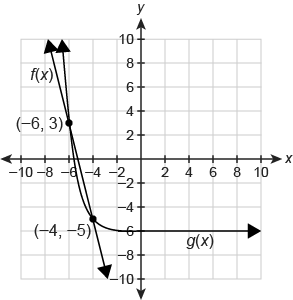
The graph shows the function f(x)=4x+21 and g(x)=−(13)x+4+6 . What are the solutions of the equation 4x+21=−(1/3)^x+4 +6 ? x=−6 and x=−4 x = 3 and x=−5 x=−6 and x=−5.75 x=−6 and x = 3
Still Need Help?
Join the QuestionCove community and study together with friends!
hallm:
1/3 on the first line too
 dude:
dude:
Just want to make sure, the equations are \(f(x)=4x+21\) and \(g(x)=−(\frac13)x+4+6\)
hallm:
yes
 dude:
dude:
g(x) has 2 numbers, is one of them supposed to have a variable? \(g(x)=−(13)x+4+6\)
Still Need Help?
Join the QuestionCove community and study together with friends!
hallm:
there is the grapg too and its (1/3) then the x + 4 is an an exponant
dude:
Ah \(g(x)=−\frac13^{x+4}+6\)?
hallm:
yes
dude:
Okay like I said in the previous post, the solution is where they intersect (Could you list off the points where they intersect?)
Can't find your answer?
Make a FREE account and ask your own questions, OR help others and earn volunteer hours!
Join our real-time social learning platform and learn together with your friends!
Join our real-time social learning platform and learn together with your friends!
Latest Questions
 KBaby:
Verse 1 We left our names in the dust of the driveway Watched the old town shrink
KBaby:
Lyrics Generator Use AI to write the lyrics for a song. Suggested Genres: Pop Hip
aitexturegenerator:
How are you all handling AI-generated textures for 3D models and game assets without losing the hand-made feel? I've been doing a small stylized environment
KBaby:
Verse 1 We left our names in the dust of the driveway Watched the old town shrink
KBaby:
Lyrics Generator Use AI to write the lyrics for a song. Suggested Genres: Pop Hip
aitexturegenerator:
How are you all handling AI-generated textures for 3D models and game assets without losing the hand-made feel? I've been doing a small stylized environment
 Demon25:
Woke up feeling like that girl and that dude well he still aint crap pluse the du
Demon25:
Woke up feeling like that girl and that dude well he still aint crap pluse the du
 playtsec:
how do I get rid of stress from teachers... I just feel like running out the classroom and leaving on my own.
playtsec:
how do I get rid of stress from teachers... I just feel like running out the classroom and leaving on my own.
 JohnnyLFowler0812:
What type of gamer would play something and then get off for a while. Why not sta
JohnnyLFowler0812:
Which is better? Metallica Rap Country R&B hiphop Medal Gospel Chill Which 3 opti
JohnnyLFowler0812:
What type of gamer would play something and then get off for a while. Why not sta
JohnnyLFowler0812:
Which is better? Metallica Rap Country R&B hiphop Medal Gospel Chill Which 3 opti
KBaby:
Verse 1 We left our names in the dust of the driveway Watched the old town shrink
1 hour ago
1 Reply
0 Medals
KBaby:
Lyrics Generator Use AI to write the lyrics for a song. Suggested Genres: Pop Hip
1 day ago
0 Replies
0 Medals
 aitexturegenerator:
How are you all handling AI-generated textures for 3D models and game assets without losing the hand-made feel? I've been doing a small stylized environment
aitexturegenerator:
How are you all handling AI-generated textures for 3D models and game assets without losing the hand-made feel? I've been doing a small stylized environment
2 days ago
4 Replies
2 Medals
 Demon25:
Woke up feeling like that girl and that dude well he still aint crap pluse the du
Demon25:
Woke up feeling like that girl and that dude well he still aint crap pluse the du
4 days ago
4 Replies
0 Medals
playtsec:
how do I get rid of stress from teachers... I just feel like running out the classroom and leaving on my own.
5 days ago
21 Replies
2 Medals
JohnnyLFowler0812:
What type of gamer would play something and then get off for a while. Why not sta
6 days ago
9 Replies
1 Medal
JohnnyLFowler0812:
Which is better? Metallica Rap Country R&B hiphop Medal Gospel Chill Which 3 opti
6 days ago
0 Replies
0 Medals