
 eviant:
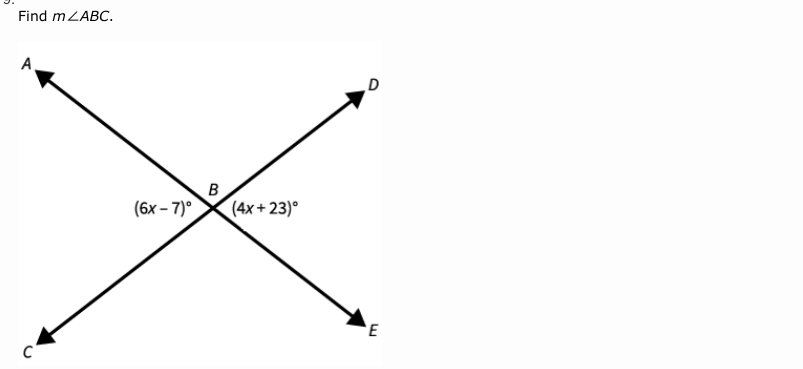
Find m∠ABC.
 eviant:
@Vocaloid
 Vocaloid:
these are vertical angles so as usual, solve for x, plug it back into m<ABC
eviant:
would it be 90 degrees or 180 degrees? @Vocaloid
Vocaloid:
|dw:1548833292704:dw|
Vocaloid:
|dw:1548833306145:dw|
Vocaloid:
|dw:1548833320385:dw|
Vocaloid:
please review the definitions of vertical angles, right angles, and straight angles
eviant:
@Vocaloid so 180?
Vocaloid:
look at your picture to see which diagram best represents your situation
Vocaloid:
notice, how, in your original problem, you have an X-shape with two angles across from each other now take a look at the three diagrams I posted. which one looks most like that?
eviant:
the first one?
Vocaloid:
good. use the diagram as a guide to solve the problem.
Vocaloid:
notice what the diagram tells you. the two angles across from each other on the x-shape are equal. try to apply this logic to your problem.
eviant:
180/2=90?
Vocaloid:
|dw:1548834235654:dw|
Vocaloid:
|dw:1548834242246:dw|
Vocaloid:
notice how A = B apply this logic to the shape on the left
eviant:
6x-7=4x+23?
Vocaloid:
perfect now solve for x, and find m<BAC
Vocaloid:
*m<ABC
eviant:
15?
Vocaloid:
almost that's the value of x take a look at the diagram to find out what m<ABC should be
eviant:
@Vocaloid I don't understand
Vocaloid:
look at your problem what is the value of m<ABC?
Vocaloid:
what is the angle formed by the points A, B, and C?
eviant:
obtuse?
Vocaloid:
|dw:1548834838506:dw|
Vocaloid:
|dw:1548834859468:dw|
Vocaloid:
notice how I found the points A, B, and C, and see how the angle I circled is m<ABC? so now, using your x-value, find m<ABC
eviant:
what is m?
Vocaloid:
m means you are looking for the measure of an angle
Vocaloid:
m<ABC = "what is the degree measure of ABC?"
Vocaloid:
if you are still confused, please refer to the problems we did before, you were doing it fine before
eviant:
@Vocaloid in the earlier problems, I was doing it like" (6x-7)+(4x+23)=90(or 180)
Vocaloid:
it's exactly like this one
eviant:
@Vocaloid 83?
Vocaloid:
good
Join our real-time social learning platform and learn together with your friends!
 KBaby:
Verse 1 We left our names in the dust of the driveway Watched the old town shrink
KBaby:
Lyrics Generator Use AI to write the lyrics for a song. Suggested Genres: Pop Hip
KBaby:
Verse 1 We left our names in the dust of the driveway Watched the old town shrink
KBaby:
Lyrics Generator Use AI to write the lyrics for a song. Suggested Genres: Pop Hip

 aitexturegenerator:
How are you all handling AI-generated textures for 3D models and game assets without losing the hand-made feel? I've been doing a small stylized environment
aitexturegenerator:
How are you all handling AI-generated textures for 3D models and game assets without losing the hand-made feel? I've been doing a small stylized environment

 Demon25:
Woke up feeling like that girl and that dude well he still aint crap pluse the du
Demon25:
Woke up feeling like that girl and that dude well he still aint crap pluse the du
 playtsec:
how do I get rid of stress from teachers... I just feel like running out the classroom and leaving on my own.
playtsec:
how do I get rid of stress from teachers... I just feel like running out the classroom and leaving on my own.
 JohnnyLFowler0812:
What type of gamer would play something and then get off for a while. Why not sta
JohnnyLFowler0812:
Which is better? Metallica Rap Country R&B hiphop Medal Gospel Chill Which 3 opti
JohnnyLFowler0812:
What type of gamer would play something and then get off for a while. Why not sta
JohnnyLFowler0812:
Which is better? Metallica Rap Country R&B hiphop Medal Gospel Chill Which 3 opti