
 ReaganLily:
ok so back to my sucky project with alittle more info this time around. Part One Read the following case summary. Case #28104 Last month, Hudson National Bank was robbed by an unidentified man. The robber wore gloves, a hat, and a bandana that covered his face. A security guard attempting to stop the robber was knocked unconscious in a struggle. However, the guard managed to pull the hat from the robber's head. Witness accounts and security tapes led police to arrest three possible suspects. None of the suspects have alibis, but police are not certain which man is the robber. Using hair samples from the hat recovered by the security guard, the crime lab did a Southern Blot test. Hair samples were also taken from each suspect. Use the suspects' hair samples to determine the guilty party. Part Two Copy the DNA sequences for each suspect into a Word document. Use your special enzyme to cut each sequence at the forward slash marks (/). (You can do this by putting spaces after each slash mark.) Arrange the DNA cuttings in order from shortest to longest. Attach them to a special piece of nitrocellulose paper (construction paper). Compare the probe base pair sequence with a DNA sample taken from Suspect A. Use a highlighter or different color font to mark any sequences that match the probe. Repeat step 1 with the DNA samples for Suspects B and C. Suspect A TCCATCCA / TCCATCCATCCA / TCCA / GGCTTACCTATAAGG / TGGATGGATGGATGGATGGA Suspect B TCCATCCA / TCCATCCAATTG / TCCA / TCCATCCATCCATCCATCCA / TGGATGGATGGATGGA Suspect C TTAGCTA / CCGGTATGA / AGGT / CGTTATCGGATATA / GGTTAGGACCTATCGATAGA Probe AGGT Questions Answer these following questions in the essay box below. Which suspect most likely committed the robbery? How do you know? You should be looking for TCCA instead of AGGT in the suspects. A' ant T's match up and G, and C match up.
 nuts:
nuts:
that probe is abit short?
ReaganLily:
it's supposed to be like that... or thats how if comes up in the lesson
ReaganLily:
oh and these are the instructions that are just driving me insane Copy the DNA sequences for each suspect into a Word document. Use your special enzyme to cut each sequence at the forward slash marks (/). (You can do this by putting spaces after each slash mark.) Arrange the DNA cuttings in order from shortest to longest. Attach them to a special piece of nitrocellulose paper (construction paper). Compare the probe base pair sequence with a DNA sample taken from Suspect A. Use a highlighter or different color font to mark any sequences that match the probe. Repeat step 1 with the DNA samples for Suspects B and C.
nuts:
so what are you having trouble with? btw this project seems pretty stupid, but I did the same thing with actual bacteria and plasmids and a petri dish with glowing bacteria... a bit cooler, but the same concept roughly applies
ReaganLily:
It just seems no matter what I do my teacher sends it back. So basically I needed help figuring out the correct suspect and having a decent reasoning
nuts:
is this all the information you've been given?
ReaganLily:
one sec, here I'll edit the original post
ReaganLily:
there that's everything I got on this
nuts:
so do you have existing work?
nuts:
basically I'm not really sure how to help here cause you're supposed to be writing stuff on construction paper and cutting it out
ReaganLily:
he doesn't need me to show my work basically he just wants the answers.
nuts:
so AGGT matches TCCA, so you're basically going into each other suspects and counting the occurrence of "TCCA" letter strings. the one with the most is the suspect i guess?
ReaganLily:
ugh this is so confusing to me this sucks so much
nuts:
I'll do suspect A for you and you do the rest.
ReaganLily:
I've literally done this twice and gotten it sent back and it's just stressing me out so much, and giving me way too much anxiety, especially for a project as dumb as this one.
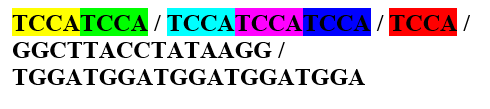 nuts:
nuts:
So that's six occurrences for subject A
ReaganLily:
I counted 9 on suspect B. and we know its not C.
nuts:
ok do you have what you need?
ReaganLily:
I don't know honestly what's the reasoning of it being suspect B.
ReaganLily:
that's what I need to know if it's Suspect B. then what's our reasoning how do we know
nuts:
what do you think it is c:
ReaganLily:
I don't know I suck at science this makes NO SENSE TO ME but ugh idk I feel so dumb right now
nuts:
take it easy, you're honestly not that bad at science, this is just a really bad project and doesn't really reflect what science really is. But to solve it you have to jump through the hoops that they want you to.
nuts:
The suspect with the most occurrences of the complementary probe DNA sequence should be mostly likely guilty because of a higher match in DNA sequence. Provide a comparative statement (suspect A has x, suspect B has y, suspect C has z occurrences) and use it to justify which suspect is most likely guilty.
ReaganLily:
I feel so weird not understanding this at all. uhh
nuts:
What's confusing you?
ReaganLily:
I mean all of it, I just don't understand how to do this I guess I don't know. I hate that I don't know I wish I did but I guess it's just science and all of this is just confusing to me I don't know what any of this means and I have no idea. I'm not making sense either.
nuts:
Ok first of all, you gotta drop this negative attitude of I hate this and I don't know and I'm bad at science etc. Not only are those statements patently untrue, but they detract from you ability to focus and maintain composure when trying to solve things. As best as you can, please set those feelings aside while trying to get things done. Second of all, this is a very artificial contrived question, and what you need to do isn't science, but rather to recognize what this question is testing for and how to demonstrate that you know how to jump through the hoops the question is asking you to. In this case, the question is trying to test if you know how to match base pairs of DNA, (A with T and G with C), and the second part of the question where you identify a suspect is just a little bit of fluff. In this case, you're simply looking for the suspect that has the DNA with the most occurrences that match the opposite of the probe sequence, because this means (by definition) that it has the highest DNA match.
nuts:
This is an oversimplification of how DNA testing is actually done in practice, which is why it might be confusing. It doesn't make sense, and its' not supposed to. As you mentioned, it's just a silly contrived example to give you work to do.
Join our real-time social learning platform and learn together with your friends!
 Demon25:
For a hoco proposal with a cheerleader and football player, what else should be a
Demon25:
For a hoco proposal with a cheerleader and football player, what else should be a

 Breathless:
TOC: "MGF any confirmation on the commander? we require confirmation as soon as[radio static].
Breathless:
TOC: "MGF any confirmation on the commander? we require confirmation as soon as[radio static].
 EdwinJsHispanic:
I wrote something that I don't know if I want it as a poem or song, Please let me know on yours thoughts about it, I'm still doing this! "Broken promises an
EdwinJsHispanic:
I wrote something that I don't know if I want it as a poem or song, Please let me know on yours thoughts about it, I'm still doing this! "Broken promises an
 thehearken:
hi um I don't know if this is the right section for this, but can someone go over my poem and tell me if its good enough to give my English professor for a
thehearken:
hi um I don't know if this is the right section for this, but can someone go over my poem and tell me if its good enough to give my English professor for a
 heartlessprophet:
Aye what's 19z%u00f74p=9u03c0 my teacher thinking of impossible questions for us
heartlessprophet:
Aye what's 19z%u00f74p=9u03c0 my teacher thinking of impossible questions for us
 kippppp:
does anyone have any good tips for writing stories? i'm trying to write a dnd campaign but i'm not that great of a writer yet.
kippppp:
does anyone have any good tips for writing stories? i'm trying to write a dnd campaign but i'm not that great of a writer yet.
 GRIZZLEY19:
Y'all let me know what y'all think about this beat I made I took me like a hour maybe rate it 0/10 https://drive.
GRIZZLEY19:
Y'all let me know what y'all think about this beat I made I took me like a hour maybe rate it 0/10 https://drive.
 Ultrilliam:
Welcome to the 10th Anniversary Update! (Part 2) Sorry this one passed the date a
Ultrilliam:
Welcome to the 10th Anniversary Update! (Part 2) Sorry this one passed the date a
 Twaylor:
was walking downtown and my adhd brain wanted to make some (rock?) lyrics: There'
Twaylor:
was walking downtown and my adhd brain wanted to make some (rock?) lyrics: There'