
 Nicole:
http://prntscr.com/occ6jp
Nicole:
@Ferredoxin4
 Ferredoxin4:
Do you know what is variance in statistics?
Nicole:
squared deviation of a random variable from its mean.
Ferredoxin4:
Variance is σ² or s²
Ferredoxin4:
Yep
Ferredoxin4:
So first you need to calculate standard deviation. Do you know how to do that?
Nicole:
no
Ferredoxin4:
\[\sqrt{\frac{ Σ|x-μ| }{ n }}\] That is the formula.
Ferredoxin4:
Sorry, |x−μ| is squared
Ferredoxin4:
So you first find the mean. Then find the distance of the points of the mean. Add those distances up. Then divide that summation over the number of terms. Finally, take that quotient and square root it.
Ferredoxin4:
By the way that formula is for discrete normal distributions. Binomial, Geometric, Poisson, and other distributions have different formulas.
Ferredoxin4:
Did you calculate it? The standard deviation is 2.7857, did you get that?
Nicole:
can you go step by step on how you got that please?
Nicole:
@Vocaloid ?
Ferredoxin4:
See in my course I was permitted to use a handheld graphing calculator which includes a feature of calculating the standard deviation. But I can briefly show you the process as it is time-consuming, and it is on your honor to complete that task. Not mine:
Ferredoxin4:
First you have to find the mean. Do you know how to do that?
Nicole:
13.2
Ferredoxin4:
Correct. Now you have to find |x−μ| μ=13.2 x=all the terms. So you will get in total 10 of those answers as there are 10 terms. You have to subtract each term from the mean and find the absolute value.
Ferredoxin4:
Then you will square each of those terms and add the numbers after squaring.
Ferredoxin4:
That will be your numerator.
Nicole:
can you help me with that pls? at least list them for me and I solve it?
Ferredoxin4:
The terms are already listed in the question..and you already have the mean.. x={10, 16, 12, 15, 9, 16, 10, 17, 12, 15} μ=13.2 You have to find |x-μ| for all of them So that would be like 10-13.2 16-13.2 12-13.2 And so on..
Ferredoxin4:
First do that. You'll be finding x-μ
Nicole:
10-13.2=-3.2 16-13.2=2.8 12-13.2=-1.2 15-3.2=1.8 9-13.2=-4.2 16-13.12=2.8 10-13.2=-3.2 17-13.2=3.8 12-13.2=-1.2 15-13.2=1.8
Ferredoxin4:
Great. Now take the absolute value of those differences
Nicole:
how
Ferredoxin4:
Do you know what is absolute value?
Nicole:
non-negative value of x without regard to its sign.
Ferredoxin4:
Yes, so find the absolute value of those numbers.
Nicole:
can you do the first one as an example
Ferredoxin4:
You're just getting definitions without knowing their significance. All you have to do to find the absolute value of a number is to remove the negative sign and ensure the value is positive. For example |-3.2| = 3.2
 sillybilly123:
if you are going to square them, you don't need to take the absolute value 😣
Nicole:
already got it, what do I do after making them positive? and no we kinda need to speed it up lol because this is timed
Ferredoxin4:
How about @sillybilly123 continues from here. Thank you.
Nicole:
thats fine if you are busy @sillybilly123 can you help please?
Ferredoxin4:
Just square them. Then add all the numbers after being squared. Then divide it by 10, the #of terms. There's your variance.
Ferredoxin4:
No need to find the square root of it again because variance = s^2
sillybilly123:
👏
sillybilly123:
square those numbers and divide them by 10
Ferredoxin4:
^
Nicole:
7.76
Nicole:
sorry I was just doing the math lol
Ferredoxin4:
Yes correct that's the answer.
Ferredoxin4:
Same process, just square root the final number after you calculate variance.
Nicole:
oh wow lmao okay this is gonna take long, is there any shorter or faster way in doing this?
Ferredoxin4:
ie in the last example, you got variance of 7.76 so standard dev is square root of that
sillybilly123:
👍
Ferredoxin4:
That's why I told you it's very time consuming unless you use a calculator
Ferredoxin4:
Other distributions like binomial and geometric take 2 seconds to find their standard deviation.
Nicole:
so the mean is 12.8?
Ferredoxin4:
Close
Nicole:
13
Ferredoxin4:
yes
Nicole:
26.2
Nicole:
then what?
Ferredoxin4:
Is that your variance?
Nicole:
yes
Ferredoxin4:
Well your variance is off
Ferredoxin4:
Otherwise, in order to find Standard dev from variance just square root your variance.
Nicole:
Im not sure everything seems right here
Ferredoxin4:
Maybe you did a computational mistake. Otherwise the variance is 31.111
Ferredoxin4:
You have to use a normal Airulative distribution here. You are asked to find: \[P(x<70)=P(z_{score}=\frac{ 70-60 }{ 10 })\]
Ferredoxin4:
cu mulative* distribution
Ferredoxin4:
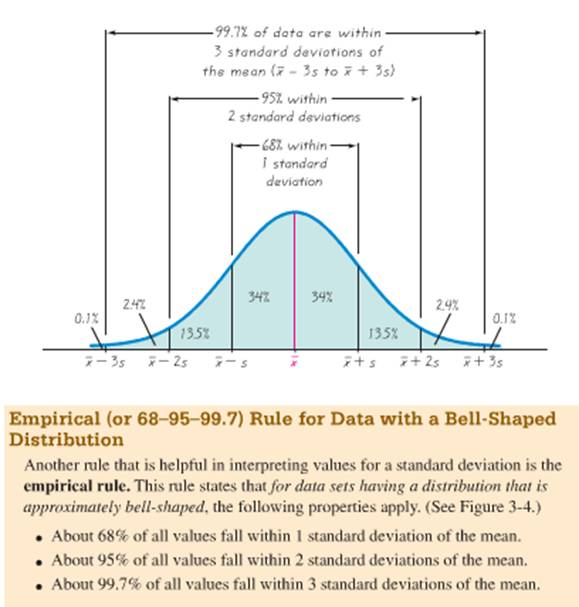
So that means P(Zscore=1) Zscore of 1 means 1 standard deviation above the mean. We can use empirical rule. Do you know the empirical rule?
Nicole:
Im confused lol
Ferredoxin4:
well then what are you confused with?
Ferredoxin4:
Are you familiar with the notation and the terms that I just used
Ferredoxin4:
Do you know how to calculate probability from a normal distribution?
Nicole:
nope
Ferredoxin4:
First you need to find the z-score. The formula is (random variable - mean)/standard deviation Your random variable is 70 mean is 60 SDev is 10 So find the z-score there. Then you can refer to a standard normal probabilities chart if you'd like, but you'll notice that you z-score is 1 here. Z-score means # of standard deviations away from the mean. Here you are 1 standard deviation above from the mean in a normal distribution. Since it's a 'pretty' number you can use the empirical rule.
Nicole:
(70-60)/10
Ferredoxin4:
Yes, that's your z score.
Nicole:
then how do we get the probability
Ferredoxin4:
So you got your z-score which can be simplified to 1. Then you would normally go to a probability table http://www.z-table.com/ and find the standard normal probability. But there's no need to do that here. Since it follows the empirical rule you can find the proability.
Ferredoxin4:
probability*
Nicole:
What is the empirical rule, thats the thing I dont know what it is so how am I supposed to find the probability
Ferredoxin4:
I assume that you would have read the supposed lesson prior to attempting the test, correct? Otherwise here is empirical rule:
 Nicole:
okay and how can I use that to find the probability
Ferredoxin4:
So 70 is 1 standard deviation above the mean. So it falls on the 34% plus whatever is below the mean, or 50% of the normal distribution. So that's 50%+34%.
Ferredoxin4:
Also, I'll let another user continue from here @Hero . It is expected that you are asking questions because you have difficulty, not because you are blindly attempting a question.
Join our real-time social learning platform and learn together with your friends!
 KBaby:
Verse 1 We left our names in the dust of the driveway Watched the old town shrink
KBaby:
Lyrics Generator Use AI to write the lyrics for a song. Suggested Genres: Pop Hip
KBaby:
Verse 1 We left our names in the dust of the driveway Watched the old town shrink
KBaby:
Lyrics Generator Use AI to write the lyrics for a song. Suggested Genres: Pop Hip

 aitexturegenerator:
How are you all handling AI-generated textures for 3D models and game assets without losing the hand-made feel? I've been doing a small stylized environment
aitexturegenerator:
How are you all handling AI-generated textures for 3D models and game assets without losing the hand-made feel? I've been doing a small stylized environment

 Demon25:
Woke up feeling like that girl and that dude well he still aint crap pluse the du
Demon25:
Woke up feeling like that girl and that dude well he still aint crap pluse the du
 playtsec:
how do I get rid of stress from teachers... I just feel like running out the classroom and leaving on my own.
playtsec:
how do I get rid of stress from teachers... I just feel like running out the classroom and leaving on my own.
 JohnnyLFowler0812:
What type of gamer would play something and then get off for a while. Why not sta
JohnnyLFowler0812:
Which is better? Metallica Rap Country R&B hiphop Medal Gospel Chill Which 3 opti
JohnnyLFowler0812:
What type of gamer would play something and then get off for a while. Why not sta
JohnnyLFowler0812:
Which is better? Metallica Rap Country R&B hiphop Medal Gospel Chill Which 3 opti