
 Ballery1:
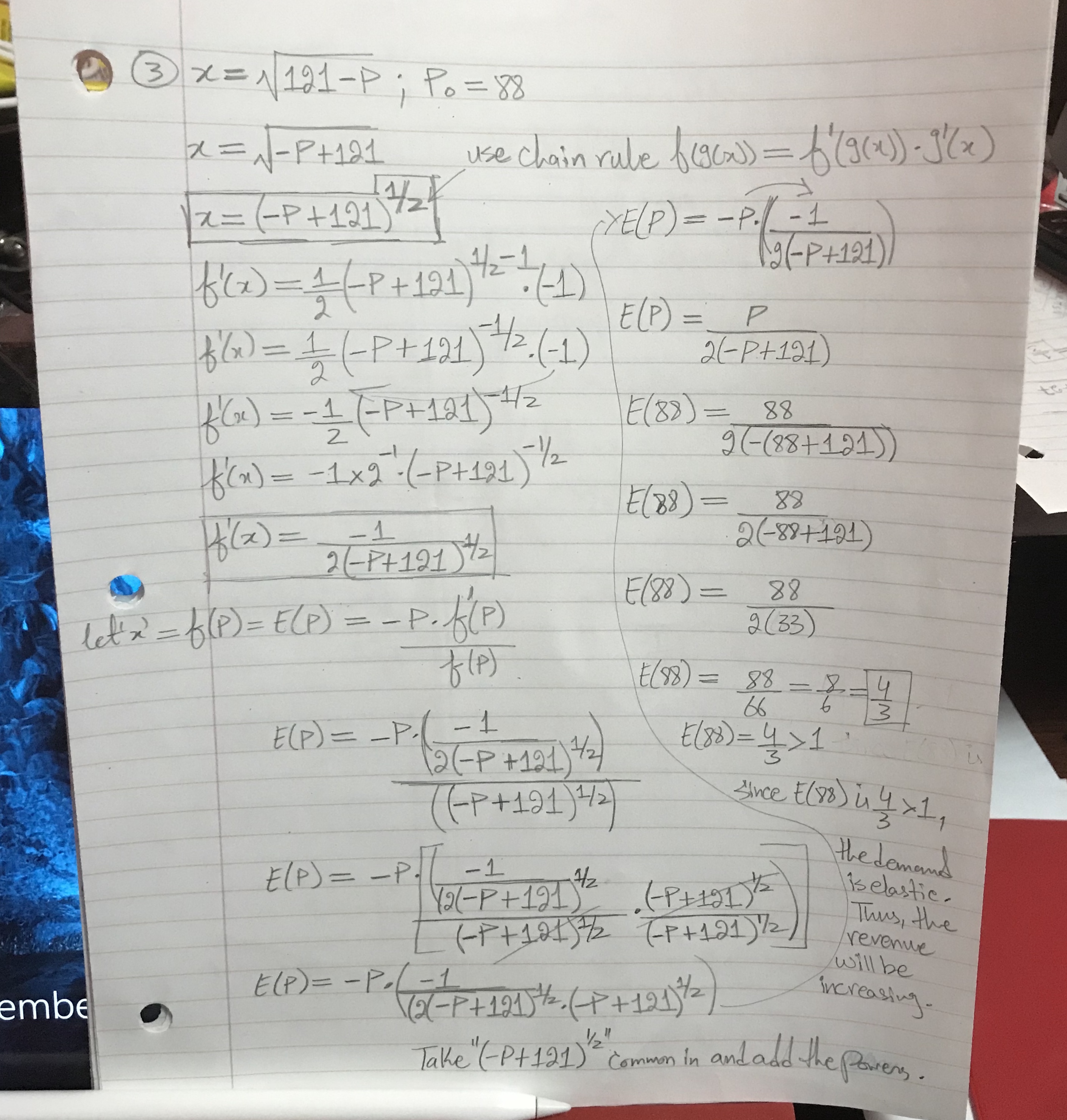
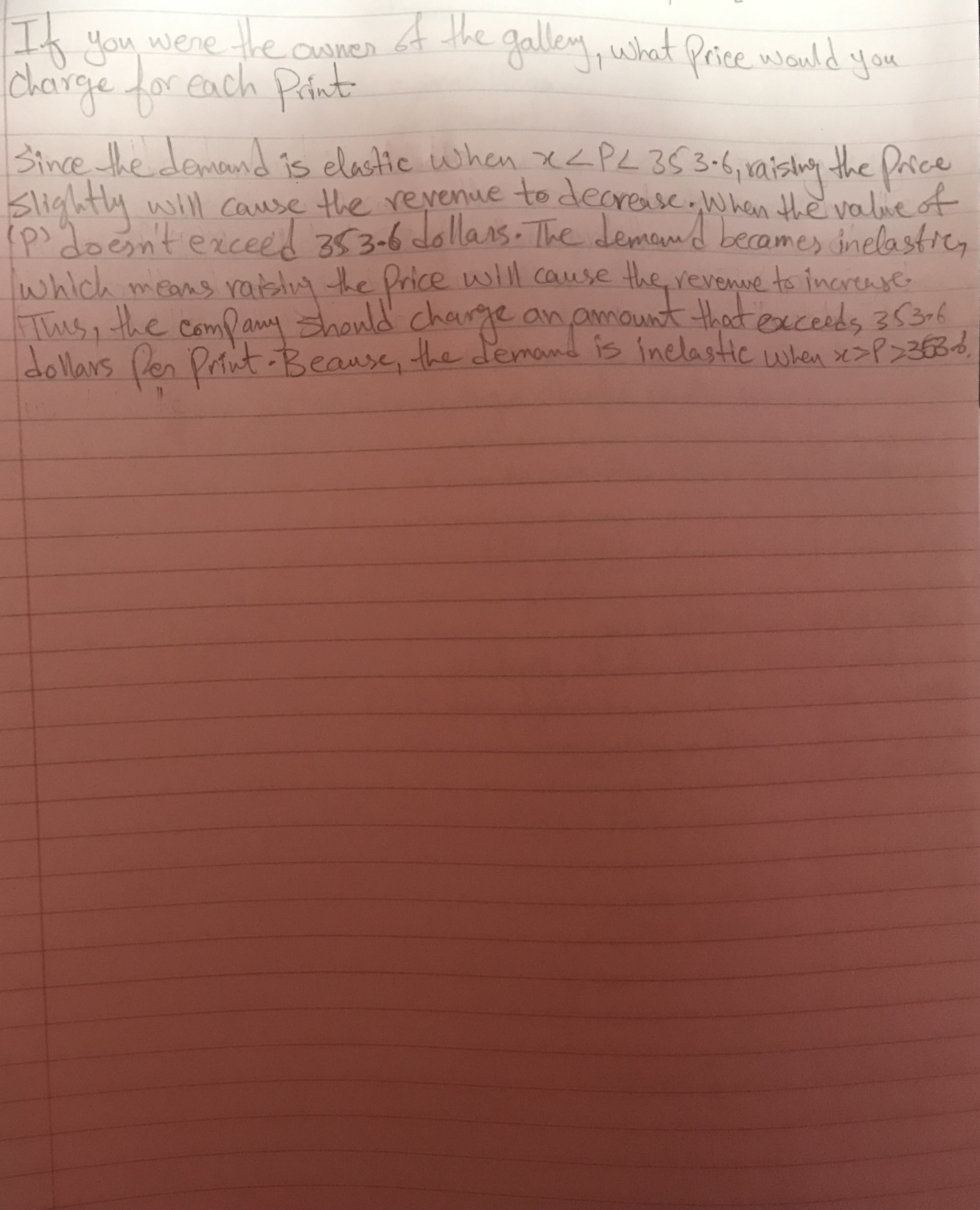
can someone please check my work ? Q) Compute the elasticity of demand and determine whether the demand is elastic, inelastic or unitary, at the given unit price P_0. If the unit price is increased slightly from P_0, will the revenue in crease or decrease?
 Hero:
Hero:
Where is the original problem?
Hero:
You posted the question, but clearly there is more to it than what you have posted.
Ballery1:
i typed out the question up there
Hero:
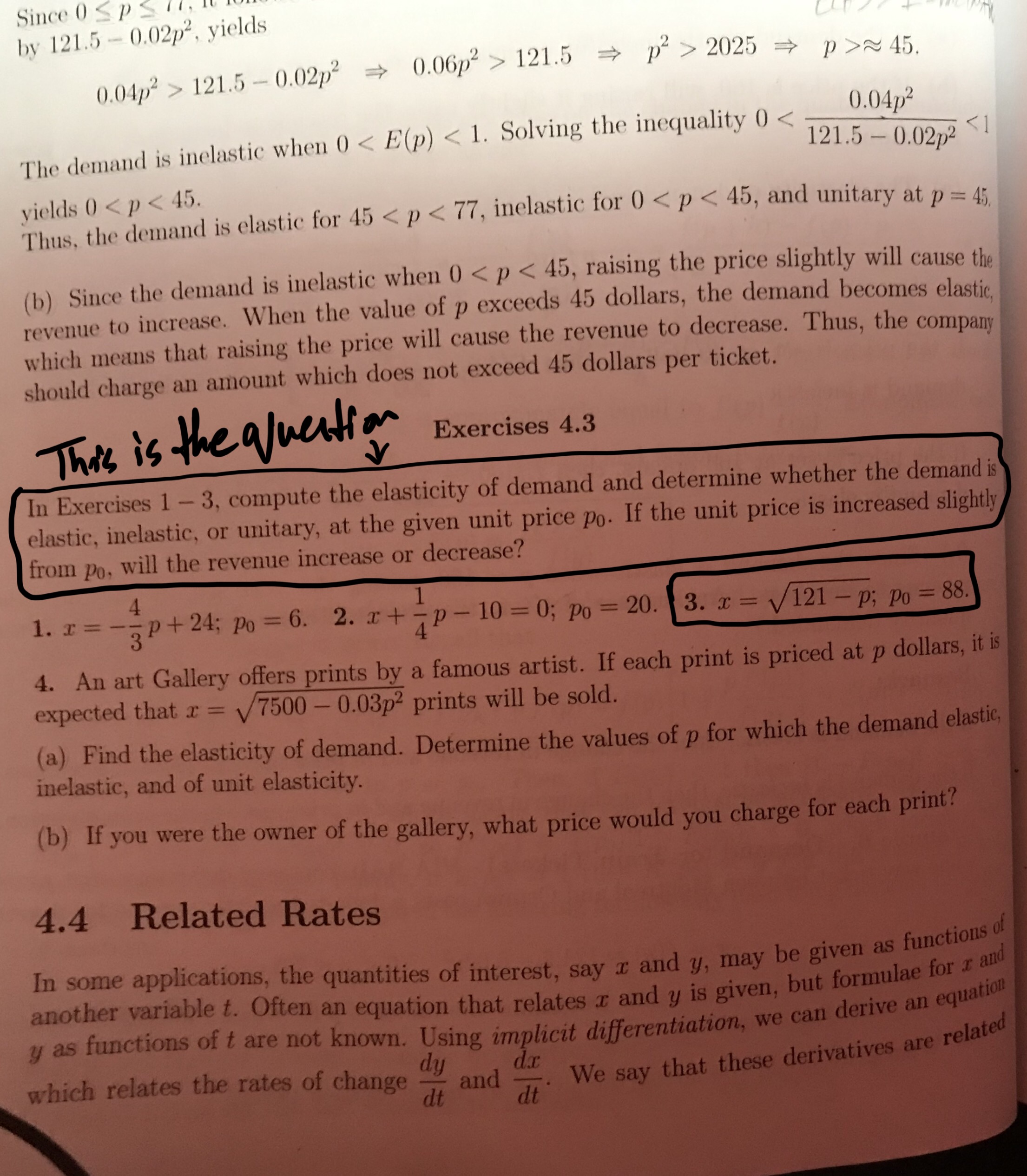
That alone is not the question because you got your equation from somewhere. Post the entire question that includes the given equation.
Ballery1:
one second, let me take a snap of the question for you :)
Hero:
I can tell when something isn't posted completely
Hero:
Students try to fool me with that. I'm never fooled
Ballery1:
lol
Hero:
Why students prefer t to post the question without including the given equation(s) is beyond me. You can't expect to get full help while posting partial information.
Ballery1:
one second lord hero.
 Hero:
Hero:
If I had to do this one, I would approach it differently.
Ballery1:
it took me years to learn this method. plz don’t confuse me hero sama
Ballery1:
i have one more queston... it’s slightly different tho
Ballery1:
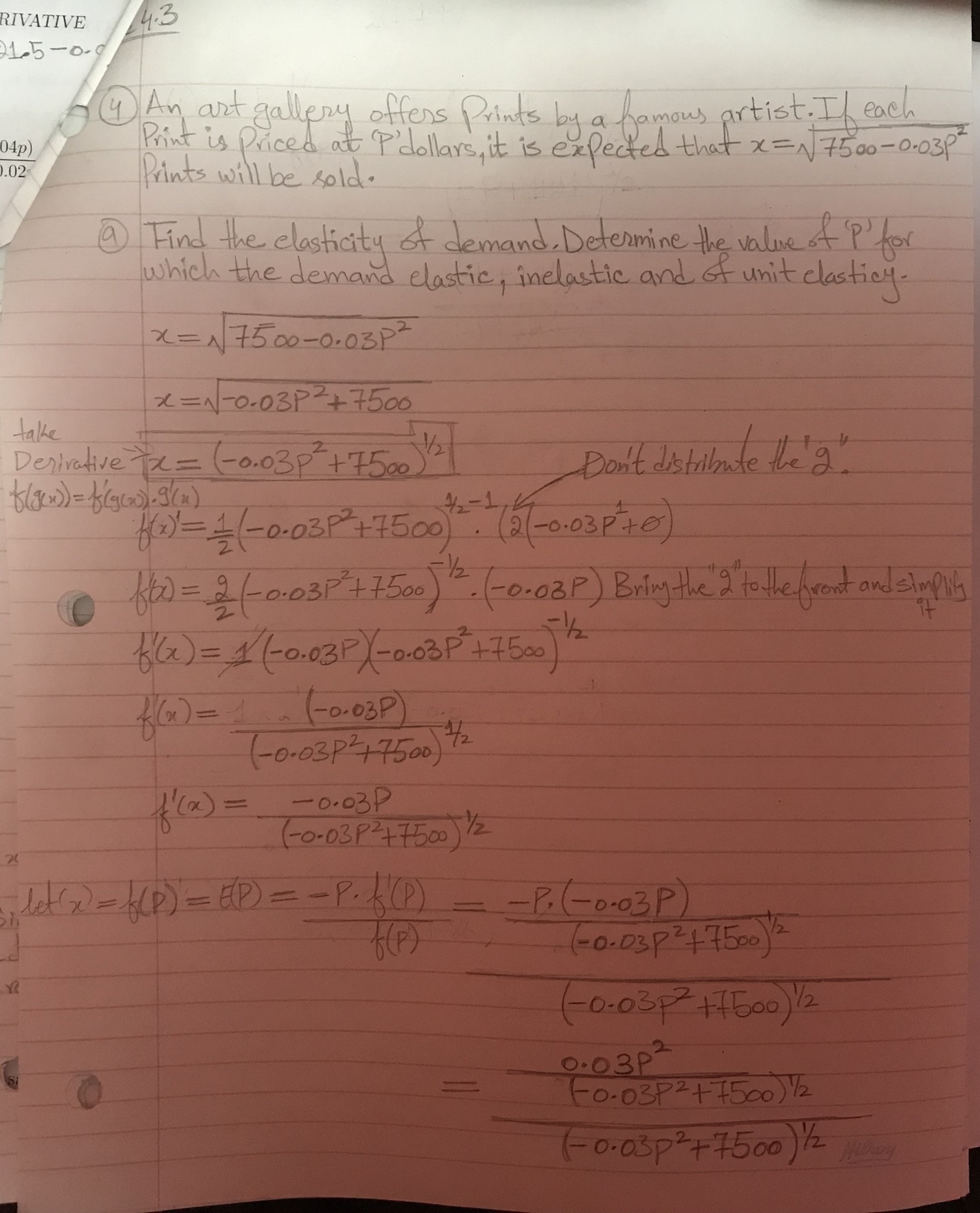
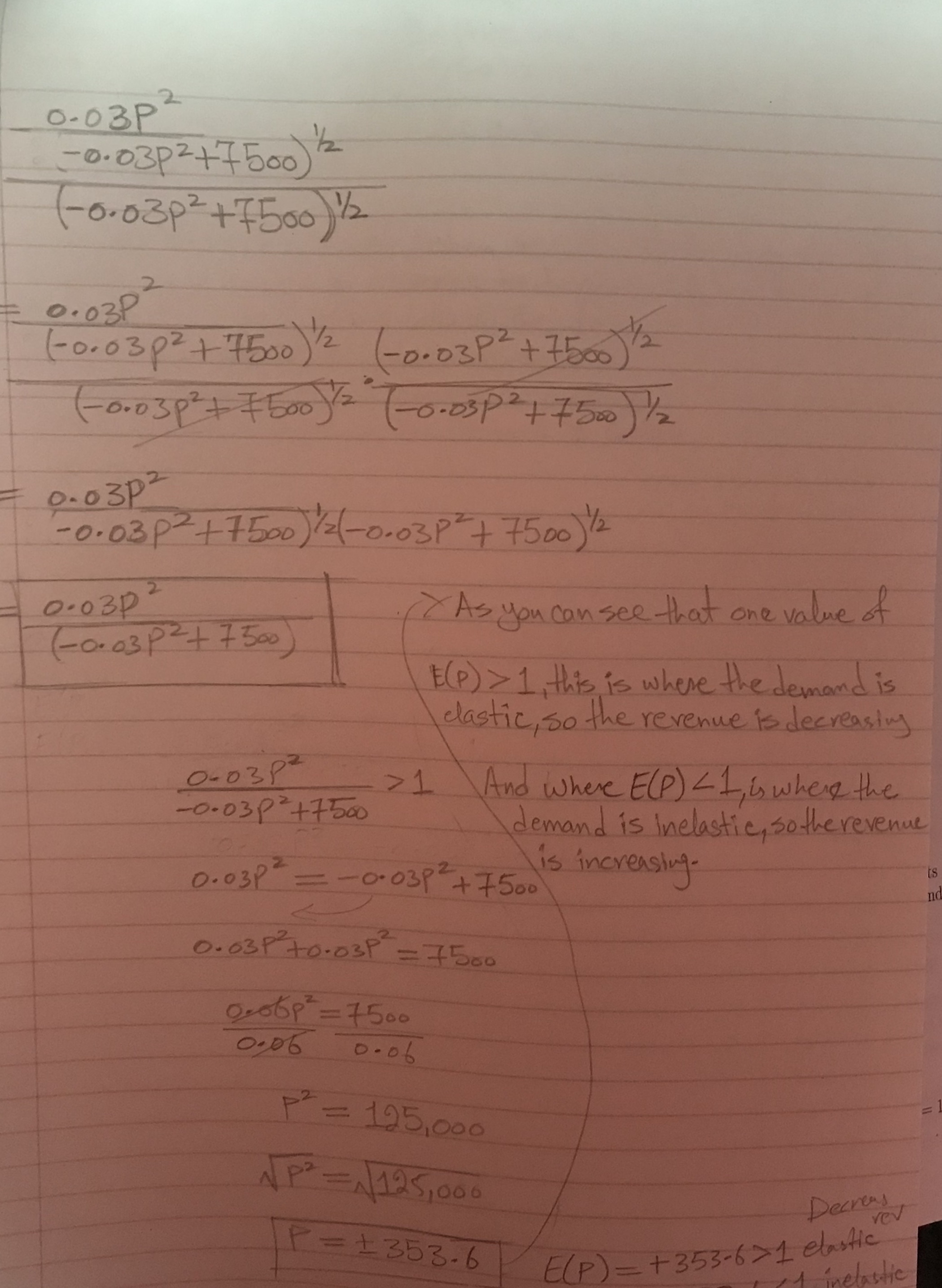
it’s the 4th question. it should be in the picture that i sent posted. here’s the solution to that problem
Ballery1:
oh oops i thought i already took the pictures of the 4th question plz gimme 2 seconds :)
Hero:
I'm not interested in the solution. I don't know why you post them
Hero:
You're interested in the solution.
Ballery1:
so you could corre t any mistakes :)
Ballery1:
i did all these questions from scratch
Hero:
Yeah, but that previous question was an exception. I did the work correctly. I just didn't realize the function was restricted.
Hero:
But I don't need the solution
Hero:
We're only trying to determine if the demand is elastic, inelastic or unitary.
Ballery1:
yes :)
Hero:
There's a formula for that
Hero:
Which is why I said I would approach this differently if I had to answer the question.
Ballery1:
i wrote out the formula in my solution tho
Hero:
Here's the thing tho. It says "If the unit price is increased slightly from \(p_0\)" where is that part in your solution?
Ballery1:
all i know is that if E(p)>1 that means the demand is elastic, meaning the revenue will decrease. if the E(p) <1 that means the demand is inelastic and the revenue will increase. However, if E(p) = 1 then the demand is unitary, meaning there’s no change in revenue
Ballery1:
i have to move to the next chapter tho :/ it’s already october and i haven’t even started calc 2 part of the textbook yet :/
Hero:
You need two quantities and two prices to compute the elasticity of demand
Hero:
If you increase the price slightly, say by one unit then you will have your two prices.
Hero:
From there you can input the two values of p to find the two quantities of x
Ballery1:
actually the next question gives you the answer to what you’re talking about. one second
Hero:
Afterwards you can use this formula to compute the elasticity of demand: \(\dfrac{(Q_1 - Q_2)/(Q_1 + Q_2)}{(P_1 - P_2)/(P_1 + P_2)}\)
Ballery1:
normally they give you the domain or P_0 along with the question. if your demand is below <1 that means the revenue is increasing. and vice versa... but the next question answers your question..
 Hero:
Hero:
That formula will answer both questions.
Ballery1:
read the last part, i summerized everything there. :)
Hero:
You're "mixing". We're not on those other questions. Only the one
Hero:
I don't like it when things are mixed.
Ballery1:
i know what you talking about, you’re wondering what happenes when P_o is slightly increased
Hero:
When you mix things, then things get unneessarily confusing
Hero:
Yes, but like I said, you can knock out two birds with one stone using that formula.
Hero:
It does not matter the order in which the questions are answered.
Ballery1:
k i’lll write that formula in my notes hero sama :)
Hero:
You can answer the second question first by simply selecting a slightly higher value of \(p_0\).
Hero:
Which I recommend that you chose \(p_1 = 89\)
Hero:
From there you calculate \(x_1\)
Hero:
Which you will find that \(x_1\) is lower than \(x_2\)
Hero:
From there you use the formula above to calculate elasticity of the demand (the first question)
Hero:
And then you're done
Ballery1:
k i’ll try that method after i gargle my throat. i have a soar throat ..sorry *~*
Hero:
I mean \(x_1\) is lower than \(x_0\). See that's the kind of silly mistakes I make
Ballery1:
k sorry :/
Hero:
Are you going to finish this one?
Hero:
I must have confused you on this one
Join our real-time social learning platform and learn together with your friends!
 Demon25:
For a hoco proposal with a cheerleader and football player, what else should be a
Demon25:
For a hoco proposal with a cheerleader and football player, what else should be a

 Breathless:
TOC: "MGF any confirmation on the commander? we require confirmation as soon as[radio static].
Breathless:
TOC: "MGF any confirmation on the commander? we require confirmation as soon as[radio static].
 EdwinJsHispanic:
I wrote something that I don't know if I want it as a poem or song, Please let me know on yours thoughts about it, I'm still doing this! "Broken promises an
EdwinJsHispanic:
I wrote something that I don't know if I want it as a poem or song, Please let me know on yours thoughts about it, I'm still doing this! "Broken promises an
 thehearken:
hi um I don't know if this is the right section for this, but can someone go over my poem and tell me if its good enough to give my English professor for a
thehearken:
hi um I don't know if this is the right section for this, but can someone go over my poem and tell me if its good enough to give my English professor for a
 heartlessprophet:
Aye what's 19z%u00f74p=9u03c0 my teacher thinking of impossible questions for us
heartlessprophet:
Aye what's 19z%u00f74p=9u03c0 my teacher thinking of impossible questions for us
 kippppp:
does anyone have any good tips for writing stories? i'm trying to write a dnd campaign but i'm not that great of a writer yet.
kippppp:
does anyone have any good tips for writing stories? i'm trying to write a dnd campaign but i'm not that great of a writer yet.
 GRIZZLEY19:
Y'all let me know what y'all think about this beat I made I took me like a hour maybe rate it 0/10 https://drive.
GRIZZLEY19:
Y'all let me know what y'all think about this beat I made I took me like a hour maybe rate it 0/10 https://drive.
 Ultrilliam:
Welcome to the 10th Anniversary Update! (Part 2) Sorry this one passed the date a
Ultrilliam:
Welcome to the 10th Anniversary Update! (Part 2) Sorry this one passed the date a
 Twaylor:
was walking downtown and my adhd brain wanted to make some (rock?) lyrics: There'
Twaylor:
was walking downtown and my adhd brain wanted to make some (rock?) lyrics: There'