
 sutralotv12:
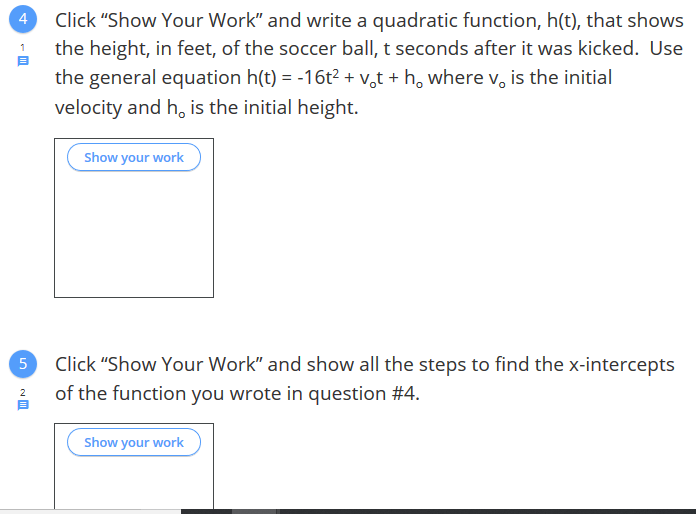
PLEASE HELP!!! write a quadratic function, h(t), that shows the height, in feet, of the soccer ball, t seconds after it was kicked. Use the general equationh(t)= - 16t^{2} + v_{0}t + h_{0} where v_o is the initial velocity and h_o is the initial height. Show how you got the x-intercepts, the vertex's as well as graph it. How long was the soccer ball in the air?
 darkknight:
I dont get it, can you make up your equation_
sutralotv12:
Idk, it doesn't give me another equation for it
darkknight:
is there a picture?
sutralotv12:
I'll give you one
darkknight:
a picture is needed for this i guess,
darkknight:
like associated with the problem is what i meant
 darkknight:
I gtg, sorry. Ask someone else to help you. I will get back to you later maybe
sutralotv12:
ok, no problem
darkknight:
Can you send the rest of the question, by any chance?
sutralotv12:
yeah
 Hero:
Hero:
I wonder what is in the "show your work" part.
sutralotv12:
they are all blank
Hero:
Says to click that first before writing the quadratic equation.
darkknight:
yeah, thats why there was no problem
Hero:
then it says "of THE soccer ball" which implies they presented you with a problem scenario to begin with. I don't see where you have posted the initial problem statement.
sutralotv12:
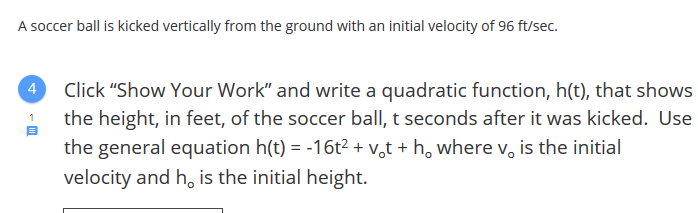
i am so sorry there was fine print I was missing, I apologize for wasting your time, it had an initial velocity of 96 ft per second. I didn't see the fine print right above it
Hero:
Can you just please screenshot the initial problem statement?
Hero:
I don't know why you've posted everything else but avoided posting the initial problem statement when that is the most essential piece of this puzzle to post.
 Hero:
Hero:
Yes, now we know essential things like "The ball was kicked vertically while on the ground"
sutralotv12:
I'm sorry. I didn't see that part
Hero:
Yes because we now know that \(h_0\), the initial height of the ball at \(t = 0\) is also zero since the ball is on the ground and not on a roof.
Hero:
We also now know that \(v_0\) the initial velocity is 96 feet per second.
Hero:
Knowing all this information, we are able to set up the quadratic function.
Hero:
If \(v_0 = 96\) and \(h_0 = 0\) how do you suppose we might write the expression for \(h(t)\)?
sutralotv12:
plug in 96 for \[v_0\] and 0 for \[h_0\]
Hero:
Correct and what would that look like if we did that? Can you write out the entire function?
sutralotv12:
that would look like h(t) = -16t2 + \[96t + 0\]
Hero:
If we're using correct notation it would be \(h(t) = -16t^2 + 96t + 0\). If you're not familiar with LaTeX just put a caret between the t and the 2: h(t) = -16t^2 + 96t + 0
sutralotv12:
oh, right forgot about that
sutralotv12:
alright I got the equation plugged in and I assume I would treat it like a regular quadratic function and find a, b, and c, and then solve using that?
darkknight:
a, b and c is already given. You can determine that from the function
sutralotv12:
right but I mean solve using a b and c
darkknight:
The problem is asking you to write a function and you have already done that. So you are done
darkknight:
Or did you need anything else?
sutralotv12:
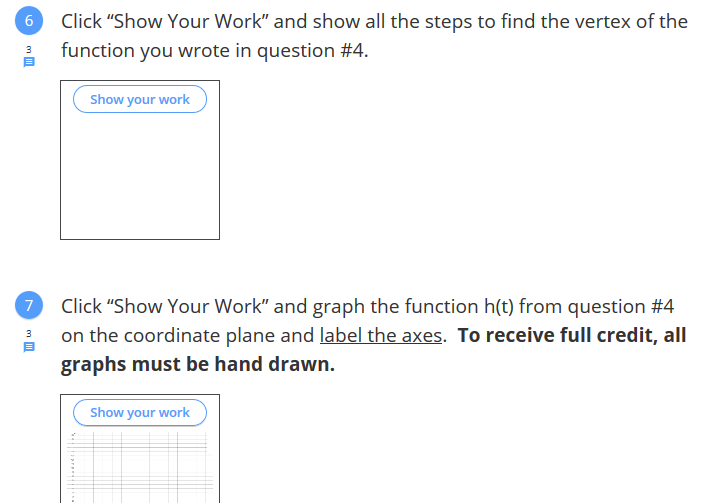
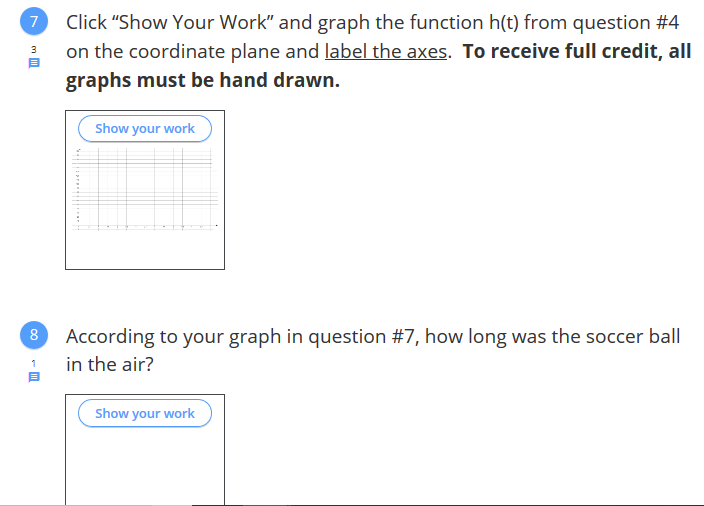
there is more, I have to find x intercepts, vertex, then graph, and then find how long the ball was in the air
darkknight:
oh okay. To find the x-intercepts you can use the quadratic formula
darkknight:
remember to find the x-coor of the vertex you can use the formula (-b/2a) and then plug that in for y
sutralotv12:
ok
darkknight:
and then ur basically done
darkknight:
graph it then find the time when the ball hits the ground, or the second x-intercept. Since we are talking about t then the time it takes for the ball to drop is how much time it was in the air because we started from 0
sutralotv12:
it says t=(6,0), would that be x intercept 1?
darkknight:
where does it say that?
darkknight:
oh you mean that the x-intercepts are at 6,0 and 0,0
darkknight:
good job
sutralotv12:
I'm using mathway for the quadratic formula since I don't got a lot of time
darkknight:
so how long was that ball in the air?
darkknight:
no im pretty sure it says that ur x-intercept is at 6
darkknight:
Now find the time it stayed in the air?
sutralotv12:
150 seconds?
darkknight:
why?
darkknight:
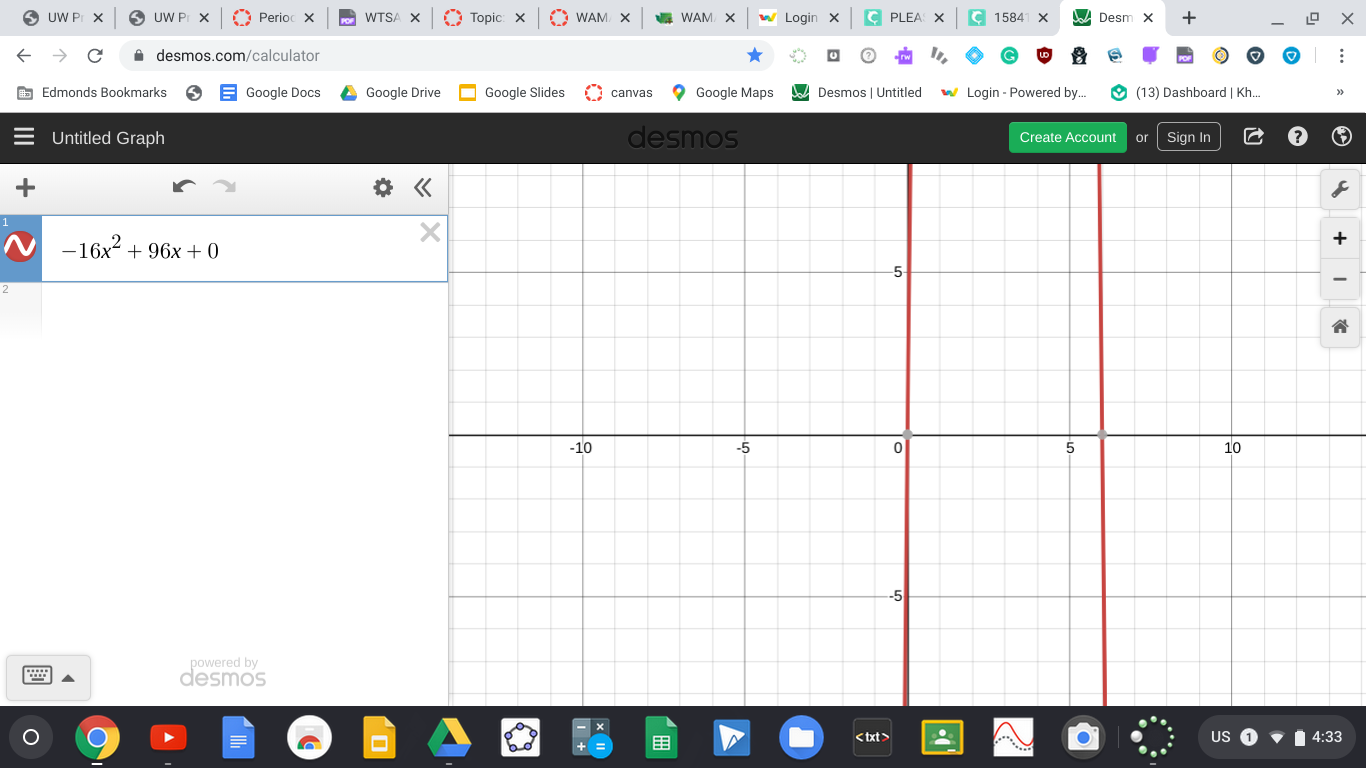
a visual might be easier to use to explain
darkknight:
hold on, ill graph this using desmos then show u
 darkknight:
how much time does it take the ball to drop is the same as how long it is in the air Can you figure it out?
sutralotv12:
oh, six seconds
sutralotv12:
dang, that is one high and steep kick
darkknight:
ye lol
darkknight:
u got it, keep it up :0
sutralotv12:
thanks
sutralotv12:
wait, can someone show me the steps to solving this with quadratic formula?
darkknight:
oh yeah sorry
darkknight:
so once you find the x-intercepts that is when the ball hits the ground right?
darkknight:
so the x-intercepts were 6 and 0 and it takes 6 seconds to drop
darkknight:
plug in the numbers
Join our real-time social learning platform and learn together with your friends!
 Demon25:
For a hoco proposal with a cheerleader and football player, what else should be a
Demon25:
For a hoco proposal with a cheerleader and football player, what else should be a

 Breathless:
TOC: "MGF any confirmation on the commander? we require confirmation as soon as[radio static].
Breathless:
TOC: "MGF any confirmation on the commander? we require confirmation as soon as[radio static].
 EdwinJsHispanic:
I wrote something that I don't know if I want it as a poem or song, Please let me know on yours thoughts about it, I'm still doing this! "Broken promises an
EdwinJsHispanic:
I wrote something that I don't know if I want it as a poem or song, Please let me know on yours thoughts about it, I'm still doing this! "Broken promises an
 thehearken:
hi um I don't know if this is the right section for this, but can someone go over my poem and tell me if its good enough to give my English professor for a
thehearken:
hi um I don't know if this is the right section for this, but can someone go over my poem and tell me if its good enough to give my English professor for a
 heartlessprophet:
Aye what's 19z%u00f74p=9u03c0 my teacher thinking of impossible questions for us
heartlessprophet:
Aye what's 19z%u00f74p=9u03c0 my teacher thinking of impossible questions for us
 kippppp:
does anyone have any good tips for writing stories? i'm trying to write a dnd campaign but i'm not that great of a writer yet.
kippppp:
does anyone have any good tips for writing stories? i'm trying to write a dnd campaign but i'm not that great of a writer yet.
 GRIZZLEY19:
Y'all let me know what y'all think about this beat I made I took me like a hour maybe rate it 0/10 https://drive.
GRIZZLEY19:
Y'all let me know what y'all think about this beat I made I took me like a hour maybe rate it 0/10 https://drive.
 Ultrilliam:
Welcome to the 10th Anniversary Update! (Part 2) Sorry this one passed the date a
Ultrilliam:
Welcome to the 10th Anniversary Update! (Part 2) Sorry this one passed the date a
 Twaylor:
was walking downtown and my adhd brain wanted to make some (rock?) lyrics: There'
Twaylor:
was walking downtown and my adhd brain wanted to make some (rock?) lyrics: There'