
 Pixel:
Sinusoidal Functions
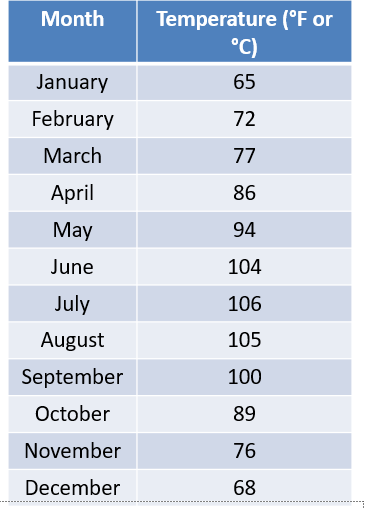 Pixel:
I need to turn this table into an equation for a sinusoidal function, and I'm lost
 Bryannastriler123:
I cant figure it out how are we suppost to do this
Bryannastriler123:
whats the question
Pixel:
that is the question, turn the table into an equation for a sinusoidal function
 imqwerty:
consider the general form of a sinusoidal equation \(\large\color{cyan}{y = a ~cos(b(x-c)) + d}\)
imqwerty:
you just need to figure out the values of a,b,c and d.
imqwerty:
the max value of y would be a+d and min value will be a-d ^ find out a and d from this
imqwerty:
b would be \(\large\frac{2\pi}{Time~period}\)
imqwerty:
you can find the time period by using the coordinates given for maxima and minima
imqwerty:
Btw, use 1,2,3...12 to represent the months
imqwerty:
c is essentially the horizontal "shift" checkout this example: https://www.youtube.com/watch?v=QOCowKoyq_4
Pixel:
Okay step one, how would one find A and D
Pixel:
is the max like, the max number on the table?
imqwerty:
we'll be using the x axis to denote the months and the y axis to denote the temperature
imqwerty:
\(\color{#0cbb34}{\text{Originally Posted by}}\) @Pixel is the max like, the max number on the table? \(\color{#0cbb34}{\text{End of Quote}}\) yes. the max means the max temperature
Pixel:
so max = 106 Min = 65
Pixel:
and then find two numbers that add up to 106 and subtract to 65?
imqwerty:
yup
imqwerty:
cos() can take values from between -1 to 1 so if you have something like a cos (b(x-c)) + d, it's max would be when the cos thing goes 1 and min would be when the cos thing goes -1 therefore max = a + d min = a-d
Pixel:
so what would be the best way of figuring out the two numbers
imqwerty:
a+d 106 a-d = 65
imqwerty:
https://www.youtube.com/watch?v=QOCowKoyq_4 this is essentially the same question, go through it and you'll probably get your answer
Pixel:
so time period = (7,106), (1,65) = 106-65 = 41 / 2 = 20.5
Join our real-time social learning platform and learn together with your friends!
 KBaby:
Verse 1 We left our names in the dust of the driveway Watched the old town shrink
KBaby:
Lyrics Generator Use AI to write the lyrics for a song. Suggested Genres: Pop Hip
KBaby:
Verse 1 We left our names in the dust of the driveway Watched the old town shrink
KBaby:
Lyrics Generator Use AI to write the lyrics for a song. Suggested Genres: Pop Hip

 aitexturegenerator:
How are you all handling AI-generated textures for 3D models and game assets without losing the hand-made feel? I've been doing a small stylized environment
aitexturegenerator:
How are you all handling AI-generated textures for 3D models and game assets without losing the hand-made feel? I've been doing a small stylized environment

 Demon25:
Woke up feeling like that girl and that dude well he still aint crap pluse the du
Demon25:
Woke up feeling like that girl and that dude well he still aint crap pluse the du
 playtsec:
how do I get rid of stress from teachers... I just feel like running out the classroom and leaving on my own.
playtsec:
how do I get rid of stress from teachers... I just feel like running out the classroom and leaving on my own.
 JohnnyLFowler0812:
What type of gamer would play something and then get off for a while. Why not sta
JohnnyLFowler0812:
Which is better? Metallica Rap Country R&B hiphop Medal Gospel Chill Which 3 opti
JohnnyLFowler0812:
What type of gamer would play something and then get off for a while. Why not sta
JohnnyLFowler0812:
Which is better? Metallica Rap Country R&B hiphop Medal Gospel Chill Which 3 opti