
 leila1234567:
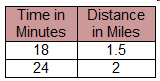
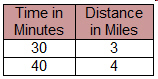
Both Andrew and Karleigh recorded the distance they ran in x minutes on treadmills. Andrew A 2-column table with 2 rows. Column 1 is labeled Time in Minutes with entries 18, 24. Column 2 is labeled Distance in miles with entries 1.5, 2. Karleigh A 2-column table with 2 rows. Column 1 is labeled Time in Minutes with entries 30, 40. Column 2 is labeled Distance in miles with entries 3, 4. Andrew and Karleigh each run for 1 hour. Which statement explains who ran a greater distance? Andrew ran a greater distance. The slope of the line described by the data in his table increased at a rate of StartFraction 1 Over 10 EndFraction mile per minute compared to Karleigh’s StartFraction 1 Over 12 EndFraction mile per minute. Karleigh ran a greater distance. The slope of the line described by the data in her table increased at a rate of StartFraction 1 Over 10 EndFraction mile per minute compared to Andrew’s StartFraction 1 Over 12 EndFraction mile per minute. Karleigh ran a greater distance. The slope of the line described by the data in her table increased at a rate of StartFraction 1 Over 12 EndFraction mile per minute compared to Andrew’s StartFraction 1 Over 10 EndFraction mile per minute. Andrew ran a greater distance. The slope of the line described by the data in his table increased at a rate of StartFraction 1 Over 12 EndFraction mile per minute compared to Karleigh’s StartFraction 1 Over 10 EndFraction mile per minute.
 giannawatson:
one sec
leila1234567:
kk
giannawatson:
so ignore the top look what the question is asking then i will tell you if your answer is wrong
leila1234567:
kk
giannawatson:
The one who ran at the greater Average Speed in 1 hour ran the greater Distance.
leila1234567:
so we have to do the slope equation?
leila1234567:
is it karleigh
giannawatson:
ex:Speed (S) is the ratio of the distance (D) covered to the time (t) taken. That is, S = D/t Suppose Andrew ran a distance D1 in 1 hour (3600 seconds) at a Speed, say S1, we have S1 = D1/t We can then say he ran a distance D1 = t × S1 = 3600S1 Similarly, let's say Karleigh ran a distance D2 = t × S2 = 3600S2 Let us compare these two, you will notice that the bigger number between S1 and S2 is going to determine the bigger number between D1 and D2. Let's choose random numbers for S1 and S2 for clarity, say S1 = 5, S2 = 10 D1 = 3600 × 5 = 18000 D2 = 3600 × 10 = 36000 This makes D2 bigger than D1. this is an example i found on the internet.
giannawatson:
hope that helps
leila1234567:
yep :3
Join our real-time social learning platform and learn together with your friends!
 Demon25:
For a hoco proposal with a cheerleader and football player, what else should be a
Demon25:
For a hoco proposal with a cheerleader and football player, what else should be a

 Breathless:
TOC: "MGF any confirmation on the commander? we require confirmation as soon as[radio static].
Breathless:
TOC: "MGF any confirmation on the commander? we require confirmation as soon as[radio static].
 EdwinJsHispanic:
I wrote something that I don't know if I want it as a poem or song, Please let me know on yours thoughts about it, I'm still doing this! "Broken promises an
EdwinJsHispanic:
I wrote something that I don't know if I want it as a poem or song, Please let me know on yours thoughts about it, I'm still doing this! "Broken promises an
 thehearken:
hi um I don't know if this is the right section for this, but can someone go over my poem and tell me if its good enough to give my English professor for a
thehearken:
hi um I don't know if this is the right section for this, but can someone go over my poem and tell me if its good enough to give my English professor for a
 heartlessprophet:
Aye what's 19z%u00f74p=9u03c0 my teacher thinking of impossible questions for us
heartlessprophet:
Aye what's 19z%u00f74p=9u03c0 my teacher thinking of impossible questions for us
 kippppp:
does anyone have any good tips for writing stories? i'm trying to write a dnd campaign but i'm not that great of a writer yet.
kippppp:
does anyone have any good tips for writing stories? i'm trying to write a dnd campaign but i'm not that great of a writer yet.
 GRIZZLEY19:
Y'all let me know what y'all think about this beat I made I took me like a hour maybe rate it 0/10 https://drive.
GRIZZLEY19:
Y'all let me know what y'all think about this beat I made I took me like a hour maybe rate it 0/10 https://drive.
 Ultrilliam:
Welcome to the 10th Anniversary Update! (Part 2) Sorry this one passed the date a
Ultrilliam:
Welcome to the 10th Anniversary Update! (Part 2) Sorry this one passed the date a
 Twaylor:
was walking downtown and my adhd brain wanted to make some (rock?) lyrics: There'
Twaylor:
was walking downtown and my adhd brain wanted to make some (rock?) lyrics: There'