
 angieee:
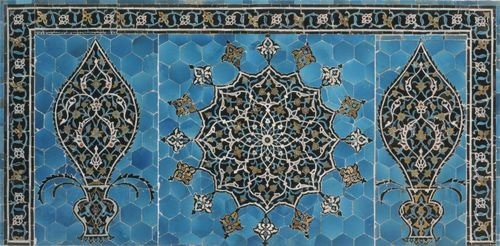
This large panel and others like it decorated the prayer room walls of an Islamic monastery in Isfahan, the capital city of Persia (now Iran), more than four hundred years ago. The monastery was built for followers of Sufism, a branch of Islam that stresses a direct relationship with God through simple living, meditation, and "the path of love." The thirteenth-century Sufi mystic Jall ad-Dn ar-Rm, known by many as "Rumi," is one of the most widely read poets throughout the world today. To create this striking panel, Persian tile makers used a difficult mosaic technique. Instead of working with small pieces of stone or glass, they covered clay tiles with colored glazes, which were then carefully cut and fit together with a template and set into wet plaster. The overall composition is simple and symmetrical. We see a large star with sixteen points in the center, a vase with flowers on each side, and a border across the top and down each side. These three elements are placed on a smooth, brilliant turquoise field of hexagon shaped tiles. Inside each element, however, there are complex geometric webs of curving, vine like lines and leaf and flower shapes. Within the large star, bright white lines form an intricate radial design that jumps out from the black background, ochre flowers, and graceful blue lines. The vases sprouting teardrop shapes contain similar layers of colorful arabesque patterns. These complicated, orderly motifs express infinite perfection and precision, while the turquoise recalls clear, blue water and lush green gardens, so desirable in the dry climate of Persia.
Join our real-time social learning platform and learn together with your friends!
 KBaby:
Verse 1 We left our names in the dust of the driveway Watched the old town shrink
KBaby:
Lyrics Generator Use AI to write the lyrics for a song. Suggested Genres: Pop Hip
KBaby:
Verse 1 We left our names in the dust of the driveway Watched the old town shrink
KBaby:
Lyrics Generator Use AI to write the lyrics for a song. Suggested Genres: Pop Hip

 aitexturegenerator:
How are you all handling AI-generated textures for 3D models and game assets without losing the hand-made feel? I've been doing a small stylized environment
aitexturegenerator:
How are you all handling AI-generated textures for 3D models and game assets without losing the hand-made feel? I've been doing a small stylized environment

 Demon25:
Woke up feeling like that girl and that dude well he still aint crap pluse the du
Demon25:
Woke up feeling like that girl and that dude well he still aint crap pluse the du
 playtsec:
how do I get rid of stress from teachers... I just feel like running out the classroom and leaving on my own.
playtsec:
how do I get rid of stress from teachers... I just feel like running out the classroom and leaving on my own.
 JohnnyLFowler0812:
What type of gamer would play something and then get off for a while. Why not sta
JohnnyLFowler0812:
Which is better? Metallica Rap Country R&B hiphop Medal Gospel Chill Which 3 opti
JohnnyLFowler0812:
What type of gamer would play something and then get off for a while. Why not sta
JohnnyLFowler0812:
Which is better? Metallica Rap Country R&B hiphop Medal Gospel Chill Which 3 opti