
 ohyhyh:
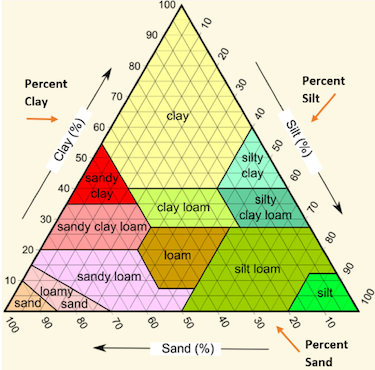
The picture below shows a soil texture triangle. Image of a soil texture triangle. Each side is labeled one of the three main soil types—silt, clay, and sand—and is divided into percentages, from 0 to 100. Each point in the triangle corresponds to a different soil texture, consisting of a different combination of silty, sandy, and clay soils. For instance, the top part of the triangle contains soils that range from approximately 50 percent clay to 100 percent clay. All these different soils are considered clays. Soils located farther down the triangle contain an increasingly small percentage of clay; for example, silty clay soils are primarily silt, with more clay than sand, and sandy clay soils are primarily sand, with more clay than silt. Soils located in the middle of the triangle contain roughly equal percentages of clay, sand, and silt; these soils are called “loam.” There are silty loam soils, which contain more silt than clay or sand; clay loam soils, which contain more clay than silt or sand, and sandy loam soils, which contain more sand than silt or clay. There are also silty clay loam soils and sandy clay loam soils. A soil sample contains 20 percent sand, 10 percent clay, and 70 percent silt. What type of soil is present in the sample? clay silty loam silty clay loam clay loam
 mw104969:
which one do you think
 ohyhyh:
mw im not sure
ohyhyh:
these questions really confuse me
mw104969:
you can cancel out A nd D
ohyhyh:
so b or c. hmm
mw104969:
For soil sample contains 20 percent sand, 10 percent clay, and 70 percent silt we have silty loam present in the sample. so its B
ohyhyh:
Thank you!
mw104969:
\(\color{#0cbb34}{\text{Originally Posted by}}\) @ohyhyh Thank you! \(\color{#0cbb34}{\text{End of Quote}}\) np love
Join our real-time social learning platform and learn together with your friends!
VERNEISH:
Two objects are moving along separate linear paths where each path is described by position, d, and time, t.

 Maci:
what are the best stock apps for people who want to start investing?
Maci:
what are the best stock apps for people who want to start investing?
 Twaylor:
genuienly how do i get better self control i keep watcing youtube and theres this
Twaylor:
genuienly how do i get better self control i keep watcing youtube and theres this
 IzzyCookie:
|dw:1792074056138:dw| Uhm, I don't know where to ask this, but I'm in college welding at my community college, and I need help learning vertical welding for
IzzyCookie:
|dw:1792074056138:dw| Uhm, I don't know where to ask this, but I'm in college welding at my community college, and I need help learning vertical welding for

 thehearken:
not sure if this is considered spam, im sorry if it is, but does anyone have tips
thehearken:
not sure if this is considered spam, im sorry if it is, but does anyone have tips