
 iuytyuioiuytyuiop:
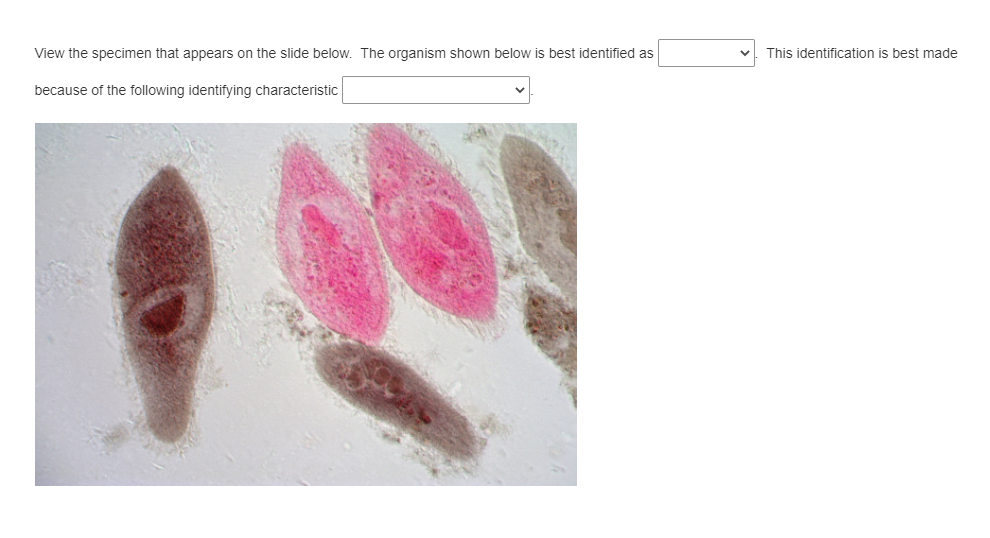
View the specimen that appears on the slide below. The organism shown below is best identified as . This identification is best made because of the following identifying characteristic
 iuytyuioiuytyuiop:
@AZ
iuytyuioiuytyuiop:
does this cell lack a cell wall?
iuytyuioiuytyuiop:
@MrMudd183
iuytyuioiuytyuiop:
@Astrid1
iuytyuioiuytyuiop:
@Yuri00 @xxDeppressionxx
iuytyuioiuytyuiop:
is it a fungal organism?
 Yuri00:
What are the answers they give you to choose from?
iuytyuioiuytyuiop:
for the first blank spot the options are prokaryotic, eukaryotic, plant, fungal, and animal
Yuri00:
Ok
iuytyuioiuytyuiop:
can you help me
iuytyuioiuytyuiop:
@Vocaloid
iuytyuioiuytyuiop:
@xxDeppressionxx
Yuri00:
I don't think it's a Fungal cell
iuytyuioiuytyuiop:
lol
Yuri00:
It could Animal cell or eukaryotic cell because it looks like it has a nucleus
 YECR:
YECR:
Ah im did biology Do u still need help?
iuytyuioiuytyuiop:
@AZ
 AZ:
AZ:
It's always best to include all the information given to you so you can receive help faster. What are the options for the second blank?
iuytyuioiuytyuiop:
the options for the second blank is unicellular, multicellular, presence of a nucleus, absence of a nucleus, lack of a cell wall, presence of a cell wall, and multiple visible organelles
AZ:
For the record, I really dislike histology/pathology. Fungi and prokaryotes both have cell walls. Eukaryotes and fungi can be unicellular. All prokaryotes are unicellular. Fungi and prokaryotes do not have cilia. However, eukaryotes can have cilia. Our specimen seems to have cilia. Honestly, I don't think that's a nucleus. I would say it looks more like a nucleoid found in prokaryotes but since prokaryotes can't have cilia, I guess it has to be a nucleus.
AZ:
(I think that counts as a direct answer but I really see no way of answering this question otherwise.)
iuytyuioiuytyuiop:
@MrMudd183
iuytyuioiuytyuiop:
is AZ saying it's prokaryote and nucleus?
 MrMudd183:
I believe so, I'm not the best at biology...it was never really my strongsuit
AZ:
It can't be a prokaryote or a fungi since it has cilia so it would have to be a eukaryote
Join our real-time social learning platform and learn together with your friends!
VERNEISH:
Two objects are moving along separate linear paths where each path is described by position, d, and time, t.

 Maci:
what are the best stock apps for people who want to start investing?
Maci:
what are the best stock apps for people who want to start investing?
 Twaylor:
genuienly how do i get better self control i keep watcing youtube and theres this
Twaylor:
genuienly how do i get better self control i keep watcing youtube and theres this
 IzzyCookie:
|dw:1792074056138:dw| Uhm, I don't know where to ask this, but I'm in college welding at my community college, and I need help learning vertical welding for
IzzyCookie:
|dw:1792074056138:dw| Uhm, I don't know where to ask this, but I'm in college welding at my community college, and I need help learning vertical welding for

 thehearken:
not sure if this is considered spam, im sorry if it is, but does anyone have tips
thehearken:
not sure if this is considered spam, im sorry if it is, but does anyone have tips