
 Seafoam:
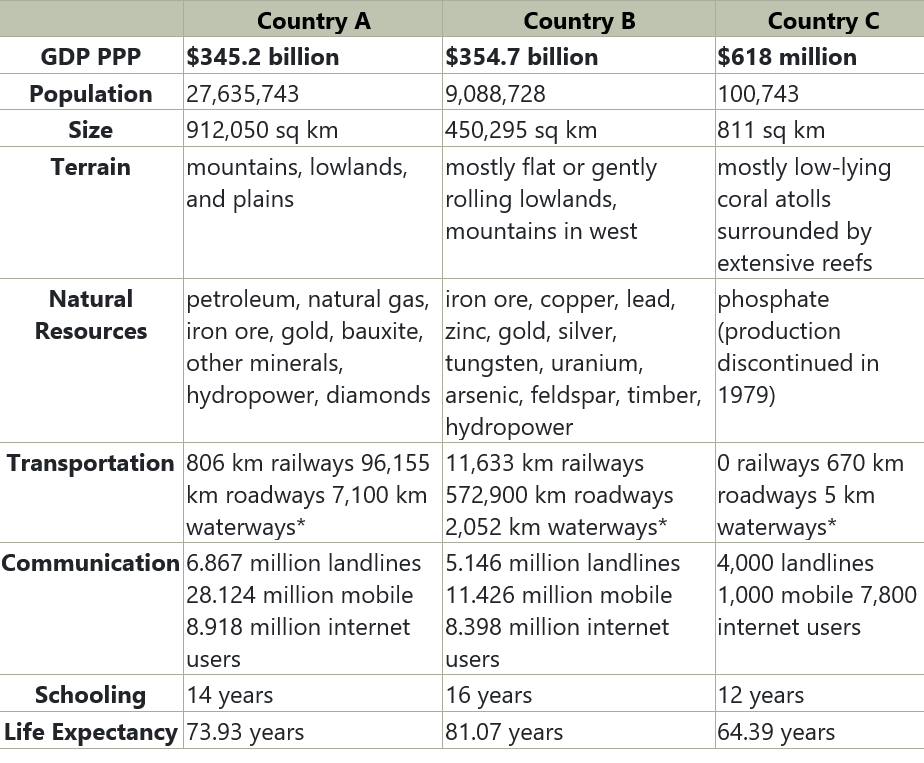
I would like my answer to be checked and evaluated please Write a paragraph that describes each country's level of development and explain what data helped you arrive at your analysis. My answer: In matters of size, it doesn’t tell much about its development and population, as the country could be heavily populated but its small, and example would be Vatican City. Or the country could be very large and it has a small population density, such as Canada. As for the terrain, A seems to be full of mountains which must take up a lot of its space, this must also be why it has the least population of the three as its hard to live in the mountains. B is flatter and easier to live in but also has a couple of mountains, this must be one of the reasons it has a higher population than Country A. And C is an island, causing it to have the smallest population. Islands have smaller islands because first of all they are smaller, and have a small carrying capacity, and islands can be very unknown, far from the mainland, and weather conditions can include a lot of hurricanes, earthquakes, and tsunamis. Country A has diamonds in there natural resources, this can be used by that countries government as a good trading product, B has a lot of metals they could be known more for jewelry, it also has hydropower its advantages are it’s a renewable water source, promotes guaranteed energy and price stability, helps fight climate changes, and improves the air we breathe. Country A’s transportation consists of less railways and much less roadways than B, but much more than C. A’s waterways are the longest, surpassing B’s by 5,048 km and C’s by 7,095. Country B in general has the most transportation in these three, and C is much less with the small size of the island. Country A has the biggest amounts of communication compared to B and C, there must be some sort of urban area to have this much, considering this this country must be more developed than the other two. B has the second most with C as the least, on an island communication must be difficult and hard to use, not to mention the lesser population numbers. As for schooling, education has a lot to do with the growing economy, with better schooling economies are typically more successful. Education in every sense is one of the fundamental factors of development, education raises people's productivity and creativity and promotes entrepreneurship and technological advances. In addition, it plays a very crucial role in securing
 Seafoam:
Ok I've changed it a bit now In matters of size, it doesn’t tell much about its development and population, as the country could be heavily populated but its small, an example would be Vatican City. Or the country could be very large and it has a small population density, such as Canada. As for the terrain, Country A seems to be full of mountains which must take up a lot of its space, this must also be why it has the least population of the three as its harder to live in the mountains. B is flatter and easier to live in but also has a couple of mountains, this must be one of the reasons it has a higher population than Country A. And C is an island, causing it to have the smallest population. Islands have smaller populations because of there small size, and have a small carrying capacity, islands can be very unknown because there are so many of them, they are far from the mainland, and weather conditions can include a lot of hurricanes, earthquakes, and tsunamis. Country A has diamonds in there natural resources, this can be used by that countries government as a good trading product, B has a lot of metals, they could be known more for jewelry, it also has hydropower its advantages are it’s a renewable water source, promotes guaranteed energy and price stability, helps fight climate changes, and improves the air we breathe. Country A’s transportation consists of less railways and much less roadways than B, but much more than C. A’s waterways are the longest, surpassing B’s by 5,048 km and C’s by 7,095. Country B in general has the most transportation in these three, and C is much less with the small size of the island. Country A has the biggest amounts of communication compared to B and C, there must be some sort of urban area to have this much, considering this this country must be more developed than the other two. B has the second most with C as the least, on an island communication must be difficult and hard to use, not to mention the lesser population numbers. As for schooling, education has a lot to do with the growing economy, with better schooling economies are typically more successful. Education is one of the fundamental factors of development, education raises people's productivity and creativity and promotes entrepreneurship and technological advances. In addition, it plays an especially important role in securing economic and social progress and improving income distribution. So in regard to this information, it would be concluded Country B developed most from education and Country C the least. Country C has the least life expectancy, this implies they have poorer food security, water quality, shelter, and medical care. And since B has the highest it would have the best of those out of these three.
Seafoam:
Ok so should I submit it?
Seafoam:
Ok never mind I'll just do it
 AZ:
AZ:
Woah, you wrote a lot and maybe it could be shorter but I stopped halfway to point out some things first The prompt wanted you to write a paragraph describing each country and their level of development. So I think it would be better if you started off with that. So for example: Country B is the most developed because they have the highest GDP PPP relative to their population as well as a high life expectancy. and you know Country C is the least developed. Doesn't have much of an economy maybe because it's just an island and a place for tourists to come but nothing much for the people to live there Country A is developed too but it doesn't have as large an economy as Country B (since the population is three times as large) so that was something I wanted to point out- You said Country A has the least population but that's not true. And you said country B has a higher population Country A has a population of 27 million people Country B has a population of 9 million people Country A >> Country B
 Astrid1:
One more thing to point out. When you say, " Country A’s transportation consists of less railways and much less roadways than B," it seems that you have already stated that when you said Country A's transportation consists of less railways. Maybe if you were to just say, "Country A's transportation consists of less railways than b, but A has more railways than (c?)
AZ:
I feel like from where you begin talking about diamonds until right before you write about education can all be simplified. It sounds almost like you're trying to explain the economy but it's not really necessary. Also one point - yeah C has fewer people but even considering that, it has much less communication set up. Like 5% of the entire population have a landline+phone whereas country B has 182% of the people have a landline or phone. Which is saying that most people have more than 1- i.e. they have a mobile and a landline. But the biggest point is that you don't mention anywhere in your paragraph about GDP in consideration with population. I think that's the biggest factor in describing the country's level of development.
Seafoam:
Oh no, I kind of already submitted it... because no one responded so I just did it. But if she doesn't like it I'll redo it with your suggestions, so thank you
AZ:
Ah, hopefully it'll be okay
Join our real-time social learning platform and learn together with your friends!
 VERNEISH:
Two objects are moving along separate linear paths where each path is described by position, d, and time, t.
VERNEISH:
Two objects are moving along separate linear paths where each path is described by position, d, and time, t.

 Maci:
what are the best stock apps for people who want to start investing?
Maci:
what are the best stock apps for people who want to start investing?
 Twaylor:
genuienly how do i get better self control i keep watcing youtube and theres this
Twaylor:
genuienly how do i get better self control i keep watcing youtube and theres this
 IzzyCookie:
|dw:1792074056138:dw| Uhm, I don't know where to ask this, but I'm in college welding at my community college, and I need help learning vertical welding for
IzzyCookie:
|dw:1792074056138:dw| Uhm, I don't know where to ask this, but I'm in college welding at my community college, and I need help learning vertical welding for

 thehearken:
not sure if this is considered spam, im sorry if it is, but does anyone have tips
thehearken:
not sure if this is considered spam, im sorry if it is, but does anyone have tips