
 Astrid1:
I need help with these two o:
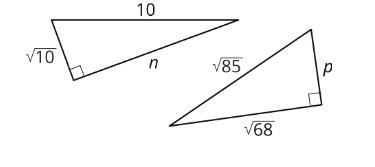
 AZ:
AZ:
Use the pythagorean theorem like you did earlier Remember that \( (\sqrt{x})^2 = x\) if you square a square root, you're just left with whatever was inside the square root
Astrid1:
So inside the square root would be 10? for the equation with n.
AZ:
yeah so a^2 + b^2 = c^2 and put in those values \( (\sqrt{10})^2 + n^2 = 10^2\) solve for n
Astrid1:
Okay so.. 10^2 + n^2 =10^2 100 +n^2 = 100 100-100=0 100-100=0 So.. the answer would be Zero?
 snowflake0531:
No it's sqrtx^2 which means that it's x So it's 10 + n^2 = 100
Astrid1:
Ohh so it'd be 90?
AZ:
no 10 + n^2 = 100 subtract 10 on both sides n^2 = ?? remember, we're solving for 'n'
Astrid1:
10-10=0 10-100=90 ._. I'm confused now.
AZ:
100 - 10 = 90 ** 10 + n^2 = 100 10 + n^2 - 10 = 100 - 10 n^2 = 90 does that make sense so far?
Astrid1:
Yeah..
AZ:
So then how do you get n all by itself? we have to take the square root of it
Astrid1:
\[\sqrt{90}\] and I've gtg o: I'll be on tomorrow.
AZ:
You got it! And we could simplify that a little more but essentially that's the same concept you apply to the other question
AZ:
I'll see you tomorrow then :)
Join our real-time social learning platform and learn together with your friends!
 VERNEISH:
Two objects are moving along separate linear paths where each path is described by position, d, and time, t.
VERNEISH:
Two objects are moving along separate linear paths where each path is described by position, d, and time, t.

 Maci:
what are the best stock apps for people who want to start investing?
Maci:
what are the best stock apps for people who want to start investing?
 Twaylor:
genuienly how do i get better self control i keep watcing youtube and theres this
Twaylor:
genuienly how do i get better self control i keep watcing youtube and theres this
 IzzyCookie:
|dw:1792074056138:dw| Uhm, I don't know where to ask this, but I'm in college welding at my community college, and I need help learning vertical welding for
IzzyCookie:
|dw:1792074056138:dw| Uhm, I don't know where to ask this, but I'm in college welding at my community college, and I need help learning vertical welding for

 thehearken:
not sure if this is considered spam, im sorry if it is, but does anyone have tips
thehearken:
not sure if this is considered spam, im sorry if it is, but does anyone have tips