
 botgiggyiggy:
MATH HELP
 Camm:
Camm:
@Extrinix
 Joaquin:
with wath
Joaquin:
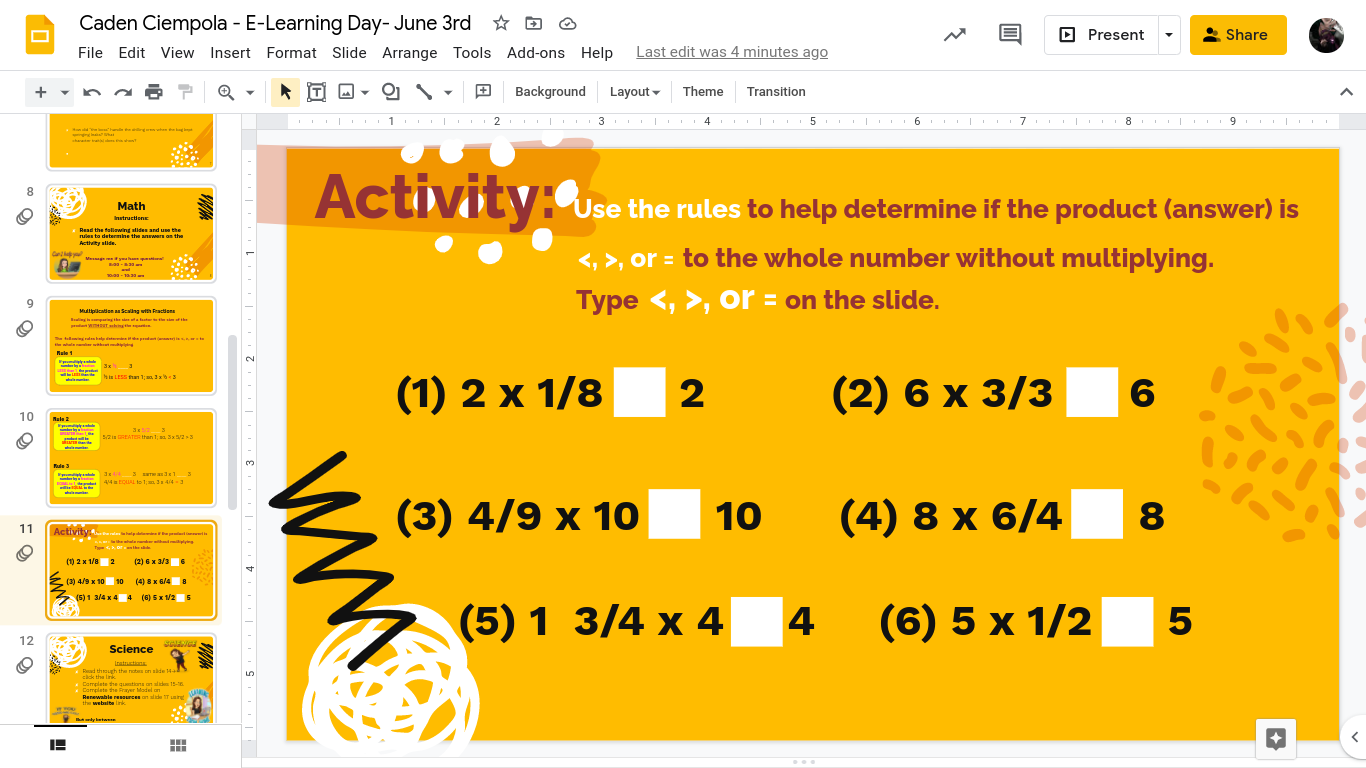
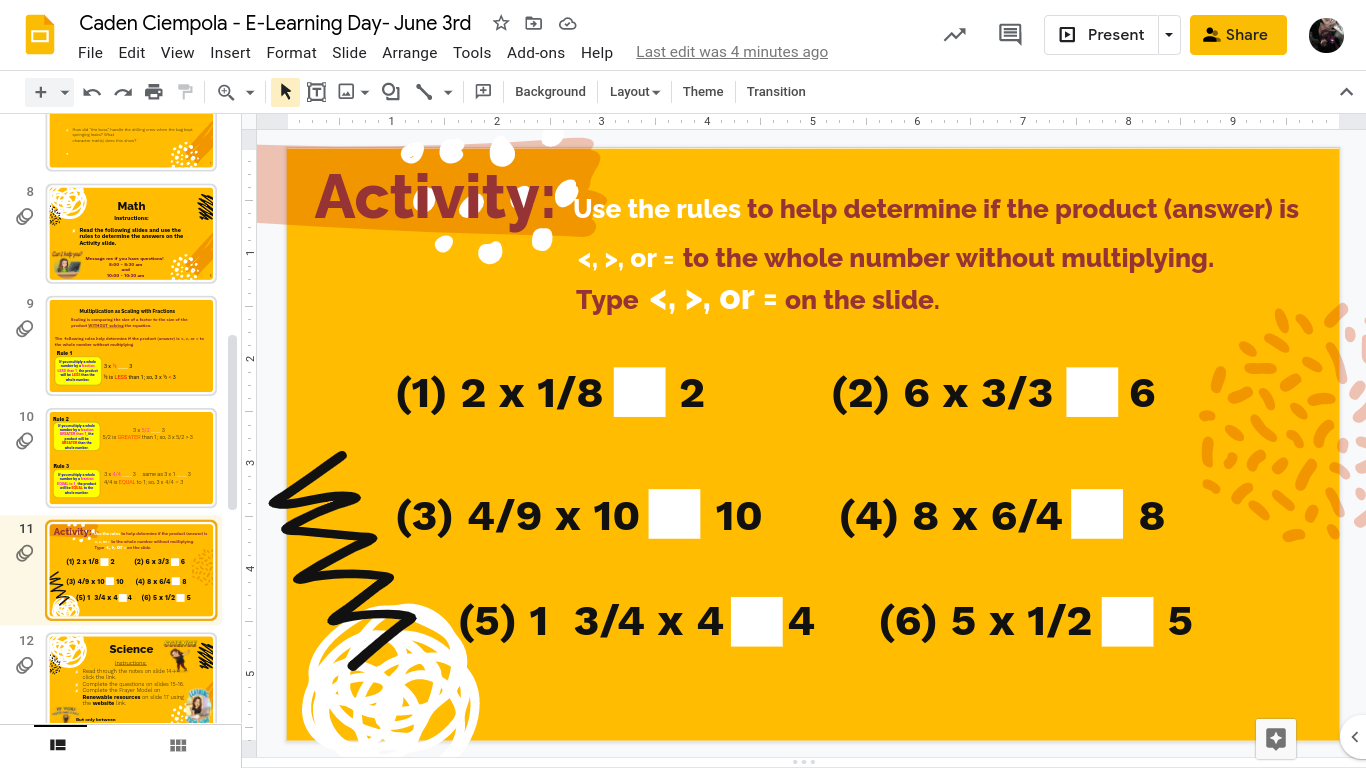
when multiplying fractions with integers, you multiply the numerator with the whole number and keep the denominator, then you simplify the fraction and determine weather what you just did is greater than, less than, or equal to the other side of the problem.
Joaquin:
great explanation Ertrinix
 Extrinix:
Messed it up some, Ok so, all you simply need is to figure out whether the fraction is larger than 1 or smaller than 1, for example \(\dfrac{3}{4}\) is less than one and \(\dfrac{6}{4}\) is more than 1. As well as that if there are any equal to 1, for example \(\dfrac{5}{5}\) is = 1. Equal to: \(\dfrac{5}{5} = 1\) Greater than: \(1\dfrac{3}{4} \gt 1\) Less than: \(\dfrac{2}{5} \lt 1\)
botgiggyiggy:
Thanks ok what else extrinix
Extrinix:
You don't necessarily need to multiply for these questions, simply look at the fraction itself and determine which one of these it would be: \(\dfrac{5}{5} = 1\) · Would make the sign \(=\) \(1\dfrac{3}{4} \gt 1\) · Would make the sign \(\gt\) \(\dfrac{2}{5} \lt 1\) · Would make the sign \(\lt\)
botgiggyiggy:
OK thanks really appreciate it
Extrinix:
You're welcome.
Join our real-time social learning platform and learn together with your friends!
VERNEISH:
Two objects are moving along separate linear paths where each path is described by position, d, and time, t.

 Maci:
what are the best stock apps for people who want to start investing?
Maci:
what are the best stock apps for people who want to start investing?
 Twaylor:
genuienly how do i get better self control i keep watcing youtube and theres this
Twaylor:
genuienly how do i get better self control i keep watcing youtube and theres this
 IzzyCookie:
|dw:1792074056138:dw| Uhm, I don't know where to ask this, but I'm in college welding at my community college, and I need help learning vertical welding for
IzzyCookie:
|dw:1792074056138:dw| Uhm, I don't know where to ask this, but I'm in college welding at my community college, and I need help learning vertical welding for

 thehearken:
not sure if this is considered spam, im sorry if it is, but does anyone have tips
thehearken:
not sure if this is considered spam, im sorry if it is, but does anyone have tips