
 ohyhyh:
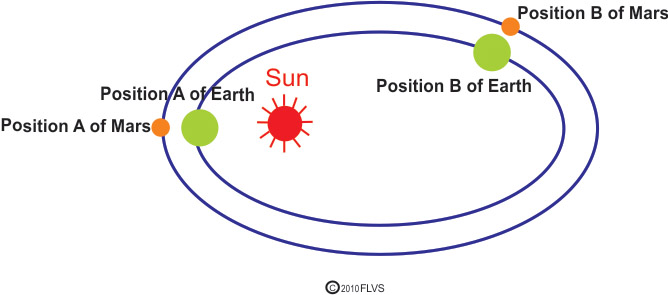
The diagram below shows different positions of Earth and Mars around the sun. Diagram shows the sun at the left hand focus of Earth's elliptical orbit. Two positions of Earth are shown on the elliptical orbit. At Position A, Earth is closest to the sun. At position B, Earth is farther away from the sun. The elliptical orbit of Mars is shown around Earth's orbit. Two positions of Mars are shown on its orbit. At Position A, Mars is closest to the sun. At position B, Mars is farther away from the sun. Based on the diagram, which of these statements is correct? The orbital speeds of Earth and Mars are greater in position B than in position A. The orbital speeds of Earth and Mars are greater in position A than in position B. The orbital period of Earth in position A is greater than the orbital period of Mars in position B. The orbital period of Earth in position B is greater than the orbital period of Mars in position B.
 XxXNessalulbaddieXxX:
u got a screen shot?
 XxXNessalulbaddieXxX:
ight which one u think it is
ohyhyh:
c
XxXNessalulbaddieXxX:
final answer? lol
ohyhyh:
yes? lol
ohyhyh:
i suck at sciencve
XxXNessalulbaddieXxX:
correct me if im wrong but i think u might be right
XxXNessalulbaddieXxX:
@kyanthedoodle
ohyhyh:
@kyanthedoodle LMAO
ohyhyh:
yup.
XxXNessalulbaddieXxX:
hes super smart lmaoo
 KyanTheDoodle:
WOW
KyanTheDoodle:
OKAY I UNDERSTAND THE QUESTION NOW LOL
KyanTheDoodle:
So when they're talking about orbital speeds they mean the rate at which they're revolving around the sun. Do you see how on the left they're a lot closer to the sun than they are when they're farther away? That means they're orbiting the sun at a faster rate than on the other end. Make sense?
ohyhyh:
KyanTheDoodle:
No
ohyhyh:
d?
ohyhyh:
KyanTheDoodle:
Let me try explaining again. On the left of the orbit, both Earth and Mars will take a shorter time around that half of the sun than they will with the half on the right.
ohyhyh:
so then a? im so sorry i can be brain dead sometimes.
KyanTheDoodle:
The opposite of A. The path is shorter, so it won't take Earth and Mars as long to orbit the sun.
KyanTheDoodle:
and don't worry about it, it's a tough question.
ohyhyh:
So B? lol
KyanTheDoodle:
That's what I would put
ohyhyh:
ok. i trust u
Join our real-time social learning platform and learn together with your friends!
VERNEISH:
Two objects are moving along separate linear paths where each path is described by position, d, and time, t.

 Maci:
what are the best stock apps for people who want to start investing?
Maci:
what are the best stock apps for people who want to start investing?
 Twaylor:
genuienly how do i get better self control i keep watcing youtube and theres this
Twaylor:
genuienly how do i get better self control i keep watcing youtube and theres this
 IzzyCookie:
|dw:1792074056138:dw| Uhm, I don't know where to ask this, but I'm in college welding at my community college, and I need help learning vertical welding for
IzzyCookie:
|dw:1792074056138:dw| Uhm, I don't know where to ask this, but I'm in college welding at my community college, and I need help learning vertical welding for

 thehearken:
not sure if this is considered spam, im sorry if it is, but does anyone have tips
thehearken:
not sure if this is considered spam, im sorry if it is, but does anyone have tips