
 carmelle:
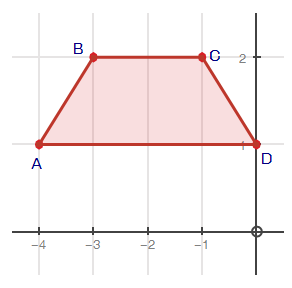
Geometry (Picture included) - If trapezoid ABCD was reflected over the y-axis, reflected over the x-axis, and rotated 180°, where would point A′ lie? A. (1, −1) B. (−4, 1) C. (1, 1) D. (−4, −1)
 QuestionCoveBot:
So, it's going to reflect off the Y-axis (to the right). So Y-axis is a mirror. The points only change by going positive. D is (0,1). It would switch to (0,1) because it stays on the same point. B is (-3,2). Since it's reflecting, it would become (3,2). This is the same for the other points. Just remove the negative.
QuestionCoveBot:
That's reflecting off the Y-Axis.
carmelle:
ok, I think I get it, how about rotating 180 degrees?
 AN0NYM0US:
the answer for that would be (-4,-1) because you would rotate the trapezoid 180˚ and before that you would reflect them both times first to the right side of the (-,-) then to the bottom of the (+,+) then the reflection of (+,-) it would be (-,-)
QuestionCoveBot:
AN0NYM0US:
therefore your answer would be A (-,-) which is (-4,-1)
QuestionCoveBot:
AN0NYM0US:
QuestionCoveBot:
AN0NYM0US:
Once over the y-axis, then once over the x-axis. So that would go into the (+,+) then the (+,-) then you rotate it 180˚ which would make it in the (-,-)’s
QuestionCoveBot:
Quadrants. Quadrant 2 (-,+) | Quadrant 1 (+,+) | | _________________|__________________ Quadrant 4 (-,-) | Quadrant 3 (+,-) | |
QuestionCoveBot:
AN0NYM0US:
the correct answer i meant to say was (-4,1)if trapezoid ABCD was reflected over the Y-axis (x,y) — (-x,y) (-4,1) — (4,1) Then ABCD was reflected over the X-axis, (x,y) — (x,-y) (4,1) — (4,-1) At the end rotate ABCD 180º (X,Y) — (-x,-y) (4,-1) — (-4,1)
AN0NYM0US:
i thought the answer was (-4,-1) but i might have been wrong.
AN0NYM0US:
but do you understand what i did?
 Timmyspu:
Also I know you are trying to explain how to do the problem but next time when qcb is answering first let qcb do it, because it makes it a lot more confusing for 2 people to explain the same thing then maybe explain it wrong.
AN0NYM0US:
i know, also if they don’t get how the other person did it then the person watching could help them.
 UPS:
UPS:
carmelle:
AN0NYM0US:
Quadrants. Quadrant 2 (-,+) | Quadrant 1 (+,+) | | _________________|__________________ Quadrant 4 (-,-) | Quadrant 3 (+,-) | Here | First you reflect it over the y-axis, and go over the line between the (-,+) and the (+,+) then you will end up on the (+,+), after that you reflect it over the x-axis which then you will be on the (+,-), so now you would rotate it 180º and it would get you to the (-,-) Quadrant.
AN0NYM0US:
Can you close your post if you are done with it?
carmelle:
yea sure, thanks the both of u, the answer was B :)
Join our real-time social learning platform and learn together with your friends!
 VERNEISH:
Two objects are moving along separate linear paths where each path is described by position, d, and time, t.
VERNEISH:
Two objects are moving along separate linear paths where each path is described by position, d, and time, t.

 Maci:
what are the best stock apps for people who want to start investing?
Maci:
what are the best stock apps for people who want to start investing?
 Twaylor:
genuienly how do i get better self control i keep watcing youtube and theres this
Twaylor:
genuienly how do i get better self control i keep watcing youtube and theres this
 IzzyCookie:
|dw:1792074056138:dw| Uhm, I don't know where to ask this, but I'm in college welding at my community college, and I need help learning vertical welding for
IzzyCookie:
|dw:1792074056138:dw| Uhm, I don't know where to ask this, but I'm in college welding at my community college, and I need help learning vertical welding for

 thehearken:
not sure if this is considered spam, im sorry if it is, but does anyone have tips
thehearken:
not sure if this is considered spam, im sorry if it is, but does anyone have tips