
 jonahneedshelp2121:
ok here is the next one
 jonahneedshelp2121:
this one looks harder
 AZ:
AZ:
Remember the previous question we just answered? They wanted us to prove that the triangles were similar by showing that there were two congruent (that means equal) angles
 Phantomdex:
Alright my knowledge on this only goes so far so, I guess I'll be taught this as well now lol
jonahneedshelp2121:
ok
jonahneedshelp2121:
b and e are the same and f and c and the same angles right?
AZ:
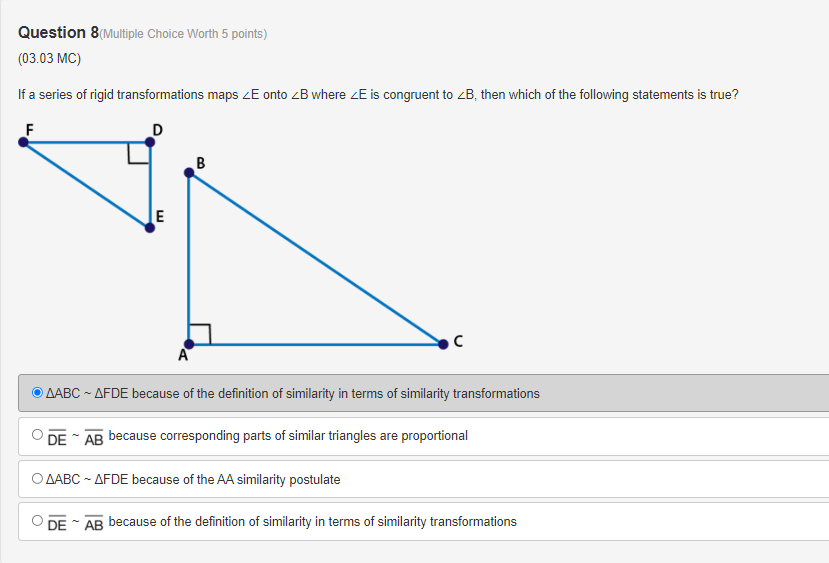
This question is asking us to do the same exact thing. Angle A and D are equal to each other. (They're both 90 degree angles)
AZ:
jonahneedshelp2121:
jonahneedshelp2121:
so know i know that what do I do next?
jonahneedshelp2121:
ok
AZ:
This question basically asks the opposite of what that question was asking
jonahneedshelp2121:
ohhh
jonahneedshelp2121:
hmmm
jonahneedshelp2121:
this part is confusing
jonahneedshelp2121:
∠E onto ∠B where ∠E is congruent to ∠B,
AZ:
Actually I was mistaken
AZ:
jonahneedshelp2121:
oh ok
jonahneedshelp2121:
so what is my next step?
AZ:
The drawings aren't to scale Because the question states rigid transformations which are translation, rotation, and reflection. This doesn't change the shape, it just moves it around
jonahneedshelp2121:
oh
jonahneedshelp2121:
i kind of like the D opjtion
AZ:
That is correct
jonahneedshelp2121:
segment DE ~ segment AB because of the definition of similarity in terms of similarity transformations
jonahneedshelp2121:
but that was kind of a guess to be truthful
AZ:
It can't be answer choice A because it doesn't match the angles correctly triangle ABC would be similar to triangle DEF while answer choices A and C both have it as ABC and FDE
AZ:
Actually I think it should be B The series of rigid transformations got triangle DEF to overlap on triangle ABC but they are similar triangles, not congruent triangles
jonahneedshelp2121:
ohhh
jonahneedshelp2121:
how?
AZ:
If you rotate the triangle DEF, you'll get it to look just like triangle ABC
jonahneedshelp2121:
oh ok that makes more sence
AZ:
We already know that angle A and D are equal. And we are told that angle E and B are congruent in the question
jonahneedshelp2121:
also i have a BIG typing part that I 100% need help to understand
jonahneedshelp2121:
jonahneedshelp2121:
you there?
Phantomdex:
I think they went offline
jonahneedshelp2121:
oof
Phantomdex:
Oof indeed
jonahneedshelp2121:
Phantomdex:
Um, I'll be honest I'm not sure I'll even now what's going on in the question
jonahneedshelp2121:
ok what to see what i looks like?
 jonahneedshelp2121:
Phantomdex:
Oh, um-
Phantomdex:
I don't know that one sorry
jonahneedshelp2121:
np
jonahneedshelp2121:
ok everyone i am making a new one
Join our real-time social learning platform and learn together with your friends!
 VERNEISH:
Two objects are moving along separate linear paths where each path is described by position, d, and time, t.
VERNEISH:
Two objects are moving along separate linear paths where each path is described by position, d, and time, t.

 Maci:
what are the best stock apps for people who want to start investing?
Maci:
what are the best stock apps for people who want to start investing?
 Twaylor:
genuienly how do i get better self control i keep watcing youtube and theres this
Twaylor:
genuienly how do i get better self control i keep watcing youtube and theres this
 IzzyCookie:
|dw:1792074056138:dw| Uhm, I don't know where to ask this, but I'm in college welding at my community college, and I need help learning vertical welding for
IzzyCookie:
|dw:1792074056138:dw| Uhm, I don't know where to ask this, but I'm in college welding at my community college, and I need help learning vertical welding for

 thehearken:
not sure if this is considered spam, im sorry if it is, but does anyone have tips
thehearken:
not sure if this is considered spam, im sorry if it is, but does anyone have tips