
 OLIVER69:
Help Please
OLIVER69:
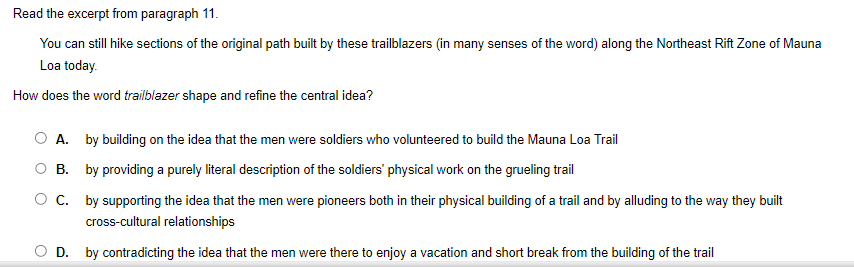
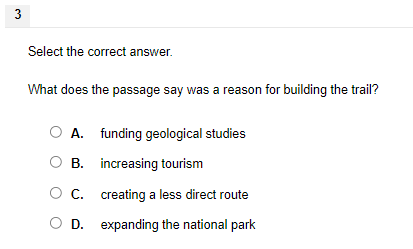
Here is the questions and passage (1) The 25th Infantry, comprised of about 850 enlisted men and officers, arrived in Honolulu on January 14, 1913. The morning after their arrival they began a two-day, twenty-three-mile march to Schofield Barracks where they were stationed until 1917. (2) Newspaper articles describe how the soldiers were viewed by Hawai'i’s multicultural society--although they did not encounter the racial hatred that they had from communities on the mainland, they did not entirely escape prejudice here. The black troops remained segregated from their white counterparts. (3) Positive cross-cultural relationships began as the troops marched in local parades and competed with civilian sports leagues in track and field and baseball. They were perhaps best known for their baseball prowess. Stories about their winning baseball team, the "Wreckers," were published in the Honolulu newspapers. . . . (4) Two names familiar in the history of Hawai'i Volcanoes National Park are businessman Lorrin Thurston and geologist Thomas Jaggar. They had three goals: To create a place to study live volcanoes (Hawaiian Volcano Observatory established in 1912) To build a place for soldiers stationed in Hawai'i for rest and recreation (Kīlauea Military Camp established in 1916) To develop a national park (Hawaii National Park established in 1916, formally opened in 1921) (5) Jaggar, new head of the observatory, described Mauna Loa, the large, rounded shield volcano that makes up more than half of Hawai'i Island as, "... a vast desert waste without water and rising to an immense height. Every expedition to the summit exhausts the energies of the men and animals employed and the animals are frequently crippled and have their legs cut through by the rough black lava. Consequently the ranchers will not rent good animals at any price and as there is no shelter on the summit, little water, no feed, violent winds and low temperatures, the men who can with difficulty be induced to go and act as guides or packers object to remaining overnight." (6) He wanted an easier route than the traditional one through 'Āinapō for geologists to access the 13,677-foot summit of Mauna Loa. Thurston was promoting the idea of a national park at Kīlauea and saw a trail to the Mauna Loa summit as an opportunity for expanded tourism. The idea for the Mauna Loa Trail was born. (7) Under the headline, "Soldiers Building Mountain Trail," the Maui News reported, "Soldiers of the Twenty-fifth Infantry to the number of 150 are at work constructing a trail from near the Volcano House to the summit of Mauna Loa. It is estimated that three or four weeks will be devoted to this work. The soldiers are doing the work as a part of their vacation exercises. . . ." (8) Building the trail was incredibly hard work and conditions were primitive. Their only tools were 12-pound sledgehammers and gunny sacks. They worked in record-breaking rain, cold weather, very thin air and on difficult terrain . . . . They camped in canvas tents which did not offer much protection during the cold, rainy nights and they did not have mules or horses to help with carrying the heavy loads. The pāhoehoe flows were often thin and brittle and could break under the weight of men or animals making it necessary to break through this lava to a more solid surface. On the a'ā flows they broke up the clinkers into gravel-sized pieces, mixed this with soil and then packed this in gunnysacks carried on their backs to pave the trail. (9) They were not only trail builders: while at base camp they also helped the geologists with their experiments, including measuring the depth of molten lava with a long iron pipe. The Hawaiian Gazette quotes Schuyler who had been part of this measuring crew, "When that pipe came up, the lava on the end of it was thick like glue." (10) The bad weather and adverse conditions also didn’t stop the soldiers from traveling down to Hilo for a game of baseball in October 1915, where they defeated the local team! (11) While on Hawai'i Island these soldiers built a 30-mile trail under gruelling conditions, won a baseball game, and suffered through record-breaking weather--surely a one-of-a-kind Hawaiian "vacation." This early trail ultimately paved the way for the present Mauna Loa Trail. You can still hike sections of the original path built by these trailblazers (in many senses of the word) along the Northeast Rift Zone of Mauna Loa today. Over a century later their handiwork is still visible and guides park visitors through rugged, unforgiving terrain.


 Arieonna:
the first pic is either B or D probably D thoe hope i am right the second one is C i believe the third one is probably D and the 4th one is definition 2 i hope they are correct
Arieonna:
@oliver69 hope i help and hope there correct
OLIVER69:
Join our real-time social learning platform and learn together with your friends!
 VERNEISH:
Two objects are moving along separate linear paths where each path is described by position, d, and time, t.
VERNEISH:
Two objects are moving along separate linear paths where each path is described by position, d, and time, t.

 Maci:
what are the best stock apps for people who want to start investing?
Maci:
what are the best stock apps for people who want to start investing?
 Twaylor:
genuienly how do i get better self control i keep watcing youtube and theres this
Twaylor:
genuienly how do i get better self control i keep watcing youtube and theres this
 IzzyCookie:
|dw:1792074056138:dw| Uhm, I don't know where to ask this, but I'm in college welding at my community college, and I need help learning vertical welding for
IzzyCookie:
|dw:1792074056138:dw| Uhm, I don't know where to ask this, but I'm in college welding at my community college, and I need help learning vertical welding for

 thehearken:
not sure if this is considered spam, im sorry if it is, but does anyone have tips
thehearken:
not sure if this is considered spam, im sorry if it is, but does anyone have tips