
 NicholasHen1615:
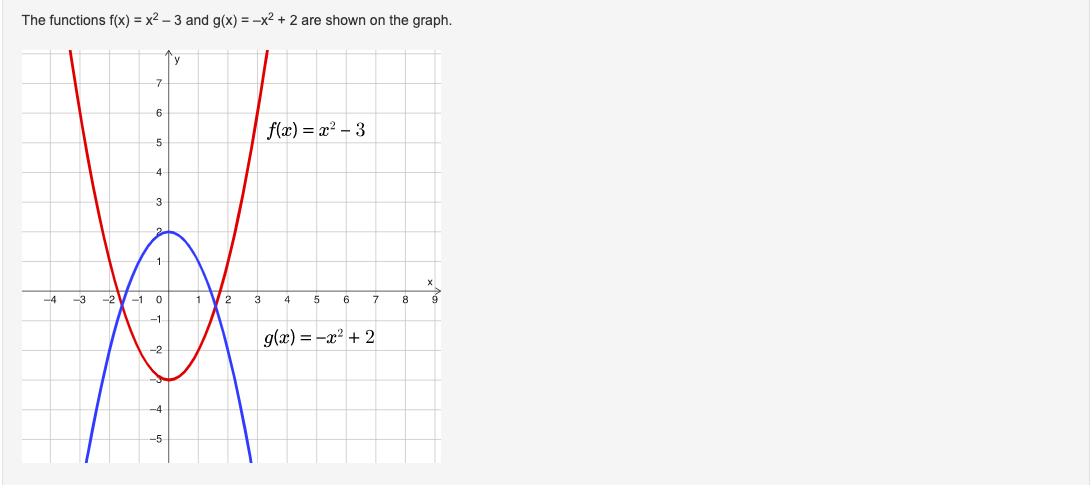
Algebra 2: The functions f(x) = x2 – 3 and g(x) = –x2 + 2 are shown on the graph. The graph shows f of x equals x squared minus 3, which is an upward opening parabola with a vertex at 0 comma negative 3 and a point at negative 1 comma negative 2 and a point at 1 comma negative 2. The graph also shows g of x, which is a downward opening parabola with a vertex at 0 comma 2 and a point at negative 1 comma 1 and a point at 1 comma 1. Explain how to modify the graphs of f(x) and g(x) to graph the solution set to the following system of inequalities. How can the solution set be identified? y ≤ x2 – 3 y > –x2 + 2

 grezzyy:
The set of inequalities y ≤ x² - 3 and y > -x² + 2 do not have a solution we have: f(x) = x² - 3 g(x) = -x² + 2 Next, we change the equations to inequalities as y ≤ x² - 3 y > -x² + 2 To modify the graph, we then perform the following transformations: Shift the function g(x) down by 2 units Reflect across the x-axis Shift the function g(x) down by 3 units After the modifications in (a), we have: y ≤ x² - 3 and y > -x² + 2 Next, we plot the graph of the inequalities From the graph of the inequalities, the curves of the inequalities have no point of intersection Hence, the set of inequalities do not have a solution
NicholasHen1615:
Alright, Thank you! u up for one more?
grezzyy:
ight
 NicholasHen1615:
Thx
grezzyy:
The f(x) has a degree of 1, hence it is linear in nature while g(x) is a polynomial function because of the third degree. The key features that they have in common are the y-intercept, domain, and range Linear and quadratic equations Linear equations are equations that has a degree of 1 while polynomial equations are equations that has a degree of 2 and above. Given the following functions f(x) = –4x + 5 and; g(x) = x^3 + x^2 – 4x + 5 Since the f(x) has a degree of 1, hence it is linear in nature while g(x) is a polynomial function because of the third degree. The key features that they have in common are the y-intercept, domain and range
NicholasHen1615:
Thank you. And to let you know the first one was wrong :(
grezzyy:
damn
NicholasHen1615:
thx though.
NicholasHen1615:
second one seems right though
NicholasHen1615:
That one was wrong to. :(
Join our real-time social learning platform and learn together with your friends!
 DoltonCarlee:
what are y'all's options on S A T essays because honestly their not that bad
DoltonCarlee:
what are y'all's options on S A T essays because honestly their not that bad

 thereneelg:
Can someone give me a summary of article 231, The war guilt clause?? I need to explain what it is, but I can't find any shortened version of what it is and
thereneelg:
Can someone give me a summary of article 231, The war guilt clause?? I need to explain what it is, but I can't find any shortened version of what it is and
 luisaam2:
What should you do when the person you want to talk to the most is the one making
luisaam2:
What should you do when the person you want to talk to the most is the one making
 Breathless:
https://medal.tv/games/roblox/clips/nAYivIl6oXB6q9QAI?invite=cr-MSxCSk4sMTY4OTA4N
Breathless:
https://medal.tv/games/roblox/clips/nAYivIl6oXB6q9QAI?invite=cr-MSxCSk4sMTY4OTA4N
 Twaylor:
I'm not that good at law can someone fact check this without bias? June 29, 2026, the Supreme Court decided Chatrie v.
Twaylor:
I'm not that good at law can someone fact check this without bias? June 29, 2026, the Supreme Court decided Chatrie v.
 Demon25:
For a hoco proposal with a cheerleader and football player, what else should be a
Demon25:
For a hoco proposal with a cheerleader and football player, what else should be a
