
 martai:
Help 🧍🏾♂️
 PureSoulless:
are you fr rn
PureSoulless:
or am I dumb
PureSoulless:
Am I not allowed to say answers again?
 umm:
umm:
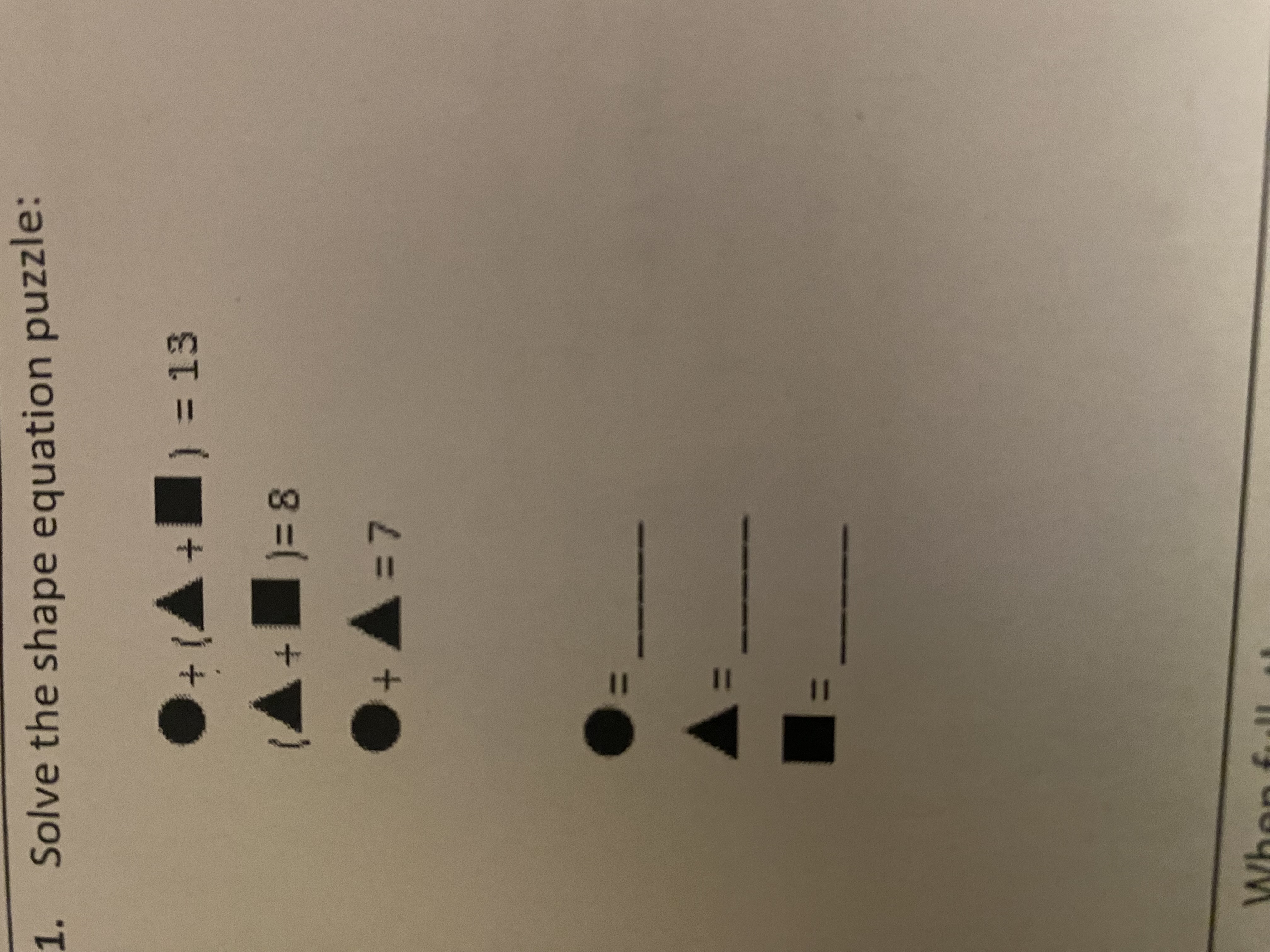
How I ended up solving this was using PEMDAS. P • Parentheses • Example: (4+4) E • Exponents • Example: 8⁶ M • Multiplication • 4x4 D • Division • 8÷6 A • Addition • 7+9 S • Subtraction • 8-9 〇 + (△+ ▢)=13 (△+ ▢)=8 〇+△=7 If 〇+(△+ ▢)=13 and we begin doing our parentheses, we’d start out given our first hint of (△+ ▢)=8. Continuing on, we’ll take clues of 〇+(△+ ▢)=13 and (△+ ▢)=8; or easier as 13-8= which is 13-8=5 letting us know 〇=5. If we carry this method on with the rest of our problems of 〇+△=7, we know know 〇=5, leaving us with △=2. So therefore, 5+2=7. Then our triangle which is 2+▢= knowing we’ve figured out the rest of our problem, it’d be 6. Therefore, 〇=5 △=2 ▢=6 In order to make sure our choices are correct from our first provided hint which is 〇 + (△+ ▢)=13 we’ll solve it from our number choices. 5+(2+6) =5+(8) =5+8 =13
Join our real-time social learning platform and learn together with your friends!
 DoltonCarlee:
what are y'all's options on S A T essays because honestly their not that bad
DoltonCarlee:
what are y'all's options on S A T essays because honestly their not that bad

 thereneelg:
Can someone give me a summary of article 231, The war guilt clause?? I need to explain what it is, but I can't find any shortened version of what it is and
thereneelg:
Can someone give me a summary of article 231, The war guilt clause?? I need to explain what it is, but I can't find any shortened version of what it is and
 luisaam2:
What should you do when the person you want to talk to the most is the one making
luisaam2:
What should you do when the person you want to talk to the most is the one making
 Breathless:
https://medal.tv/games/roblox/clips/nAYivIl6oXB6q9QAI?invite=cr-MSxCSk4sMTY4OTA4N
Breathless:
https://medal.tv/games/roblox/clips/nAYivIl6oXB6q9QAI?invite=cr-MSxCSk4sMTY4OTA4N
 Twaylor:
I'm not that good at law can someone fact check this without bias? June 29, 2026, the Supreme Court decided Chatrie v.
Twaylor:
I'm not that good at law can someone fact check this without bias? June 29, 2026, the Supreme Court decided Chatrie v.
 Demon25:
For a hoco proposal with a cheerleader and football player, what else should be a
Demon25:
For a hoco proposal with a cheerleader and football player, what else should be a
