
 youandi12:
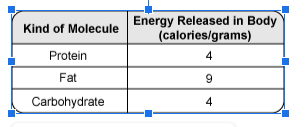
Macromolecules contain varying amounts of energy, as shown in the table below. Animals that hibernate in the winter require more fats in their diets. Fat will break down over a longer period of time than carbohydrates and allow the animal to survive the winter. Describe some other kinds of activities that would benefit the most from each molecule in the table.
 Alexis1415:
Let's first explain what they do and how they work : 1. Proteins are composed of amino acids monomers. Proteins are highly diverse in structure and function. 2. Carbohydrates are primarily used as a source of energy. They are composed of sugar molecules such as, 'monosaccharides'. Macromolecules, such as proteins, fats, and carbohydrates contain an abundant amount of energy in organisms. Proteins and carbohydrates release 4 calories per gram. While fats release 9 calories per gram. Which would mean FATS provide more energy.
Alexis1415:
To describe some other activities that would benefit animals that hibernate in the winter that require more fats in their diet, - Gathering food reserves - Creating nests and/or burrows - Adjust body temp to their metabolism - Store fat reserves
Join our real-time social learning platform and learn together with your friends!
 DoltonCarlee:
what are y'all's options on S A T essays because honestly their not that bad
DoltonCarlee:
what are y'all's options on S A T essays because honestly their not that bad

 thereneelg:
Can someone give me a summary of article 231, The war guilt clause?? I need to explain what it is, but I can't find any shortened version of what it is and
thereneelg:
Can someone give me a summary of article 231, The war guilt clause?? I need to explain what it is, but I can't find any shortened version of what it is and
 luisaam2:
What should you do when the person you want to talk to the most is the one making
luisaam2:
What should you do when the person you want to talk to the most is the one making
 Breathless:
https://medal.tv/games/roblox/clips/nAYivIl6oXB6q9QAI?invite=cr-MSxCSk4sMTY4OTA4N
Breathless:
https://medal.tv/games/roblox/clips/nAYivIl6oXB6q9QAI?invite=cr-MSxCSk4sMTY4OTA4N
 Twaylor:
I'm not that good at law can someone fact check this without bias? June 29, 2026, the Supreme Court decided Chatrie v.
Twaylor:
I'm not that good at law can someone fact check this without bias? June 29, 2026, the Supreme Court decided Chatrie v.
 Demon25:
For a hoco proposal with a cheerleader and football player, what else should be a
Demon25:
For a hoco proposal with a cheerleader and football player, what else should be a
