
 KarmaXD:
help please
 KarmaXD:
@toga
 whyjustwhy:
snakes
 Bones:
 uicornarts:
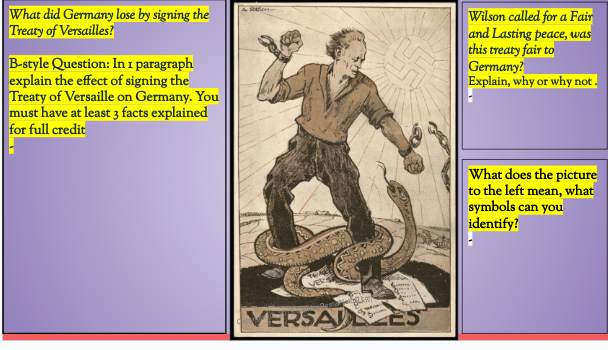
The Treaty of Versailles, signed in 1919, had significant consequences for Germany, leading to economic, territorial, and military losses. Firstly, Germany was required to cede about 13% of its territory, including regions like Alsace-Lorraine to France and parts of Prussia to Poland, which not only reduced its land size but also stripped it of valuable resources. Secondly, the treaty imposed heavy reparations, demanding that Germany pay large sums of money to the Allied powers, contributing to a severe economic crisis and hyperinflation in the years following the war. Lastly, the military restrictions included limiting the German army to 100,000 troops, prohibiting tanks and an air force, and demilitarizing the Rhineland, which weakened Germany’s defense capabilities and national pride. In terms of fairness, many argue that the Treaty of Versailles was not fair to Germany. While President Woodrow Wilson advocated for a fair and lasting peace, the punitive measures placed on Germany were seen as excessively harsh and humiliating. This created significant resentment among the German populace and laid the groundwork for future conflicts, including World War II.
Join our real-time social learning platform and learn together with your friends!
 DoltonCarlee:
what are y'all's options on S A T essays because honestly their not that bad
DoltonCarlee:
what are y'all's options on S A T essays because honestly their not that bad

 thereneelg:
Can someone give me a summary of article 231, The war guilt clause?? I need to explain what it is, but I can't find any shortened version of what it is and
thereneelg:
Can someone give me a summary of article 231, The war guilt clause?? I need to explain what it is, but I can't find any shortened version of what it is and
 luisaam2:
What should you do when the person you want to talk to the most is the one making
luisaam2:
What should you do when the person you want to talk to the most is the one making
 Breathless:
https://medal.tv/games/roblox/clips/nAYivIl6oXB6q9QAI?invite=cr-MSxCSk4sMTY4OTA4N
Breathless:
https://medal.tv/games/roblox/clips/nAYivIl6oXB6q9QAI?invite=cr-MSxCSk4sMTY4OTA4N
 Twaylor:
I'm not that good at law can someone fact check this without bias? June 29, 2026, the Supreme Court decided Chatrie v.
Twaylor:
I'm not that good at law can someone fact check this without bias? June 29, 2026, the Supreme Court decided Chatrie v.
 Demon25:
For a hoco proposal with a cheerleader and football player, what else should be a
Demon25:
For a hoco proposal with a cheerleader and football player, what else should be a
