
 randogirl123:
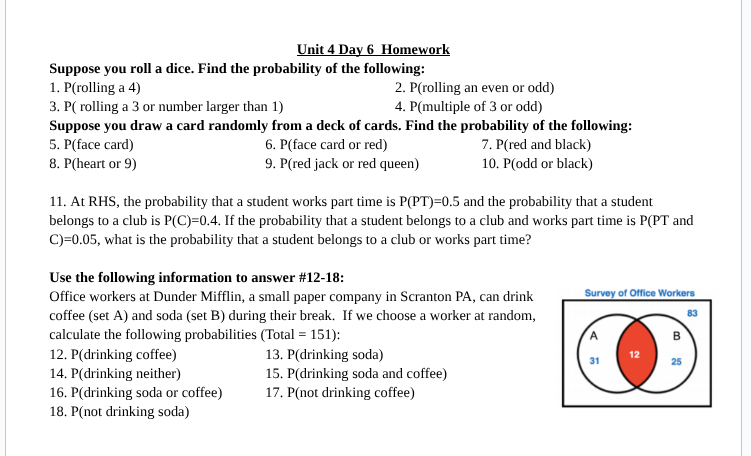
Does anyone know how Adding Probablity works?? I need helppp
 tax:
tax:
What's the problem?
tax:
@randogirl123
randogirl123:
tax:
randogirl123:
this is my homework from the day I was one and so the teacher explained it but I am confused how it works
 heymon3y:
To add probabilities, you use the Addition Rule: P(A or B) = P(A) + P(B) for events that can't happen together (mutually exclusive), or P(A or B) = P(A) + P(B) - P(A and B) for events that can overlap, subtracting the overlap to avoid double-counting, which is essential for "or" scenarios like rolling a die and getting an even number or a multiple of 3.
randogirl123:
tax:
heymon3y:
Yep
heymon3y:
Google helps for a lot ngl
randogirl123:
Google don't help
heymon3y:
oh dear?
randogirl123:
I've done research and it gets confusing and confusing
heymon3y:
well watch a video? that kinda helps me
tax:
Well this is the formula $$P(A \text{ or } B) = P(A) + P(B)$$
tax:
I can do one of them for you
heymon3y:
what a great teacher
randogirl123:
randogirl123:
tax:
randogirl123:
tax:
Probability of working part-time: P(PT) = 0.5 Probability of belonging to a club: P(C) = 0.4 Probability of both (the overlap): P(PT and C) = 0.05 Now we're gonna use this formula: $$P(PT \text{ or } C) = P(PT) + P(C) - P(PT \text{ and } C)$$ Then we'll plug in the numbers to the equation: $$P(PT \text{ or } C) = 0.5 + 0.4 - 0.05$$$$P(PT \text{ or } C) = 0.9 - 0.05$$$$P(PT \text{ or } C) = 0.85$$ Then, 0.85 (or 85%) will be your final answer
 tax:
tax:
Sorry this was so long :sob:
randogirl123:
oooo hmm
randogirl123:
it kinda makes sense
tax:
randogirl123:
tax:
Lemme take a look rq
randogirl123:
ok
randogirl123:
u still typing ;-;
tax:
So we know that there's 6 sides on a die, so there will be a total of 6 possible outcomes For #1 since we know that there's only one "4" on a standard dice we can tell that the Successful Outcome would be {4} and the result would be 1/6. For #2 the numbers are either even or odd because every number falls into one of the two categories: Even: 3/6 Odd: 3/6 Calculation: 3/6 + 3/6 = 6/6 = 1 So for this one the result would be 1 or a 100% chance For #3 since "3" is larger than one, we can avoid double-counting by listing the unique values: Rolling a 3: {3} Numbers larger than one: {2,3,4,5,6} Unique set: {2,3,4,5,6} Result: 5/6 For #4 we're going to do the same thing like the others, which is putting everything in a separate category: Multiples of 3: {3,6} Odd numbers: {1,3,5} The overlap: 3, because it's in both lists Calculation using the addition rule: P(mult of 3) + P(odd) - P(both) 2/6 + 3/6 - 1/6 = 4/6 (simplified to 2/3) Final answers: 1. 1/6 2. 1 3. 5/6 4. 2/3
tax:
randogirl123:
randogirl123:
more helppp
Join our real-time social learning platform and learn together with your friends!
 VERNEISH:
Two objects are moving along separate linear paths where each path is described by position, d, and time, t.
VERNEISH:
Two objects are moving along separate linear paths where each path is described by position, d, and time, t.

 Maci:
what are the best stock apps for people who want to start investing?
Maci:
what are the best stock apps for people who want to start investing?
 Twaylor:
genuienly how do i get better self control i keep watcing youtube and theres this
Twaylor:
genuienly how do i get better self control i keep watcing youtube and theres this
 IzzyCookie:
|dw:1792074056138:dw| Uhm, I don't know where to ask this, but I'm in college welding at my community college, and I need help learning vertical welding for
IzzyCookie:
|dw:1792074056138:dw| Uhm, I don't know where to ask this, but I'm in college welding at my community college, and I need help learning vertical welding for

 thehearken:
not sure if this is considered spam, im sorry if it is, but does anyone have tips
thehearken:
not sure if this is considered spam, im sorry if it is, but does anyone have tips