
 randogirl123:
More helppp
 tax:
tax:
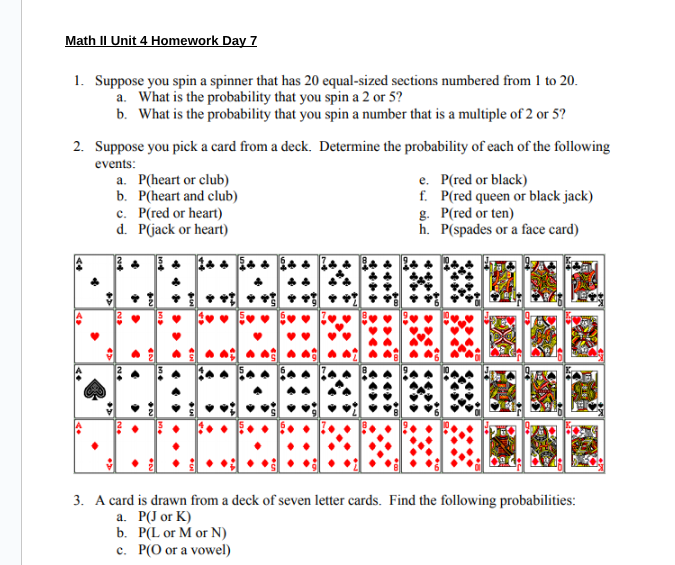
1. So the total number of outcomes is 20. a. P(2 or 5): There are 2 favorable outcomes {2, 5}... so P = 2/20 = 1/10 b. Multiples of 2: {2, 4, 6, 8, 10, 12, 14, 16 18, 20} these are the 10 numbers Multiples of 5: {5, 10, 15, 20} these are the 4 numbers (SINCE 12 AND 20 ARE IN BOTH LISTS, WE ONLY COUNT THEM ONCE) Unique outcomes: {2, 4, 5, 6, 8, 10, 12, 14, 15, 16, 18, 20} these are the 12 numbers So your final result is P = 12/20 = 3/5 2. So a standard card deck has 13 cards of each suit a. P(heart or club): 13 hearts + 13 clubs = 26 cards. P = 26/52 = 1/2 b. P(heart and club): A single card cannot be two suits at once. P = 0/52 = 0 c. P(red or heart): All hearts are already red. So this is just the total number of red cards, which is 26. P = 26/52 = 1/2 d. P(jack or heart): 13 hearts + 3 other jacks.P = 16/52 = 4/13 e. P(red or black): Every card is either red or black. 52/52 = 1 f. P(red queen or black jack): 2 red queens + 2 black jacks = 4 cards. 4/52 = 1/13 g. P(red or ten): 26 red cards + 2 black tens. P = 28/52 = 7/13 h. P(spades or a face card): 13 spades + 9 face cards from the other suits. P = 22/52 = 11/26 3. So the total number of cards is 7 a. P(J or K): 2 favorable outcomes ({J, K}). So P would = 2/7 b. P(L or M or N): 3 favorable outcomes ({L, M, N}). So P would = 3/7 c. P(O or a vowel): In this set, "O" is the only vowel. So P would = 1/7
randogirl123:
and 4 and 5?
tax:
tax:
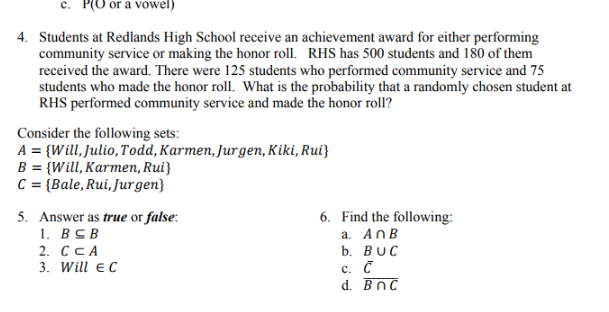
For #4: To find the number of students who did both (community service AND honor roll), we use the Inclusion-Exclusion Principle formula: First we're gonna identify the given values: Total students (N): 500 Students with award (A U B): 180 Community Service (A): 125 Honor Roll (B): 75 Now we're going to solve for the overlap: 180 = 125 + 75 - Both 180 = 200 - Both Both = 200 - 180 = 20 Now we're going to calculate the probability: P(Both) = 20/500 = 2/50 = 0.04 (or 4%) For #5: 1. True: Every set is a subset of itself. 2. False: While Rui and Jurgen are in A, Bale is not in set A. Therefore, C is not a subset of A. 3. False: Will is in sets A and B, but he is not listed in set C. For #6: 1. Since every person in $B$ is also in $A$, the intersection is just set B {Will, Karmen, Rui} 2. Combine all names from both lists, removing duplicates (Rui appears in both): {Will, Karmen, Rui, Bale, Jurgen} 3. Assuming set A (or the combination of all named students) is the universal set, we list the names in A that are not in C: {Will, Julio, Todd, Karmen, Kiki} 4. First, find B ∩ C: Only {Rui} is in both.The complement is everything in the group except Rui. {Will, Julio, Todd, Karmen, Jurgen, Kiki, Bale}
tax:
@randogirl123
 jhaseker:
u lost me
tax:
tax:
@randogirl123 hope that helped
jhaseker:
I do astronomy and I got so lost n math
tax:
Join our real-time social learning platform and learn together with your friends!
 VERNEISH:
Two objects are moving along separate linear paths where each path is described by position, d, and time, t.
VERNEISH:
Two objects are moving along separate linear paths where each path is described by position, d, and time, t.

 Maci:
what are the best stock apps for people who want to start investing?
Maci:
what are the best stock apps for people who want to start investing?
 Twaylor:
genuienly how do i get better self control i keep watcing youtube and theres this
Twaylor:
genuienly how do i get better self control i keep watcing youtube and theres this
 IzzyCookie:
|dw:1792074056138:dw| Uhm, I don't know where to ask this, but I'm in college welding at my community college, and I need help learning vertical welding for
IzzyCookie:
|dw:1792074056138:dw| Uhm, I don't know where to ask this, but I'm in college welding at my community college, and I need help learning vertical welding for

 thehearken:
not sure if this is considered spam, im sorry if it is, but does anyone have tips
thehearken:
not sure if this is considered spam, im sorry if it is, but does anyone have tips