
 Tutorials:
The Unit Circle Tutorial Creator of Tutorial: BloomLocke367
Tutorials:
This first two things you must understand before delving into \(\large\color{navy}{\mathbb{{The~Unit~Circle}}}\), is the \(\large\mathbb{\color{red}{Pythagorean~ Theorem}}\) and the use of \(\large\mathbb{\color{hotpink}{Sine}}\), \(\large\mathbb{\color{lime}{Cosine}}\), and \(\large\mathbb{\color{teal}{Tangent}}\). \(\large\bf\color{cornflowerblue}{(SohCahToa)}\)
Tutorials:
\(\huge\mathbb{\color{red}{The~Pythagorean~Theorem:}}\) If you are familiar with trigonometry and right triangles, this should be easy for you. When you have a \(\bf\color{#FF4000}{right ~triangle}\), a triangle with a \(\bf\color{#FF4000}{90° angle}\), there are two legs and a hypotenuse (the longest side to the triangle). We'll call the first leg \(\color{green}{a}\), the second leg \(\color{orange}{b}\), and the hypotenuse \(\color{blue}{c}\). To solve for a side-length, you use the \(\large\mathbb{\color{red}{Pythagorean~ Theorem}}\), which is: \(\huge \color{green}{a}^2\LARGE +\huge\color{orange}{b}^2\LARGE =\huge\color{blue}{c}^2\) All you have to do is plug in your given values and solve for the missing variable.
Tutorials:
\(\bf\huge\color{cornflowerblue}{SOHCAHTOA:}\) \(\large\mathbb{\color{hotpink}{Sine}}\theta =\color{hotpink}{\frac{\color{hotpink}{opposite}}{hypotenuse}}\) \(\large\mathbb{\color{lime}{Cosine}}\theta =\color{lime}{\frac{adjacent}{hypotenuse}}\) \(\large\mathbb{\color{teal}{Tangent}}\theta =\color{teal} {\frac{opposite}{adjacent}}\) The \(\color{blue}{\underline{ hypotenuse}}\) is the longest side. The \(\color{red}{\underline{ adjacent}}\) side is the side length that is next to the given angle (\(\theta\)). The \(\color{green}{\underline{opposite}}\) side is the side length that is across from the given angle (\(\theta\)).
Tutorials:
It is also important that you know how to measure your angles in radians, and how to convert from degrees to radians, and vice versa. \(\large 360°=2\pi~ radians\) \(~~~~~~~or\) \(\large 180°=\pi~radians\)
Tutorials:
To convert from degrees to radians, you must take the angle in degrees and multiply it by \(\Large\frac{\pi}{180}\). \(\Large\bf Radians=\theta\times \LARGE \frac{\pi}{180}\) For example, if \(\Large\theta=180°\), you plug 180 in for theta. \(\LARGE\bf 180°\times\frac{\pi}{180}=\pi~radians\)
Tutorials:
Now, we can move onto the \(\Large\mathbb{\color{navy}{Unit~Circle}}\).
It is called the unit circle because it has a radius of 1 and is centered at the origin (0,0). It also follows the equation \(\large x^2+y^2=1\)
 let r=1 in this, as we already know the radius is 1.
Given what I told you earlier about \(\bf\color{cornflowerblue}{SOHCAHTOA}\), you know that \(\bf\large\color{hotpink}{sin}\theta=\color{hotpink}{\frac{opposite}{hypotenuse}}\) and \(\bf\large\color{lime}{cos}\theta=\color{lime}{\frac{adjacent}{hypotenuse}}\) .
Given this, you know that
\(\bf\large\color{hotpink}{sin}\theta=\color{hotpink}{\frac{y}{1}}=\color{hotpink}{y}\)
and
\(\bf\large\color{lime}{cos}\theta=\color{lime}{\frac{x}{1}}=\color{lime}{x}\)
let r=1 in this, as we already know the radius is 1.
Given what I told you earlier about \(\bf\color{cornflowerblue}{SOHCAHTOA}\), you know that \(\bf\large\color{hotpink}{sin}\theta=\color{hotpink}{\frac{opposite}{hypotenuse}}\) and \(\bf\large\color{lime}{cos}\theta=\color{lime}{\frac{adjacent}{hypotenuse}}\) .
Given this, you know that
\(\bf\large\color{hotpink}{sin}\theta=\color{hotpink}{\frac{y}{1}}=\color{hotpink}{y}\)
and
\(\bf\large\color{lime}{cos}\theta=\color{lime}{\frac{x}{1}}=\color{lime}{x}\)
Tutorials:
From this, you can construct the unit circle.
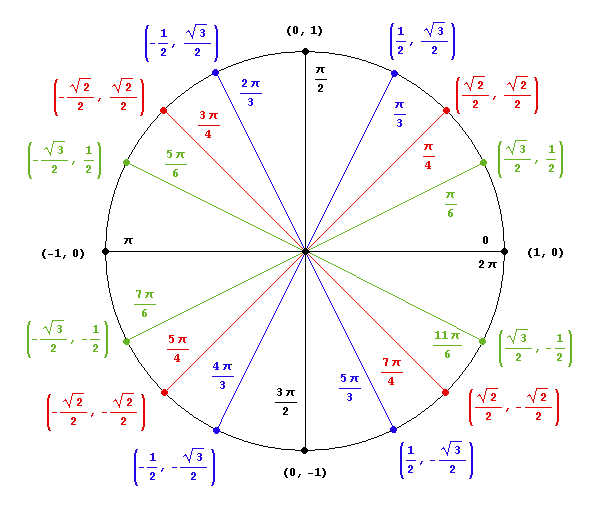
The unit circle has key points at 0°, 30°, 45°, 60°, 90°, 120°, 135°, 150°, 180°, 210°, 225°, 240°, 270°, 300°, 315°, 330°, and 360°--as shown below
 \(\bf **Notice: ~There ~is~ a~ pattern ~with ~the~ angle~ measures.\\ Add~ 30,~ 15, ~15, ~30~ and~ repeat**\)
You can use what I said earlier, and convert the angles to radians. You can also use Sine and Cosine to compute the find the coordinates on the circle at those angles.
\(\bf **Notice: ~There ~is~ a~ pattern ~with ~the~ angle~ measures.\\ Add~ 30,~ 15, ~15, ~30~ and~ repeat**\)
You can use what I said earlier, and convert the angles to radians. You can also use Sine and Cosine to compute the find the coordinates on the circle at those angles.
Tutorials:
After you do that, you will get this--the Unit Circle:
 Remember:
\(\bf\color{hotpink}{sin\theta=y}\) and \(\bf\color{lime}{cos\theta=x}\).. You can check this by using the coordinates on the circle.
Remember:
\(\bf\color{hotpink}{sin\theta=y}\) and \(\bf\color{lime}{cos\theta=x}\).. You can check this by using the coordinates on the circle.
Tutorials:
It is also helpful to know that \(\bf\color{teal}{tangent=\Large \frac{\color{hotpink}{sin}}{\color{lime}{cos}}\normalsize=\Large \frac{\color{hotpink}{y}}{\color{lime}{x}}}\). That's really all there is to the unit circle! I may add a part 2 with more advanced information in the future.
Join our real-time social learning platform and learn together with your friends!
 VERNEISH:
Two objects are moving along separate linear paths where each path is described by position, d, and time, t.
VERNEISH:
Two objects are moving along separate linear paths where each path is described by position, d, and time, t.

 Maci:
what are the best stock apps for people who want to start investing?
Maci:
what are the best stock apps for people who want to start investing?
 Twaylor:
genuienly how do i get better self control i keep watcing youtube and theres this
Twaylor:
genuienly how do i get better self control i keep watcing youtube and theres this
 IzzyCookie:
|dw:1792074056138:dw| Uhm, I don't know where to ask this, but I'm in college welding at my community college, and I need help learning vertical welding for
IzzyCookie:
|dw:1792074056138:dw| Uhm, I don't know where to ask this, but I'm in college welding at my community college, and I need help learning vertical welding for

 thehearken:
not sure if this is considered spam, im sorry if it is, but does anyone have tips
thehearken:
not sure if this is considered spam, im sorry if it is, but does anyone have tips