
 Nnesha:
Series
Nnesha:
\[y_1(x)=4+\frac{4}{8}x^2+\frac{4}{4\cdot 4\cdot 3}x^4+\frac{24 \cdot 4}{4\cdot 4\cdot 3\cdot 5\cdot6}x^6\] i have to write the sigma notation of ^the series
 Ultrilliam:
Tagging doesnt work in the question... Remind me to fix that
Nnesha:
they are not online so doesn't matter lol
Ultrilliam:
Yea but if the haven't disabled notifications they would receive a email lol
 ThisGirlPretty:
@Vocaloid Help Help Help pleaseeeee D:
 Vocaloid:
I'm not sure, I believe if you start n at 0 you can write the x part as x^2n but I'm uncertain about the coefficients @hero
Nnesha:
yeah i'm also confused about the numbers.
Nnesha:
\[=\large\rm \frac{4}{1!}+\frac{4}{4\cdot 2!} x^2+\frac{4}{4 \cdot 2 \cdot 3!}x^4+\frac{ 24 \cdot4 }{ 4!\cdot 2\cdot 6\cdot 5}x^6\]
 Hero:
Hero:
Thanks for the update. The original post was not making any sense at all.
Nnesha:
It's same as the top post.
Hero:
The top post does not have factorials
Nnesha:
We can't write this as sigma notation, so good thing i don't have to simplify anymore..
Nnesha:
yeah I've simplified to see the pattern but didn't work out.
Hero:
What did you simplify it to?
Nnesha:
the 2nd one.
Hero:
You can simplify it even further than that
Nnesha:
do you mean reducing fractions? yeah but i meant to say that i don't have to see the pattern. I just need the terms as final solution.
Hero:
Yes, reducing the fractions.
Nnesha:
i'll definitely do that :=))
Hero:
Post your result
Nnesha:
result ?
Hero:
Yes, post the expression you get after reducing the fractions.
Nnesha:
lol ok sir
Nnesha:
\[y(x)= 4+2x^2+12x^4+\frac{2}{90}x^6\]
Hero:
I got completely different coefficients
Nnesha:
sorry 1/45
Hero:
Even still
Nnesha:
show me your work.
Hero:
\(\dfrac{4}{4 \cdot 2!} = \dfrac{4}{4 \cdot2\cdot1} = \dfrac{4}{4} \times \dfrac{1}{2 \cdot 1}\)
Hero:
For example
Nnesha:
\[\frac{ 2\cancel{4} \cdot \cancel{ 4 }}{ \cancel{4} \cdot cancel{4} \cdot 3\cdot 5\cdot 6 }\]
Hero:
Why'd you skip the first one?
Nnesha:
\[\frac{ 2\cancel{4} \cdot \cancel{4} }{ \cancel{4} \cdot \cancel{4} \cdot 3 \cdot 5 \cdot 6 }\]
Nnesha:
bec you're going to do it for me. thank you
Hero:
Yep, and you can still simplify even further.
Hero:
You should get fractional coefficients for all but the first term.
Nnesha:
\[\frac{ 2\cancel{4 }\cdot \cancel{4} }{\cancel{ 4} \cdot \cancel{4} \cdot 3 \cdot 5 \cdot 6 }= \frac{2}{90}=\frac{1}{45}\]
Hero:
Which term is that? You have to start from the beginning. I don't know which term that is.
Nnesha:
last one
Nnesha:
i start from right
Nnesha:
\[\frac{ 2\cancel{4 }\cdot \cancel{4} }{\cancel{ 4} \cdot \cancel{4} \cdot 3 \cdot 5 \cdot \color{Red}{\cancel{6}} }x^\color{Red}{\cancel{6}}= =\frac{2}{15}\]
Nnesha:
found a mistake sorry
Hero:
Of course you did.
Hero:
I don't feel like typing it all out to be honest.
Nnesha:
same
Nnesha:
just give me the answer
Hero:
Hang on
Nnesha:

Nnesha:
that's wrong ?? :o
Hero:
Where's the SIX in the numerator. Remember, originally, you had 24 * 4 in the numerator, right?
Nnesha:
yes 24 since 4 and 4 are the same so 4 cancels out
Hero:
And how are you cancelling the \(x^6\) term?
Hero:
Your work as currently constructed makes no sense.
Nnesha:
since 6 and 6 are alike, 6 cancels out
Hero:
You're cancelling exponents with coefficients. That doesn't make any sense.
Nnesha:
ohh i can't do that ??? hmm sorry
Hero:
NO, you definitely cannot do that.
Nnesha:
ohh okay don't yell at me still learning
Hero:
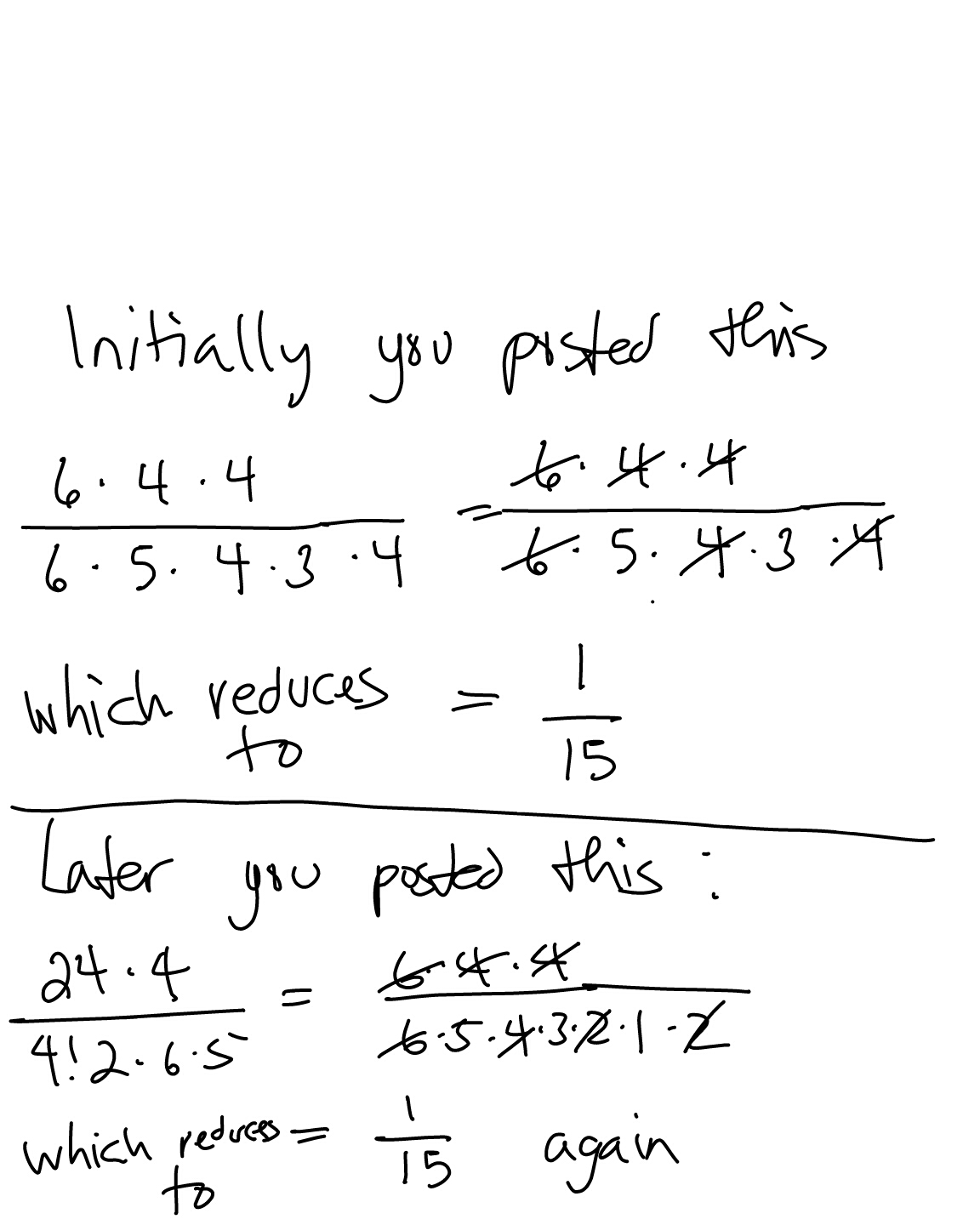
Hero:
As far as I know, that is correct.
Hero:
Unless your 24 isn't 24.
Hero:
Is 24 supposed to be TWENTY-FOUR? Or is it supposed to be 2 times 4?
Hero:
Is 24 supposed to be TWENTY-FOUR? Or is it supposed to be 2 times 4?
Nnesha:
yeah 24 is 24 or it can 42 right since ab=ba
Hero:
Because you have it written as TWENTY-FOUR not 2 times 4. Do you understand what I'm saying?
Nnesha:
yes sir
Hero:
If I interpret what you have written literally. \(24\) as you have written \(/ne\ 2 \times 4\) Do you understand?
Hero:
I'm gonna give up if you don't comprehend that you wrote 24 and not \(2 \times 4\)
Nnesha:
it's too wenty for
Nnesha:
i have to go thanks hero!!
Hero:
smh
Hero:
Good luck. You seem to confuse numbers at certain points. You have to work on that.
Nnesha:
lol
Nnesha:
i can't believe what i ended up doing
Hero:
@Nnesha perhaps try posting the problem from the original source itself.
Nnesha:

Join our real-time social learning platform and learn together with your friends!
 VERNEISH:
Two objects are moving along separate linear paths where each path is described by position, d, and time, t.
VERNEISH:
Two objects are moving along separate linear paths where each path is described by position, d, and time, t.

 Maci:
what are the best stock apps for people who want to start investing?
Maci:
what are the best stock apps for people who want to start investing?
 Twaylor:
genuienly how do i get better self control i keep watcing youtube and theres this
Twaylor:
genuienly how do i get better self control i keep watcing youtube and theres this
 IzzyCookie:
|dw:1792074056138:dw| Uhm, I don't know where to ask this, but I'm in college welding at my community college, and I need help learning vertical welding for
IzzyCookie:
|dw:1792074056138:dw| Uhm, I don't know where to ask this, but I'm in college welding at my community college, and I need help learning vertical welding for

 thehearken:
not sure if this is considered spam, im sorry if it is, but does anyone have tips
thehearken:
not sure if this is considered spam, im sorry if it is, but does anyone have tips