
 smithm29:
Advanced function
 smithm29:
ikr
 Vocaloid:
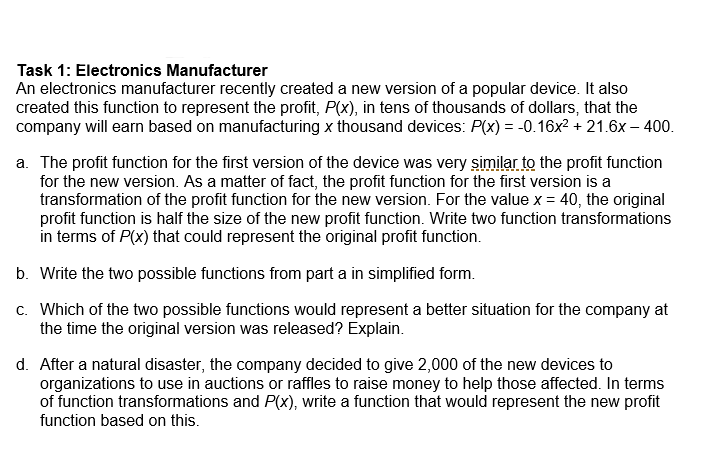
first step would be to substitute x = 40 into the new equation (-0.16x^2 + 21.6x - 400)
Vocaloid:
new = 208 so the old function has to equal 104
Vocaloid:
if P(x) = the new function then old = new/2 so old = (-0.16x^2 + 21.6x - 400)/2
smithm29:
ok
smithm29:
ok bc i cant figure it out at all... while u think im gonna take a quick shower and walk my neighbor home.
smithm29:
ok?
Vocaloid:
sure
smithm29:
ok thx
Vocaloid:
I guess we can set old = 104 = (-0.16x^2 + 21.6x - 400)/2 and simplify to get 208 = -0.16x^2 + 21.6x - 400 which simplifies to -0.16x^2 + 21.6x - 608
Vocaloid:
comparing that with P(x) = -0.16x^2 + 21.6x - 400 old = P(x) - 208
Vocaloid:
so for part a) I end up with two transformation functions, old = P(x)/2 and old = P(x) - 208?
Vocaloid:
and for part b) I would just plug in -0.16x^2 + 21.6x - 400 and simplify?
Vocaloid:
part d seems like a horizontal transformation by substituting x - 2 for x?
Vocaloid:
anyway to recap:
Vocaloid:
part a: function transformations in terms of P(x) old = P(x)/2 and old = P(x) - 208
Vocaloid:
part b: substituting P(x) = -0.16x^2 + 21.6x - 400 to get -0.08x^2 + 10.8x - 200 and -0.16x^2 + 21.6x - 608
 SmokeyBrown:
I think Froppy has the right idea for part a. If you want to verify that those functions work, you can plug (40) in for x, and you'll see that they equal 104 in both cases.
SmokeyBrown:
For part b, your first step to simplifying the quadratic equation would be to divide out the common coefficient for each element. We can take the first equation, -0.16x^2 + 21.6x - 608
SmokeyBrown:
If we divide each element by (-0.16) we are left with the equation -0.16(x^2 -135x +3800)
SmokeyBrown:
We can further simplify the binomial inside the parenthesis by observing that 95+40=135, and that 95*40=3800. The function can therefore be simplified as (x-95)(x-35). If you multiply these elements together using distribution, you will get the binomial above
SmokeyBrown:
Altogether, the simplified equation is -0.16(x-95)(x-40)
SmokeyBrown:
We can apply the same process to the second equation, P(x)= -0.08x^2 + 10.8x -200
Vocaloid:
should I do the factoring? we can factor out (-0.08) to get -0.08(x^2 -135x + 2500)
smithm29:
idk how to lol
SmokeyBrown:
So it looks like that's as far as we can simplify that equation. -0.08(x^2-135+2500) might be as far as we can go.
SmokeyBrown:
The way the question is phrased is a little confusing. "at the time the original version was released" doesn't really suggest any value of (x), other than, as Vocaloid suggested earlier, 0. We could take this to mean, before any units of the device have been produced or sold.
SmokeyBrown:
If we follow this reasoning, it's easy to see that -0.16x^2 + 21.6x - 608 will return a value of (-608) when x=0. Likewise -0.08x^2 +10.8x -200 will return a value of (-200) when x=0. Practically, you can think of this meaning that the fixed cost to start marketing the devices is either 608(thousand) dollars in one scenario and only 200(thousand) dollars in the other. In these terms, I think that the latter option is preferable, at least from the beginning.
Vocaloid:
so for part d am I right in my reasoning that, if 2,000 devices are given away, then we substitute (x-2) for x in the equation? :S
SmokeyBrown:
Yes, I agree with you there as well, Froppy. Since the functions are originally based on the costs and revenues for each thousand units produced and sold, giving up 2000 units would shift the equation to the right by 2 units. For the "new" function we are given at the outset, we would get P(x) = -0.16(x-2)^2 + 21.6(x-2) -400... which we can simplify to -0.16x^2 + 22.24x -443.84 by multiplying out all the factors. Feel free to substitute x for (x-2) with the other two equations to get the new profit functions for those.
Vocaloid:
it says to write it in terms of P(x) though
Vocaloid:
so if new profit function after donations = -0.16x^2 + 22.24x -443.84 and P(x) before donations = -0.16x^2 + 21.6x - 400, then:
Vocaloid:
new = 0.8x + P(x) - 43.84 (?)
SmokeyBrown:
So I took "in terms of function transformations and P(x)" to mean, "in the case of the original function and the transformed functions," not that the equation itself has to be written in terms of P(x). But that interpretation definitely makes sense too!
Vocaloid:
idk yours makes more sense mathematically
Vocaloid:
I would go with -0.16x^2 + 22.24x -443.84 for d
SmokeyBrown:
Oh, and I think we're meant to repeat the process for the "possible original" functions we found as well. That is, replacing (x) with (x-2) for the [-0.16x^2 + 21.6x - 608] version and the [0.08x^2 + 10.8x -200] version. It's a little extra work, but I believe you can do it.
Vocaloid:
@smithm29 it's a lot of algebra but it's just a substitution
Vocaloid:
-0.16x^2 + 21.6x - 608 we replace "x" with "x-2" whenever x shows up in the equation so we get: -0.16(x-2)^2 + 21.6(x-2) - 608 which you can further simplify using distribution
smithm29:
@Vocaloid my head hurts just looking at it lol
Vocaloid:
(x-2)^2 = (x-2)(x-2) = x^2 - 4x + 4
Vocaloid:
so we get: -0.16(x^2 - 4x + 4) + 21.6(x-2) - 608
 Vocaloid:
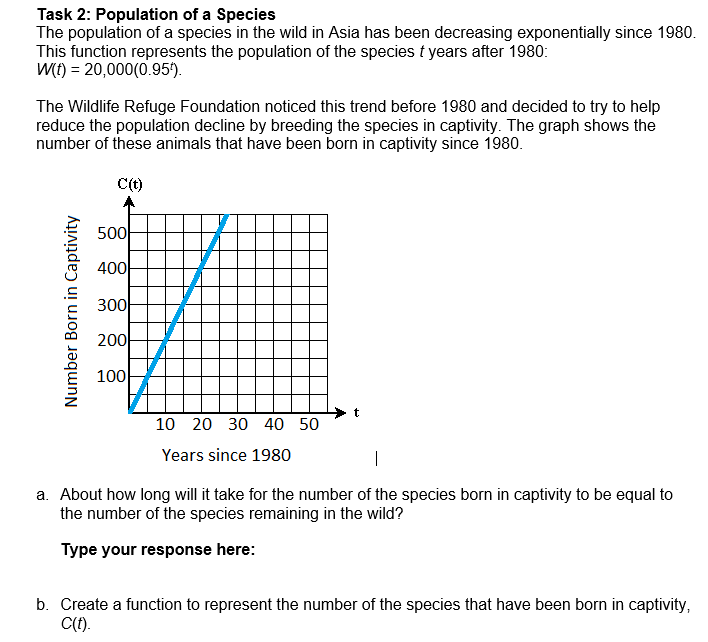
do you know how to write an equation for the blue line?
smithm29:
um would it be y=2x?
Vocaloid:
almost
Vocaloid:
if our "rise" is 100 for every 5 "run" then our slope should be 20 not 2
Vocaloid:
so if captivity born = remaining in wild then 20t = 20,000(0.95^t) then we can solve for t I would just use software for this tbh
Vocaloid:
so I end up with t = 56.144444 so I would just round to 56
Vocaloid:
(protip you can also type equations into WolframAlpha to solve them)
Vocaloid:
anyway, that's part a
Vocaloid:
we actually did part b, it should be C(t) = 20t
 Vocaloid:
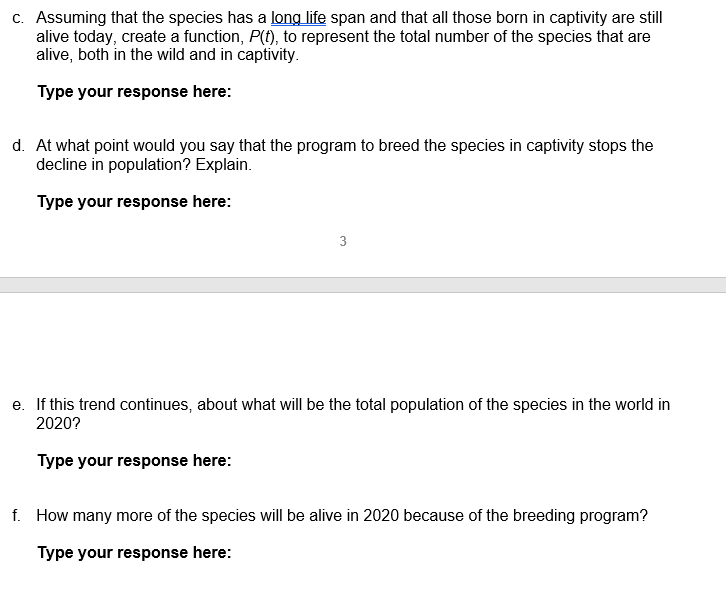
for part c we just add them together P(t) = 20t + 20,000(0.95^t)
Vocaloid:
for part d we already found out that captivity breeding = wild when t = about 56 yrs so I would say that for t > 56 years the breeding program stops the decline in population
Vocaloid:
for part e, since t = years since 1980 then 2020 - 1980 = 40 so we substitute t = 40 into the equation
Vocaloid:
if t = 40 then 20t + 20,000(0.95^t) = ?
Vocaloid:
(use a calc for this one)
smithm29:
as t?
Vocaloid:
wat
smithm29:
in the eq.
Vocaloid:
20t + 20,000(0.95^t) 20(40) + 20,000(0.95^40) = ?
smithm29:
what is The sum of 2ab2 and (-5ab2) is the same as the sum of (-6ab2) and ___?
Vocaloid:
we're not done with the other problem yet :S
smithm29:
the 2s at the end r _^2
smithm29:
ik but i skipped one earlier and its warning me
smithm29:
i dont wanna forget
Vocaloid:
2ab2 and (-5ab2) = (-6ab2) + x add 6ab^2 to both sides
Vocaloid:
2ab^2 - 5ab^2 + 6ab^2 = ?
smithm29:
3ab^2
Vocaloid:
good, that's your ans
smithm29:
and the one before that would be 2673
Vocaloid:
that's not what I got, check your calc
Vocaloid:
20(40) + 20,000(0.95^40) = ?
Vocaloid:
make sure you are hitting the exponent button not the multiplication button
smithm29:
got the same thing
Vocaloid:
ans should be about 3370
Vocaloid:
anyway for part e we just use our breeding equation C(t) = 20(t) = 20(40) = 800
Join our real-time social learning platform and learn together with your friends!
 VERNEISH:
Two objects are moving along separate linear paths where each path is described by position, d, and time, t.
VERNEISH:
Two objects are moving along separate linear paths where each path is described by position, d, and time, t.

 Maci:
what are the best stock apps for people who want to start investing?
Maci:
what are the best stock apps for people who want to start investing?
 Twaylor:
genuienly how do i get better self control i keep watcing youtube and theres this
Twaylor:
genuienly how do i get better self control i keep watcing youtube and theres this
 IzzyCookie:
|dw:1792074056138:dw| Uhm, I don't know where to ask this, but I'm in college welding at my community college, and I need help learning vertical welding for
IzzyCookie:
|dw:1792074056138:dw| Uhm, I don't know where to ask this, but I'm in college welding at my community college, and I need help learning vertical welding for

 thehearken:
not sure if this is considered spam, im sorry if it is, but does anyone have tips
thehearken:
not sure if this is considered spam, im sorry if it is, but does anyone have tips