
 princeevee:
help please
princeevee:
@Vocaloid
 princeevee:
@Ultrilliam
 Ultrilliam:
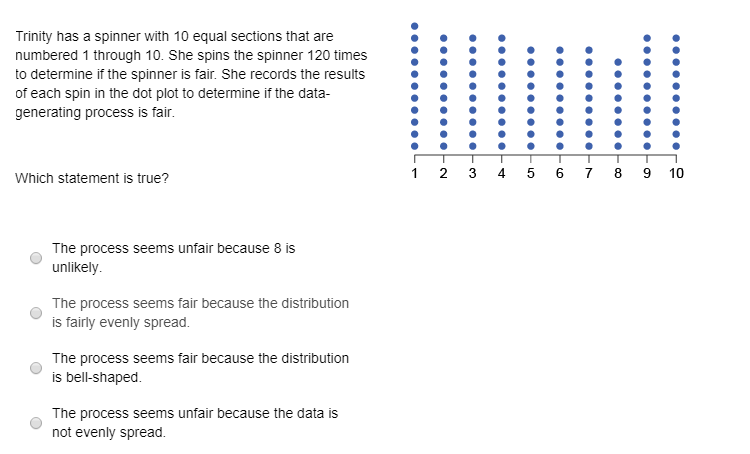
Ima say B for self explanatory reasoning
 Ultrilliam:
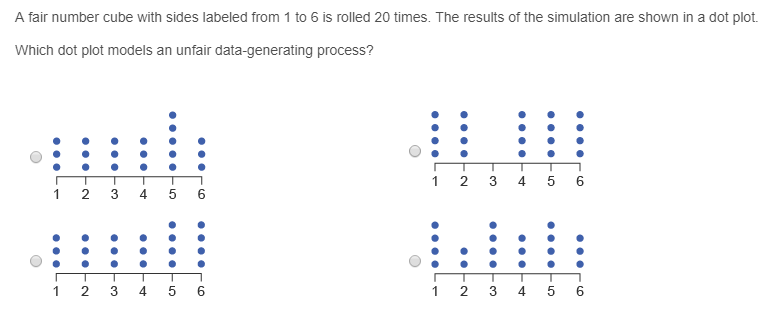
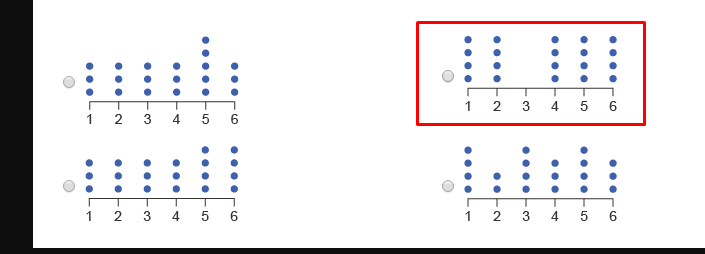
I'm confused on this one actually...
Ultrilliam:
@JustSaiyan
 Vocaloid:
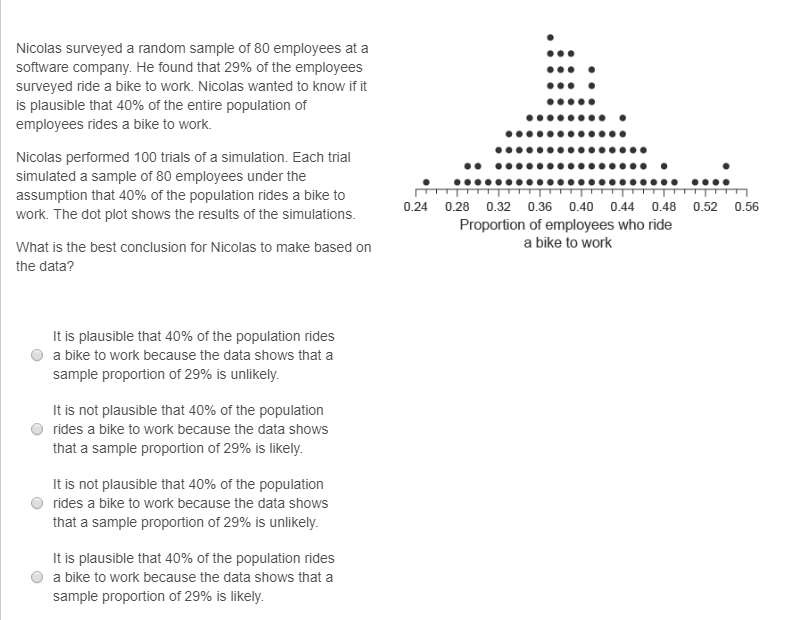
hm. the data tells us that 0.29 is very unlikely so that eliminates b and d
Vocaloid:
the question isn't written well but I would say 0.40 is plausible based on the data so A?
princeevee:
i guess
 Vocaloid:
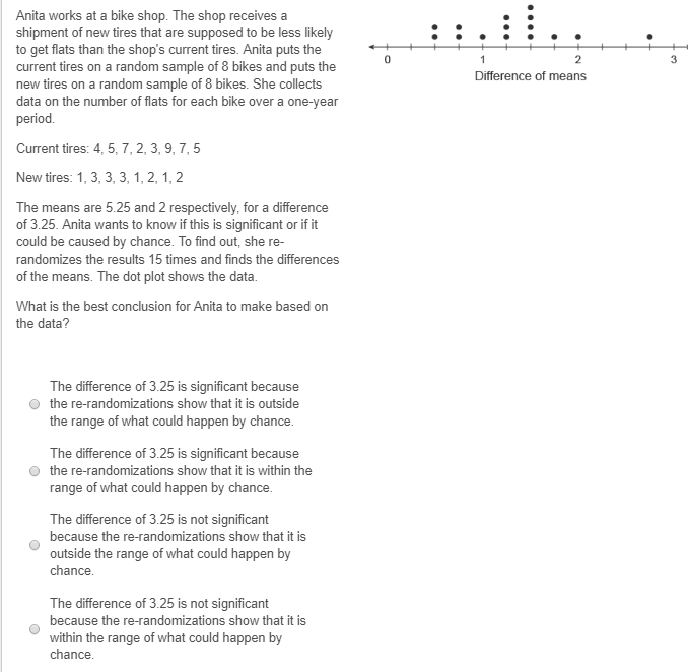
hint: is 3.25 on the dot plot?
Vocaloid:
that is, is there a dot at or above 3.25?
princeevee:
no?
Vocaloid:
good so 3.25 is outside the range of what could happen by chance, making the answer statistically significant
princeevee:
C?
princeevee:
i think thats what it is
Vocaloid:
hint: the answer IS statistically significant which answer choice matches?
princeevee:
A
Vocaloid:
awesome
 Vocaloid:
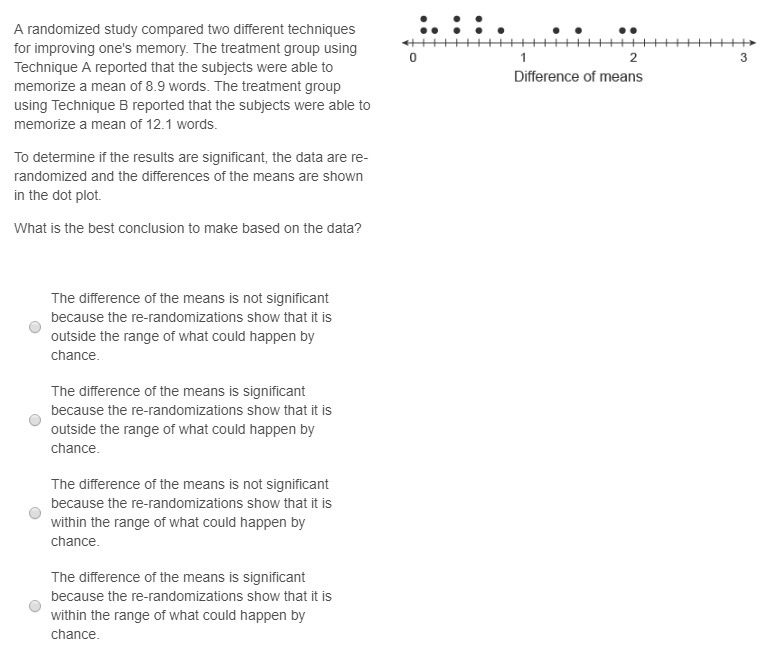
first step: 12.1 - 8.9 = ?
princeevee:
3.2
Vocaloid:
good, and is 3.2 on the dot plot?
princeevee:
no
Vocaloid:
good, so that means it's outside the range and it is statistically significant which answer choice matches?
princeevee:
B
Vocaloid:
good
princeevee:
so how was that new job going for you?
princeevee:
was it being a teacher or something?
Vocaloid:
sorta yea, it's ok
princeevee:
nice, g4u
princeevee:
i have another few question i need to have help on
princeevee:
@Vocaloid if you can help
Vocaloid:
sure
princeevee:
A sample proportion of 0.62 is found. To determine the margin of error for this statistic, a simulation of 200 trials is run, each with a sample size of 100 and a point estimate of 0.62. The minimum sample proportion from the simulation is 0.73, and the maximum sample proportion from the simulation is 0.97. What is the margin of error of the population proportion using an estimate of the standard deviation? ±0.02 ±0.08 ±0.12 ±0.16
Vocaloid:
i'm not sure how to do this without using a z-table let me try finding something on the internet
princeevee:
find anything?
 JustSaiyan:
Why do you do this to me, @Ultrilliam
Vocaloid:
still looking
princeevee:
......
princeevee:
@Vocaloid you can jsut look one up on google i think
Vocaloid:
formula for error margin: +/- z * sqrt(p*(1-p)/n) the second part is easy to find since we are given p and n
Vocaloid:
sqrt(p*(1-p)/n) = 0.0485 I'm just not sure what we're supposed to use for z because the usual values aren't giving me an answer in the choices
princeevee:
oof, this is tricky..
Vocaloid:
there's an alternative formula that's just standard deviation/sqrt(n) the "estimate" for standard deviation is range/4 which is 0.06 but that doesn't work either since 0.06/sqrt(100) = 0.006
princeevee:
D?
Vocaloid:
sure, I don't have a better answer than that
princeevee:
The results of a survey indicate that between 76% and 84% of the season ticket holders are satisfied with their seat locations. What is the survey’s margin of error?
Vocaloid:
were you given a formula for margin of error, given range? I am not aware of such a formula existing
Vocaloid:
otherwise my best guess would just be range/2 which is just (0.84-0.76)/2 = 0.04
princeevee:
The results of a survey indicate that the true proportion of households who recycle paper products is likely in the interval (0.61,0.7). What is the point estimate of the proportion of households who recycle paper? Enter your answer, as a decimal
Vocaloid:
the halfway point maybe? (0.61+0.7)/2 ?
princeevee:
0.655
Vocaloid:
yeah that's my best guess
princeevee:
Based on a poll of 500 citizens, a property development group claims that 54% of the population is in favor of the construction of a new hotel near the airport. An environmental group claims that the poll is not valid and that only 38% of the citizens favor the construction of the hotel. To determine whether this sample supports the population proportion of 0.54, a simulation of 100 trials is run, each with a sample size of 200 and a point estimate of 0.38. The minimum sample proportion from the simulation is 0.32, and the maximum sample proportion from the simulation is 0.50. The margin of error of the population proportion is found using an estimate of the standard deviation. What is the interval estimate of the true population proportion? (0.42,0.66) (0.29,0.47) (0.26,0.5) (0.32,0.44)
Vocaloid:
I'm not sure what formula they want to use for this :s D seems like the only reasonable answer
princeevee:
maybe i should screenshot
princeevee:
A recent poll taken by the national ice cream industry shows that 32% of the population names vanilla as its favorite ice cream flavor. A sample of 200 people shows that only 20% of those polled names vanilla as their favorite ice cream flavor. To determine whether this sample supports the population proportion of 0.32, a simulation of 100 trials is run, each with a sample size of 50 and a point estimate of 0.20. The minimum sample proportion from the simulation is 0.16, and the maximum sample proportion from the simulation is 0.28. What is the margin of error of the population proportion using half the range? ±0.02 ±0.04 ±0.06 ±0.08
Vocaloid:
half the range is just (0.28-0.16)/2
Vocaloid:
so ±0.06 i think
princeevee:
alright
princeevee:
i got a 60%, though its alright
 BlankSpace:
soz bruh
Join our real-time social learning platform and learn together with your friends!
 DoltonCarlee:
what are y'all's options on S A T essays because honestly their not that bad
DoltonCarlee:
what are y'all's options on S A T essays because honestly their not that bad

 thereneelg:
Can someone give me a summary of article 231, The war guilt clause?? I need to explain what it is, but I can't find any shortened version of what it is and
thereneelg:
Can someone give me a summary of article 231, The war guilt clause?? I need to explain what it is, but I can't find any shortened version of what it is and
 luisaam2:
What should you do when the person you want to talk to the most is the one making
luisaam2:
What should you do when the person you want to talk to the most is the one making
 Breathless:
https://medal.tv/games/roblox/clips/nAYivIl6oXB6q9QAI?invite=cr-MSxCSk4sMTY4OTA4N
Breathless:
https://medal.tv/games/roblox/clips/nAYivIl6oXB6q9QAI?invite=cr-MSxCSk4sMTY4OTA4N
 Twaylor:
I'm not that good at law can someone fact check this without bias? June 29, 2026, the Supreme Court decided Chatrie v.
Twaylor:
I'm not that good at law can someone fact check this without bias? June 29, 2026, the Supreme Court decided Chatrie v.
 Demon25:
For a hoco proposal with a cheerleader and football player, what else should be a
Demon25:
For a hoco proposal with a cheerleader and football player, what else should be a
