
 PandaSurvive:
Help please cx
 bobbieanne:
@Ultrilliam
 Ultrilliam:
What do you need help with?
 PandaSurvive:
same
 563blackghost:
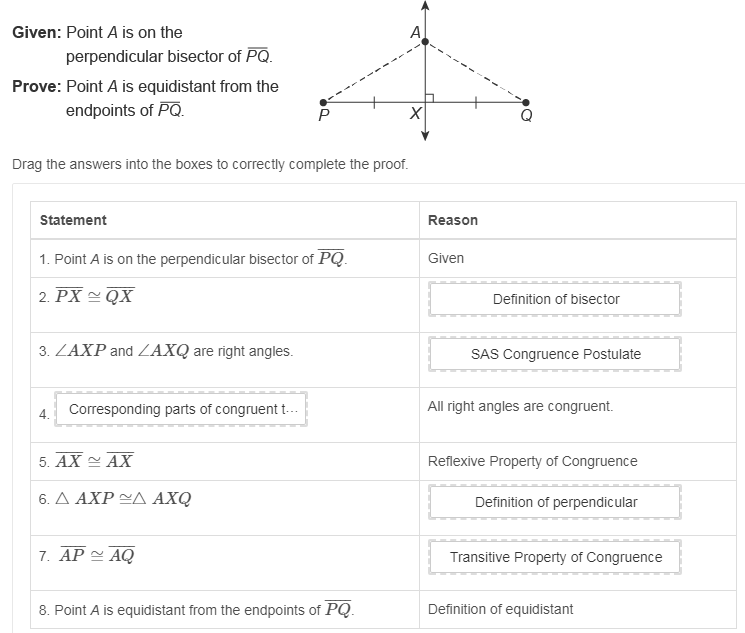
Reason 2 is correct.
563blackghost:
Reason 3 is incorrect, let me write an explanation. One sec.
563blackghost:
Since we are told that \(\bf{\overline{\rm PQ}}\) bisects PERPENDICULARLY this would mean that it would create TWO right angles on either side. Meaning for Reason 3 it would be \(\bf{definition~of~Perpendicular}\).
563blackghost:
Since we are told that \(\bf{\angle AXP}\) and \(\bf{\angle AXQ}\) are `right angles` this would mean that they are `congruent` to each other. So for statement 4 it would be \(\large\bf{\angle AXP \cong \angle AXQ}\).
PandaSurvive:
oh that makes sense
563blackghost:
We prove our triangle based on how we proved sides and angles `in order`. We first identified that \(\large\bf{\overline {\rm PX} \cong \overline {\rm QX}}\) being sides, we then identified that \(\large{\angle AXP \cong AXQ}\) being sides, and last we identified by reflexive that \(\large\bf{\overline {\rm AX} \cong \overline {\rm AX}}\) being a side. Side-angle-Side is the \(\large\bf{SAS~Congruence~Postulate}\).
563blackghost:
Reason 7 would be \(\large\bf{CPCTC}\) since we proved the triangle, thus making \(\large\bf{\overline {\rm AP} \cong \overline {\rm AQ}}\) being congruent to each other.
PandaSurvive:
Thank you BlackGhost cx
563blackghost:
np :)
Join our real-time social learning platform and learn together with your friends!
VERNEISH:
Two objects are moving along separate linear paths where each path is described by position, d, and time, t.

 Maci:
what are the best stock apps for people who want to start investing?
Maci:
what are the best stock apps for people who want to start investing?
 Twaylor:
genuienly how do i get better self control i keep watcing youtube and theres this
Twaylor:
genuienly how do i get better self control i keep watcing youtube and theres this
 IzzyCookie:
|dw:1792074056138:dw| Uhm, I don't know where to ask this, but I'm in college welding at my community college, and I need help learning vertical welding for
IzzyCookie:
|dw:1792074056138:dw| Uhm, I don't know where to ask this, but I'm in college welding at my community college, and I need help learning vertical welding for

 thehearken:
not sure if this is considered spam, im sorry if it is, but does anyone have tips
thehearken:
not sure if this is considered spam, im sorry if it is, but does anyone have tips