
 zarkam21:
7 and 2.5?
 Pixel:
?
Pixel:
what's the question
 zarkam21:
@Nnesha @Vocaloid @563blackghost
Pixel:
sorry i wish i could help
 563blackghost:
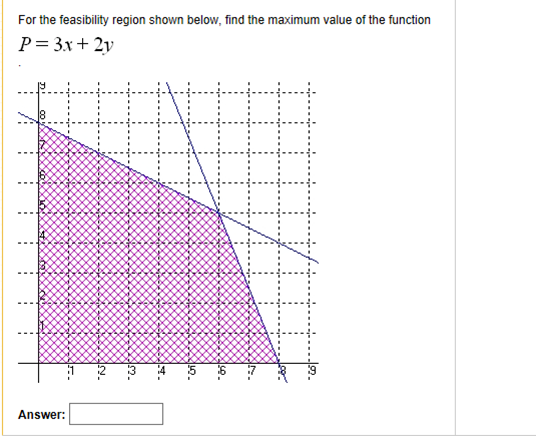
So we have the point `(0,8)`, `(6,5)`, and `(8,0)`. Input. \(\large\bf{3(0)+2(8)=16=P}\) \(\large\bf{3(6)+2(5)=28=P}\) \(\large\bf{3(8)+2(0)=24=P}\) It is asking for the `maximum value` of the function, this means the largest `P` can be. If we look at the equations above we see the largest is `28` made by `(6,5)`.
563blackghost:
In conclusion, it is `28`.
zarkam21:
It is max value?
zarkam21:
Does that mean the quartile etc or is this something else
zarkam21:
@563blackghost I'm sorry I just want to have a full understanding of the topic and dont want to fish around for answers
zarkam21:
:S
563blackghost:
That is alright, I like it when people want full understanding XD
563blackghost:
For feasibility regions we are given equations that create something like the graph in your problem. The `solutions` to this is where the `line intersects with other lines` since the shading is contained within `x-axis and y-axis` they will also include for `solutions`. So we see we have an intersection as `(6,5)` this means it is a `solution`. We see it intersects at `(0,8)` and at `(8,0)` this means these two are solutions as well. Now, when you plug these into the equation we get a total this is known as the `value`. Some `values`may be larger than others. There is a `maximum` and `minimum` value. The `maximum` value is where a `solution` makes the outcome be a `large` number (bigger than the others). The `minimum` value is where a `solution` makes the outcome be a `smaller` number (smaller than the others).
Join our real-time social learning platform and learn together with your friends!
 VERNEISH:
Two objects are moving along separate linear paths where each path is described by position, d, and time, t.
VERNEISH:
Two objects are moving along separate linear paths where each path is described by position, d, and time, t.

 Maci:
what are the best stock apps for people who want to start investing?
Maci:
what are the best stock apps for people who want to start investing?
 Twaylor:
genuienly how do i get better self control i keep watcing youtube and theres this
Twaylor:
genuienly how do i get better self control i keep watcing youtube and theres this
 IzzyCookie:
|dw:1792074056138:dw| Uhm, I don't know where to ask this, but I'm in college welding at my community college, and I need help learning vertical welding for
IzzyCookie:
|dw:1792074056138:dw| Uhm, I don't know where to ask this, but I'm in college welding at my community college, and I need help learning vertical welding for

 thehearken:
not sure if this is considered spam, im sorry if it is, but does anyone have tips
thehearken:
not sure if this is considered spam, im sorry if it is, but does anyone have tips