
 Shadow:
Use what you know about end behavior and zeros to graph the following function.
Shadow:
\[f(x) = x(x - 5)(x - 3)(x + 2)(x + 4)\] x-intercepts: -4, -2, 0, 3, 5 I would give it an end behavior of: \[x \rightarrow -\infty, y \rightarrow +\infty\] \[x \rightarrow +\infty, y \rightarrow +\infty\]
Shadow:
Also, a y-intercept of 0.
Shadow:
How do I draw this xD
 Vocaloid:
check the left hand limit again if x becomes a very large negative number then your function is essentially (a large negative number) ^ 5 which ends up going to - infinity
Vocaloid:
since the highest power is 5 the graph has 5 - 1 = 4 "turns" or places where the function changes from increasing to decreasing or vice versa "bumps" in the function
Shadow:
Oh, the coefficient is 1 and the degree is positive. It should be: \[x \rightarrow -\infty, y \rightarrow -\infty\] \[x \rightarrow +\infty, y \rightarrow +\infty\]
Vocaloid:
yeah
Vocaloid:
|dw:1512078925707:dw|
Vocaloid:
|dw:1512078934232:dw|
Vocaloid:
that's the initial setup, then I draw a graph that goes through all the intercepts and makes 4 "turns"
Vocaloid:
|dw:1512078981694:dw|
Vocaloid:
if you want to get picky about the shape you could substitute values into the equation to get more precise y-values
Shadow:
No, my teacher does not need for it to be precise. This works. https://www.wolframalpha.com/input/?i=f(x)+%3D+x(x+-+5)(x+-+3)(x+%2B+2)(x+%2B+4) I just did not know what to do with the x-intercepts, but I get it now. Start with the end behavior, then just do the turns.
Shadow:
And wolfram links still do not work ._.
Vocaloid:
yeah some of the special characters like parentheses mess it up :S
Vocaloid:
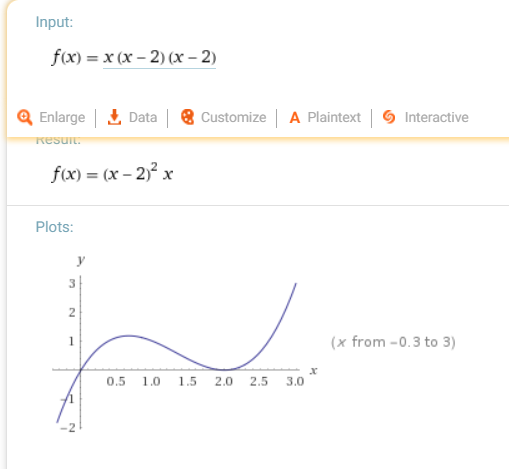
one more important thing, if you have a repeated root like f(x) = x(x-2)(x-2) the graph doesn't cross through x = 2 to the other side, it touches the zero and then "bounces" back in the original direction
Shadow:
Like a parabola?
 Vocaloid:
yeah sort of
Vocaloid:
the graph above crosses through x = 0 but when it gets to x = 2 it "touches" x = 2 and then goes back up w/o crossing the y-axis
 sweetburger:
another method here (might be beyond the scope of your course) is to evaluate the critical numbers of the first derivative to model increasing and decreasing behaviour and evaluating the second derivative hypercritical points to determine concavity behaviour.
Vocaloid:
@shadow is this calc or pre-calc?
Shadow:
Precal, so that concept is beyond my course. Would be willing to learn it through.
Vocaloid:
derivatives make this process a lot easier, I think you'd enjoy it ^^ I don't think I have the the capacity to teach the fundamentals well though
Shadow:
Well, I have to go atm but we could explore/discuss this later. Should be free in roughly 20-30min.
Shadow:
Just some quick clarifications as I just came across an example of this: "one more important thing, if you have a repeated root like f(x) = x(x-2)(x-2) the graph doesn't cross through x = 2 to the other side, it touches the zero and then "bounces" back in the original direction" This is basically multiplicity 2? and what do you mean by "touches the zero." @Vocaloid
Vocaloid:
Yeah that's multiplicity By touches I mean the graph reaches 0 without crossing through the axis
Shadow:
So it reaches y = 0 but does not touch the x axis?
Vocaloid:
It touches the x axis but doesn't cross through
Shadow:
oh
Shadow:
I got it
Shadow:
Thank you
Join our real-time social learning platform and learn together with your friends!
 VERNEISH:
Two objects are moving along separate linear paths where each path is described by position, d, and time, t.
VERNEISH:
Two objects are moving along separate linear paths where each path is described by position, d, and time, t.

 Maci:
what are the best stock apps for people who want to start investing?
Maci:
what are the best stock apps for people who want to start investing?
 Twaylor:
genuienly how do i get better self control i keep watcing youtube and theres this
Twaylor:
genuienly how do i get better self control i keep watcing youtube and theres this
 IzzyCookie:
|dw:1792074056138:dw| Uhm, I don't know where to ask this, but I'm in college welding at my community college, and I need help learning vertical welding for
IzzyCookie:
|dw:1792074056138:dw| Uhm, I don't know where to ask this, but I'm in college welding at my community college, and I need help learning vertical welding for

 thehearken:
not sure if this is considered spam, im sorry if it is, but does anyone have tips
thehearken:
not sure if this is considered spam, im sorry if it is, but does anyone have tips