
 princeevee:
help please
 princeevee:
@Vocaloid
 Vocaloid:
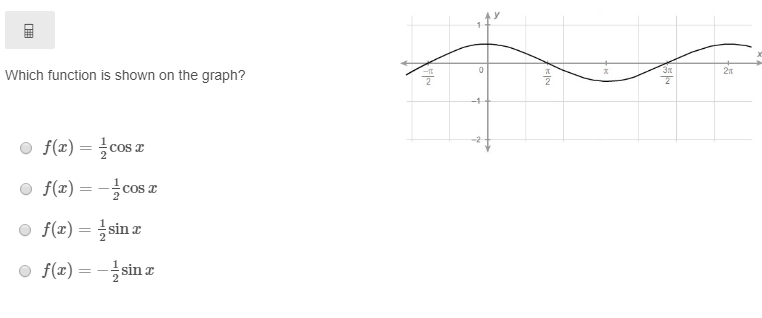
if you can recall, which graph is symmetric about the y-axis, cosine or sine? you can look these functions up on google images if you are having trouble remembering
princeevee:
its hazy..
Vocaloid:
|dw:1515796375646:dw|
Vocaloid:
which one is symmetric on the y-axis?
princeevee:
cosx
Vocaloid:
good if we look at the problem, it is just cos(x) with a vertical shrink by 1/2 so the answer is 1/2 cosx (first choice)
 Vocaloid:
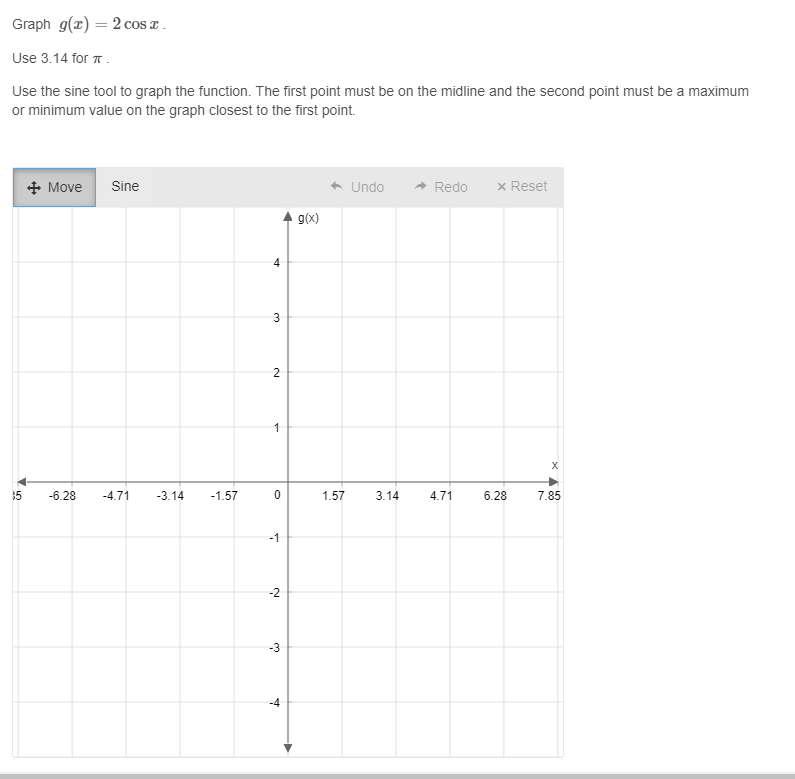
the midline of this function is just the horizontal line y = 0 so the first point can be (pi/2,0) since that's where 2cos(x) = 0 the second point needs to be on the max or min, so 2cos(x) has its max when theta = 0, so it crosses (0,2)
Vocaloid:
the function basically looks like this, but instead of maxing out/minimum at 1 or -1 it reaches 2 and -2|dw:1515796761830:dw|
Vocaloid:
|dw:1515796771449:dw|
 Vocaloid:
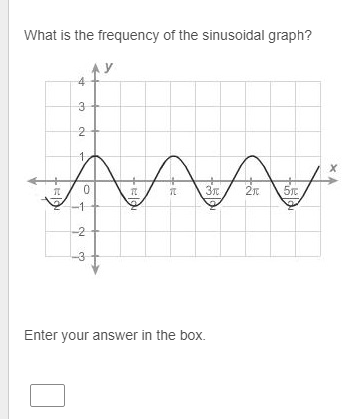
first we determine the length of one of its cycles |dw:1515797153768:dw|
Vocaloid:
|dw:1515797159798:dw|
Vocaloid:
then it's just 1/period
princeevee:
1/2?
princeevee:
thats still 1
Vocaloid:
|dw:1515797414692:dw|
princeevee:
pi?
Vocaloid:
yup so frequency = 1/ period = 1/pi
princeevee:
0.318?
Vocaloid:
weell it doesn't say what format the answer needs to be in, so if they let you enter 1/pi then do that, but if not, then go ahead and round to 0.318
 Vocaloid:
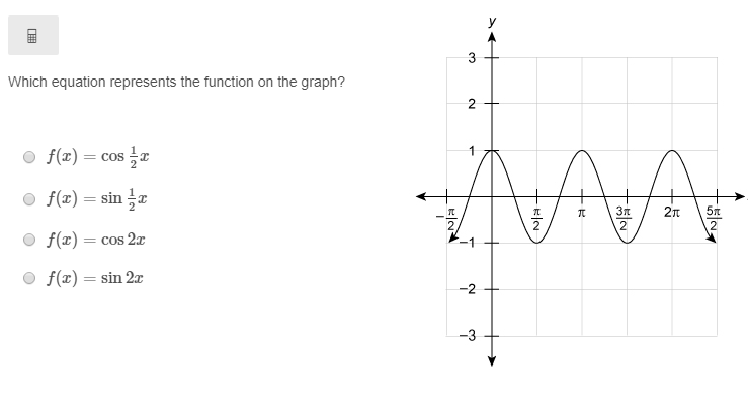
it has to be another cos function based on its shape (symmetry to the y-axis) it can't be 2cos(x) because the max/min are still 1 not 2 so cos(1/2x) is our only possiblility
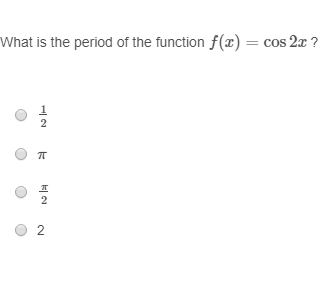 Vocaloid:
|dw:1515797840166:dw|
princeevee:
D?
Vocaloid:
first we draw a horizontal line from peak-to-peak to get our period|dw:1515797863299:dw|
Vocaloid:
about what is the length of this horizontal line? (it's a little off but use your best estimate)
princeevee:
uh....
Vocaloid:
it starts at -pi and goes to 0, how long is this?
princeevee:
5?
Vocaloid:
think about how we measure the length of a horizontal line it's (right point - left point) so 0 - (-pi) = ?
princeevee:
pi?
Vocaloid:
good so the period = pi = your answer
princeevee:
thanks
Join our real-time social learning platform and learn together with your friends!
 VERNEISH:
Two objects are moving along separate linear paths where each path is described by position, d, and time, t.
VERNEISH:
Two objects are moving along separate linear paths where each path is described by position, d, and time, t.

 Maci:
what are the best stock apps for people who want to start investing?
Maci:
what are the best stock apps for people who want to start investing?
 Twaylor:
genuienly how do i get better self control i keep watcing youtube and theres this
Twaylor:
genuienly how do i get better self control i keep watcing youtube and theres this
 IzzyCookie:
|dw:1792074056138:dw| Uhm, I don't know where to ask this, but I'm in college welding at my community college, and I need help learning vertical welding for
IzzyCookie:
|dw:1792074056138:dw| Uhm, I don't know where to ask this, but I'm in college welding at my community college, and I need help learning vertical welding for

 thehearken:
not sure if this is considered spam, im sorry if it is, but does anyone have tips
thehearken:
not sure if this is considered spam, im sorry if it is, but does anyone have tips