
 zarkam21:
??
 Vocaloid:
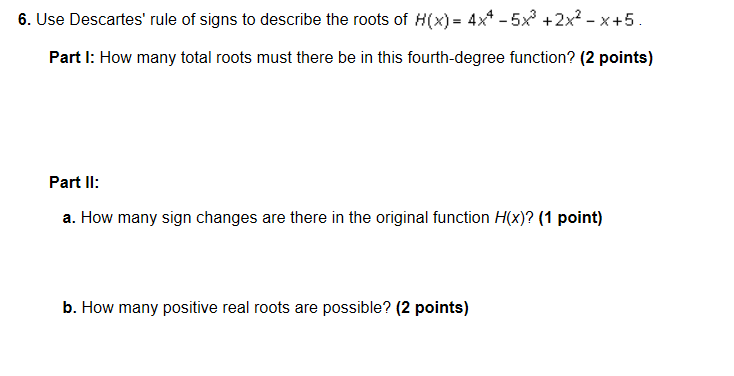
for part I the max number of roots is equal to the degree
zarkam21:
3?
Vocaloid:
the degree is the highest exponent
zarkam21:
4
Vocaloid:
good for part IIa) count the sign changes in H(x)
zarkam21:
3?
Vocaloid:
|dw:1516218132719:dw|
Vocaloid:
|dw:1516218137905:dw|
Vocaloid:
so 4 maximum positive real roots
zarkam21:
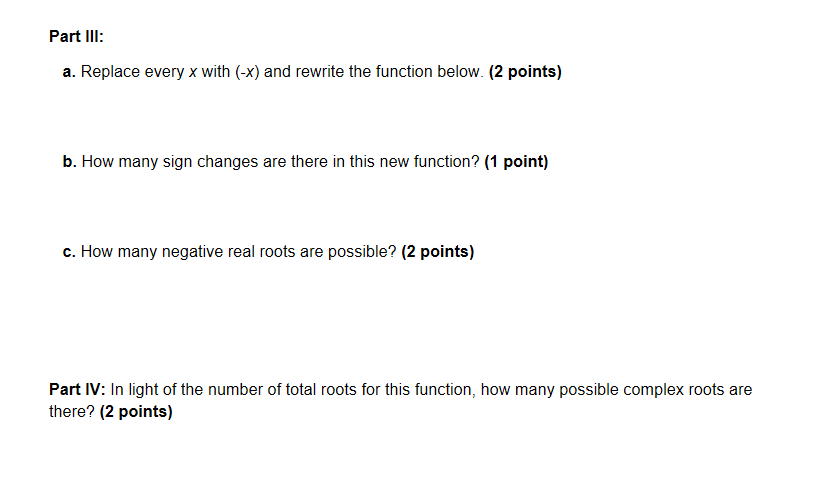
okay so for part iii a\[4(-x)^4-5(-x)^3+2(-x)^2+x+5\]
Vocaloid:
good, now simplify this and count the number of sign changes in the simplified expression
zarkam21:
um 2?
Vocaloid:
4x^4 + 5x^3 + 2x^2 + x + 5 ^ how many sign changes?
zarkam21:
not 2?
Vocaloid:
no, not 2 count the number of sign changes in the above expression
zarkam21:
from the original right?
Vocaloid:
\(\color{#0cbb34}{\text{Originally Posted by}}\) @Vocaloid 4x^4 + 5x^3 + 2x^2 + x + 5 ^ how many sign changes? \(\color{#0cbb34}{\text{End of Quote}}\)
Vocaloid:
the one after we plugged in (-x)
zarkam21:
4
Vocaloid:
notice how all the signs are positive
zarkam21:
yeah
Vocaloid:
so how many sign changes are there if they all are positive?
zarkam21:
1
zarkam21:
\(\color{#0cbb34}{\text{Originally Posted by}}\) @Vocaloid 4x^4 + 5x^3 + 2x^2 + x + 5 ^ how many sign changes? \(\color{#0cbb34}{\text{End of Quote}}\)
zarkam21:
after the 4x^4 it is a positive that's all i see
Vocaloid:
a sign change is defined as an instance where the sign changes from + to - or from - to + with that being said, how many sign changes are there?
zarkam21:
3
Vocaloid:
the first term is positive the second term is positive (so no change) the third term is positive (still no change) the fourth term is positive (still no change) so how many sign changes?
zarkam21:
1
zarkam21:
Ugh sorry
Vocaloid:
remember, for a sign change the sign has to switch from + to - or from - to +
Vocaloid:
so if they are all + how many sign changes?
zarkam21:
\(\color{#0cbb34}{\text{Originally Posted by}}\) @Vocaloid the first term is positive the second term is positive (so no change) the third term is positive (still no change) the fourth term is positive (still no change) so how many sign changes? \(\color{#0cbb34}{\text{End of Quote}}\)
zarkam21:
From this 1
Vocaloid:
notice how all the terms are positive for something to count as a sign change, the sign MUST change from + to - or from - to + but notice how we don't have any negative signs, so there must be __ sign changes
zarkam21:
zero
Vocaloid:
good, zero sign changes and zero possible roots for c) since total roots = 0 and positive roots can be at most 4, if we consider complex roots as doubles there can be either 4, 2, or 0 complex roots
zarkam21:
so 4,2,0
Vocaloid:
yes
zarkam21:
okay so for part IV
zarkam21:
would it be the same answer?
Vocaloid:
c) should be 0 negative roots, IV should be 4/2/0 complex roots
Join our real-time social learning platform and learn together with your friends!
 VERNEISH:
Two objects are moving along separate linear paths where each path is described by position, d, and time, t.
VERNEISH:
Two objects are moving along separate linear paths where each path is described by position, d, and time, t.

 Maci:
what are the best stock apps for people who want to start investing?
Maci:
what are the best stock apps for people who want to start investing?
 Twaylor:
genuienly how do i get better self control i keep watcing youtube and theres this
Twaylor:
genuienly how do i get better self control i keep watcing youtube and theres this
 IzzyCookie:
|dw:1792074056138:dw| Uhm, I don't know where to ask this, but I'm in college welding at my community college, and I need help learning vertical welding for
IzzyCookie:
|dw:1792074056138:dw| Uhm, I don't know where to ask this, but I'm in college welding at my community college, and I need help learning vertical welding for

 thehearken:
not sure if this is considered spam, im sorry if it is, but does anyone have tips
thehearken:
not sure if this is considered spam, im sorry if it is, but does anyone have tips