
 zarkam21:
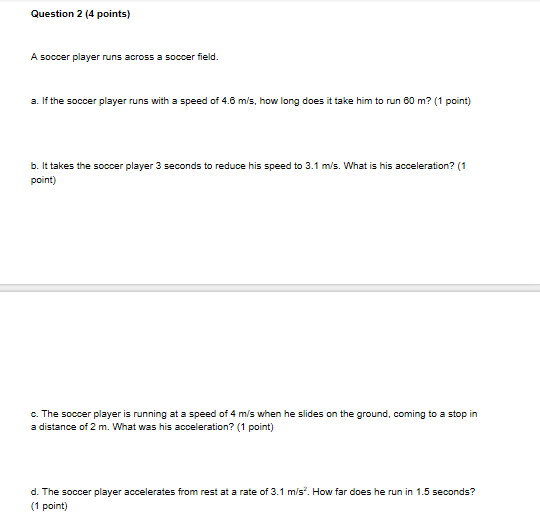
Help
 Vocaloid:
a) is just a velocity = distance/time question
zarkam21:
13.04
Vocaloid:
good acceleration = (final velocity - initial velocity)/time = >
zarkam21:
that would be m?
zarkam21:
like 13.04m?
Vocaloid:
keep in mind what the question is asking for to determine what the units would be
zarkam21:
m/s
Vocaloid:
"how long does it take" what are the units?
zarkam21:
s?
Vocaloid:
good, it is asking for time so the units must be in time, so seconds
Vocaloid:
and for b) acceleration = (final velocity - initial velocity)/time --> plug the values in
zarkam21:
(3.1)/3
Vocaloid:
it's final velocity - initial velocity using the velocity from a) as the initial velocity
zarkam21:
(3.1-13.04)/3
Vocaloid:
13.04 is the time not the initial velocity
zarkam21:
oh hold on , I'm screwing it up
zarkam21:
(3.1-4.6)/13.04
Vocaloid:
use the time from part b) in the denominator not the time from part a)
zarkam21:
(3.1-4.6)/3
Vocaloid:
good, and that equals..?
zarkam21:
-0.5
Vocaloid:
good, so -0.5 m/s/s
zarkam21:
okay so for c
Vocaloid:
|dw:1516751922613:dw|
Vocaloid:
you are given initial velocity, final velocity, and distance, which equation should we use to find the acceleration? note that you are not given time
zarkam21:
4
Vocaloid:
good, now solve for a
zarkam21:
initial velocity =4 distance=2
Vocaloid:
yes, keep going
zarkam21:
4^2=2+2(a)x
Vocaloid:
delta x is the distance if he is coming to a stop what must the final velocity be?
Vocaloid:
good, so 0^2 = 4^2 + 2a(2)
zarkam21:
./..
zarkam21:
-4
Vocaloid:
good, so -4 m/s/s is your answer
Vocaloid:
for d) use kinematics equation 3 to find the distance
zarkam21:
x=3.1(1.5)+1/2(-4)t
Vocaloid:
using the initial velocity, acceleration, and time given in d)
zarkam21:
x=3.1(1.5)+1/2(a)t
zarkam21:
isn't it 3.1 and 1.5
Vocaloid:
"accelerates from rest" what is the initial velocity?
Vocaloid:
good, now plug in deltax = v_o * t + (1/2)at^2 using the time and acceleration given in problem d)
zarkam21:
;'';'
zarkam21:
deltax=0*1.5+(1/2)a(1.5)^2
Vocaloid:
don't forget to plug in a
zarkam21:
deltax=0*1.5+(1/2)(3.1)^2
Vocaloid:
t^2 is still 1.5^2
Vocaloid:
just plug in a = 3.1 while leaving everything else as it was
zarkam21:
deltax=0*1.5+(1/2)(3.1)(1.5)^2
Vocaloid:
good, now solve for delta x
zarkam21:
3.49
Vocaloid:
good so 3.49 m
Join our real-time social learning platform and learn together with your friends!
 VERNEISH:
Two objects are moving along separate linear paths where each path is described by position, d, and time, t.
VERNEISH:
Two objects are moving along separate linear paths where each path is described by position, d, and time, t.

 Maci:
what are the best stock apps for people who want to start investing?
Maci:
what are the best stock apps for people who want to start investing?
 Twaylor:
genuienly how do i get better self control i keep watcing youtube and theres this
Twaylor:
genuienly how do i get better self control i keep watcing youtube and theres this
 IzzyCookie:
|dw:1792074056138:dw| Uhm, I don't know where to ask this, but I'm in college welding at my community college, and I need help learning vertical welding for
IzzyCookie:
|dw:1792074056138:dw| Uhm, I don't know where to ask this, but I'm in college welding at my community college, and I need help learning vertical welding for

 thehearken:
not sure if this is considered spam, im sorry if it is, but does anyone have tips
thehearken:
not sure if this is considered spam, im sorry if it is, but does anyone have tips