
 zarkam21:
?
 Vocaloid:
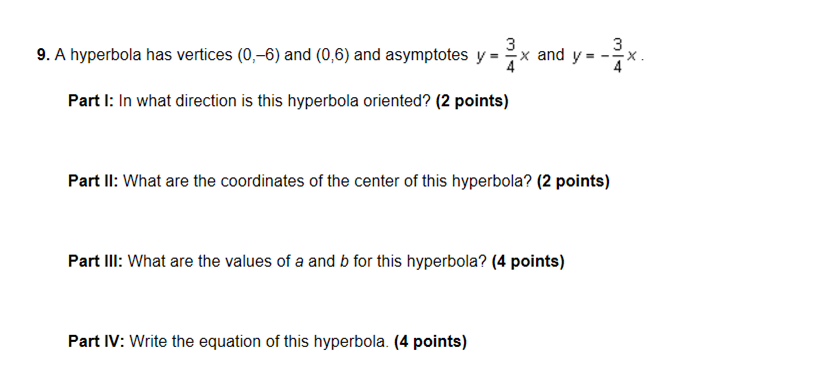
vertices are on the y-axis so I'm thinking it's oriented along the y-axis for part I) [not entirely sure but it will become clear as we finish the calculations]
Vocaloid:
center is the midpoint of the vertices
zarkam21:
so maybe i should just leave part i blank for now until we finish
Vocaloid:
sure for II) center is midpoint of the vertices
zarkam21:
(0,0)
Vocaloid:
awesome for part III) we use the right column (since our hyperbola is y-oriented) |dw:1519172868356:dw|
Vocaloid:
our asymptotes have slope 3/4 and -3/4 so a = 3 and b = 4
Vocaloid:
now for part IV) just need to plug in a and b into the hyperbola equation on the right hand column, given that our h and k values are 0 and 0 (since it's centered at origin)
zarkam21:
|dw:1519172974525:dw|
zarkam21:
THIS ONE?
Vocaloid:
yes
zarkam21:
\[\frac{ (y-0)^2 }{ 3^2 }-\frac{ (x-0)^2 }{ 4^2}=1\]
Vocaloid:
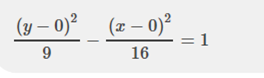
good, just make sure to write things in simplest terms (so don't leave those 0's there, and simplify those exponents
 zarkam21:
would this be the simplest form
Vocaloid:
don't leave those 0's there (x-0 and y-0 are just x and y
zarkam21:
so the equation as it isz but the numerator is just x and y
Vocaloid:
x^2 and y^2
zarkam21:
okay so how it is x^2 and y^2
zarkam21:
how it is with just x^2 and y^2
Vocaloid:
|dw:1519173365823:dw|
Vocaloid:
|dw:1519173370878:dw|
Vocaloid:
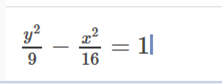
the square exponents don't just disappear
 Vocaloid:
good
Vocaloid:
for part I I'm not sure how they want you to phrase it, you could say it "opens up and down along the y-axis" something like that
Join our real-time social learning platform and learn together with your friends!
 KBaby:
Verse 1 We left our names in the dust of the driveway Watched the old town shrink
KBaby:
Lyrics Generator Use AI to write the lyrics for a song. Suggested Genres: Pop Hip
KBaby:
Verse 1 We left our names in the dust of the driveway Watched the old town shrink
KBaby:
Lyrics Generator Use AI to write the lyrics for a song. Suggested Genres: Pop Hip

 aitexturegenerator:
How are you all handling AI-generated textures for 3D models and game assets without losing the hand-made feel? I've been doing a small stylized environment
aitexturegenerator:
How are you all handling AI-generated textures for 3D models and game assets without losing the hand-made feel? I've been doing a small stylized environment

 Demon25:
Woke up feeling like that girl and that dude well he still aint crap pluse the du
Demon25:
Woke up feeling like that girl and that dude well he still aint crap pluse the du
 playtsec:
how do I get rid of stress from teachers... I just feel like running out the classroom and leaving on my own.
playtsec:
how do I get rid of stress from teachers... I just feel like running out the classroom and leaving on my own.
 JohnnyLFowler0812:
What type of gamer would play something and then get off for a while. Why not sta
JohnnyLFowler0812:
Which is better? Metallica Rap Country R&B hiphop Medal Gospel Chill Which 3 opti
JohnnyLFowler0812:
What type of gamer would play something and then get off for a while. Why not sta
JohnnyLFowler0812:
Which is better? Metallica Rap Country R&B hiphop Medal Gospel Chill Which 3 opti