
 GlockParrot69:
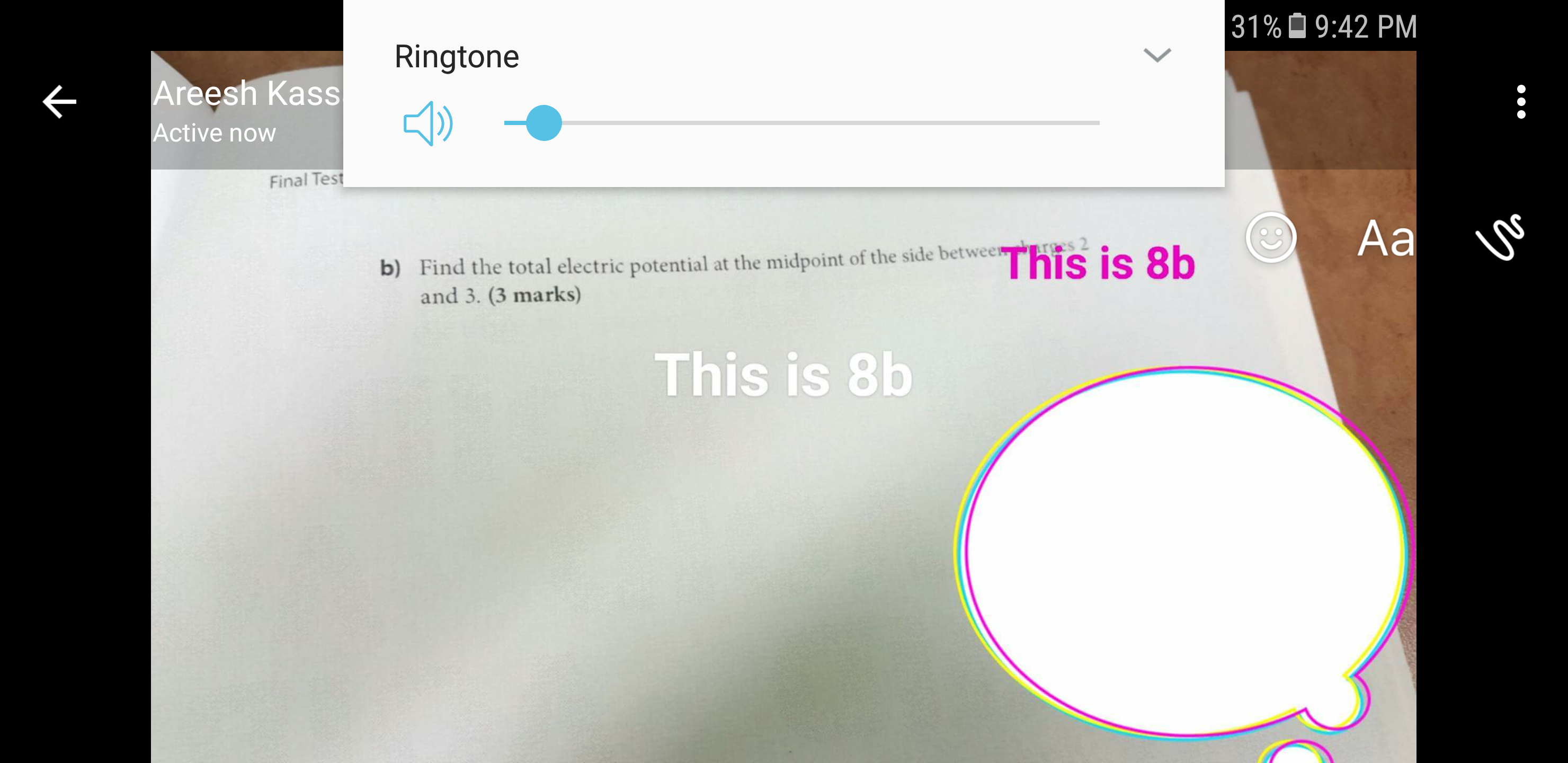
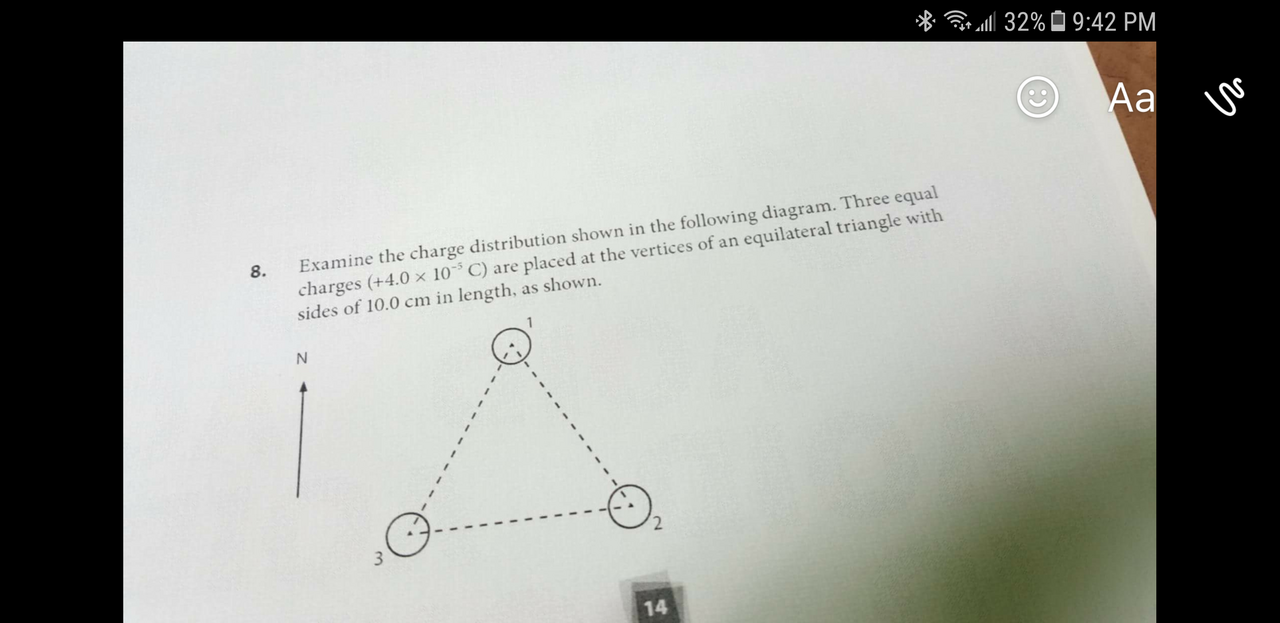
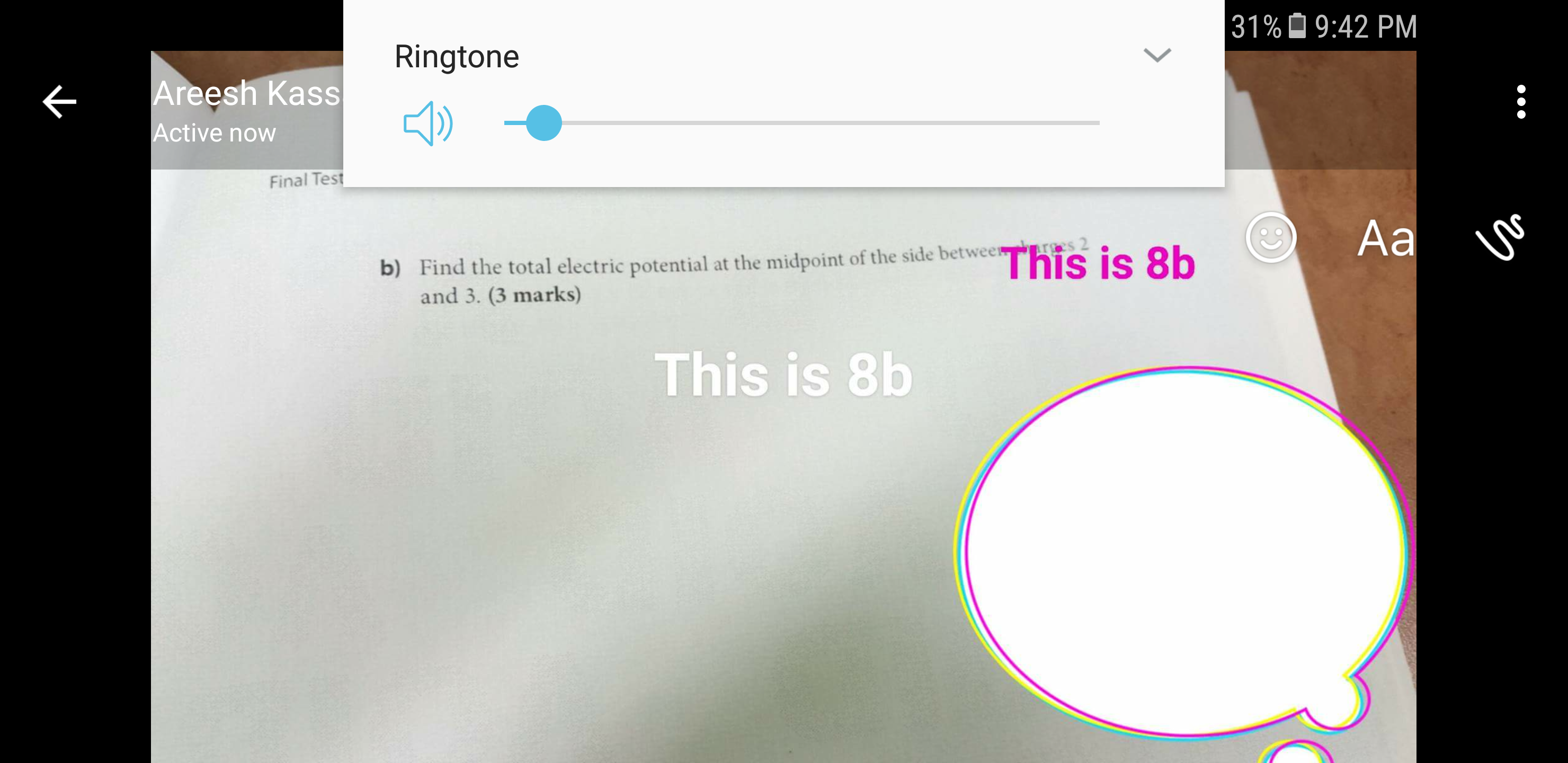
Here's the question. https://s18.postimg.org/bvwkg2zax/Screenshot_20171031-214236.png
GlockParrot69:
wait let me upload the actual question.
 Elsa213:
@563blackghost
GlockParrot69:
Find the total electric potential at the midpoint of the side between charges 2 and 3.
Elsa213:
@shadow
 Shadow:
Where is 2 and 3?
Shadow:
Oh in the link. Blocked w/school wifi, got it on my phone
Shadow:
\[PE = K \frac{ q _{1} \times q _{2} }{ r }\]
Shadow:
\[K = 8.99×10^9 N m^2 C^−2.\]
GlockParrot69:
shadow. sorry bro. i was werking on the question which i just finished. btw tell me if this question is similar to what i've posted up there.
 GlockParrot69:
|dw:1520371907103:dw|
GlockParrot69:
|dw:1520372053598:dw|
 sillybilly123:
|dw:1520372648962:dw|
sillybilly123:
for your first problem, they want potential (V), not potential energy (U). potential (V) has units of Joules / Coulomb, aka Volts. you can measure potential at the midpoint of 2 and 3 by placing a hypothetical *unit* (ie 1C) test charge there. and, if you actually did that and released it, the test charge would fly off in the direction of \(F_{\text{net}}\) as per the drawing. the force on the unit charge due to the charges at 2 and 3 cancel out, as drawn. at that singular point in time, the potential would be \(V = k\dfrac{q_1}{d}\) the second problem is the same idea with slightly different geometry. again, exploit the symmetry. you are only being asked about that point in time in which the symmetry applies. a lot of EM is about setting stuff up the right way to keep the analysis simple. my first + last word on this thread :)
GlockParrot69:
Hi Billy. Can you please check my diagram? Thanks!
sillybilly123:
look at the symmetry forget about what you have done thusfar.
sillybilly123:
good luck !!
 Sam:
Sam:
I suggest you find the distance between the midpoint and each charges first (2:3 ratio if I'm not mistaken), once you've got "r" then you can use V=kq/r for each charge then find the total V by adding them up
GlockParrot69:
ok so again. do i need to find the distance from charge 1 to the mid-point?
GlockParrot69:
thats what i was about to say.
GlockParrot69:
sam can u plz work with me?
Sam:
Yeah, I'm pretty sure there is an easier way though
GlockParrot69:
i'll draw to make this fast.
GlockParrot69:
|dw:1520373112933:dw|
GlockParrot69:
|dw:1520373188218:dw|
GlockParrot69:
is my midpoint right?
Sam:
|dw:1520373118225:dw|
GlockParrot69:
wait wait wait. you have the wrong diagram sam :/
Sam:
Really? Show me your current problem
GlockParrot69:
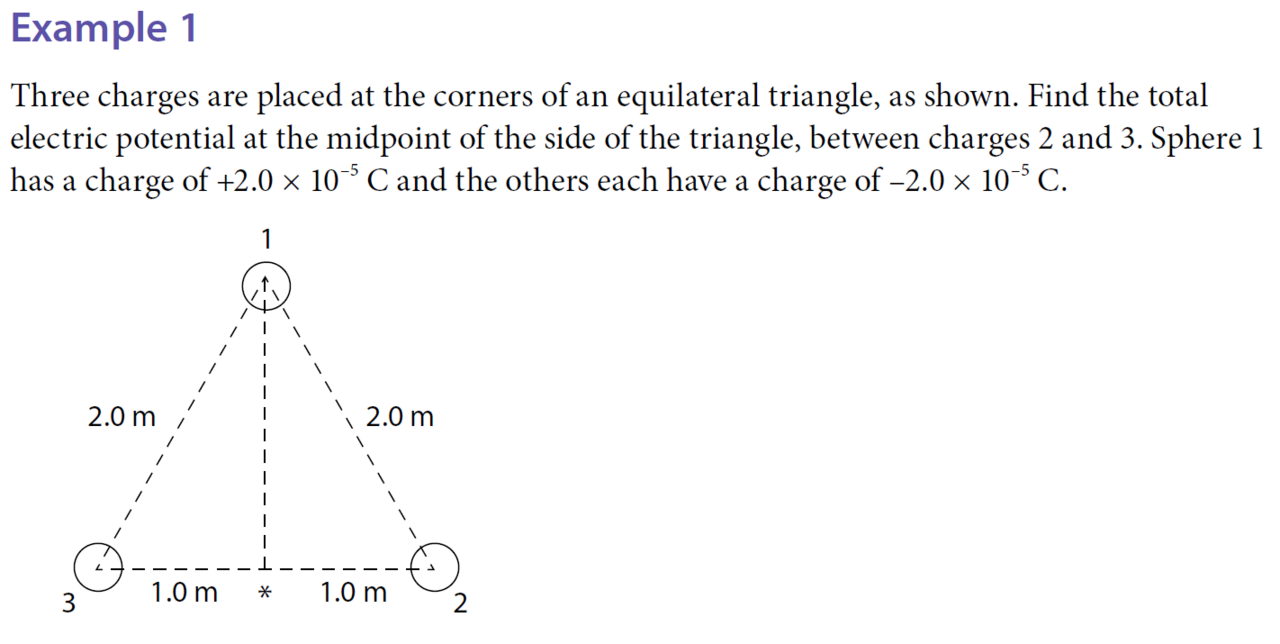
that was just an example from my course work. :/ sorry i didnt know what i was doing to i pulled out an example problem
Sam:
No problem
 GlockParrot69:
|dw:1520373488917:dw| this is what i drew based on the description.
GlockParrot69:
|dw:1520373516683:dw|
Sam:
|dw:1520373550479:dw|
GlockParrot69:
wow!! :O
Sam:
|dw:1520373810645:dw|
GlockParrot69:
btw is the distance from the midpoint to charge 1 = |dw:1520374000194:dw|
GlockParrot69:
if my distance is right can i use the following equation to solve for the electric potential?!?!? by using this formula.
Sam:
I forgot how electric potential works but I think its similar to electric force, just the formula's different, First \(V_A\) on point X, \[V_A= k\frac{q}{r}= 9\times10^9 ( \frac{4\times10^{-5}}{\frac{\sqrt{5}}{20}})\] Then \(V_B\) and \(V_C\) on point X, \[V_B= k\frac{q}{r}= 9\times10^9 ( \frac{4\times10^{-5}}{0.05})\] \[V_C= k\frac{q}{r}= 9\times10^9 ( \frac{4\times10^{-5}}{0.05})\] Then \(V_A\)+\(V_B\)+\(V_C\) This is probably how it's done, I'm not sure myself though, do we have a potential between two equipotential charges?
GlockParrot69:
nope no volts are given in the question.
Sam:
We're trying to find the electric potential at the midpoint between charge B and C, not the midpoint of the triangle
Sam:
Well electric potential is V isn't it xD
GlockParrot69:
yup electric potential is volts.
GlockParrot69:
|dw:1520374438120:dw|
Sam:
I need to refresh on this, I haven't done E&M for quite a while
GlockParrot69:
:/
Sam:
So from this https://courses.lumenlearning.com/physics/chapter/19-4-equipotential-lines/ Like charges repel, so the only E potential will be coming from \(V_A\) only
GlockParrot69:
wait 1 sec.
GlockParrot69:
im looking
Sam:
\(V=4.1569 \times 10^6V?\)
GlockParrot69:
yeah its the same thing but since we are asked to find the total eletric potential of charges 2 and 3....i think we need to modify the equation a little like this..
GlockParrot69:
|dw:1520374842547:dw|
GlockParrot69:
wait let me show you a question example from my course...pretty much the same question i think.... wait.
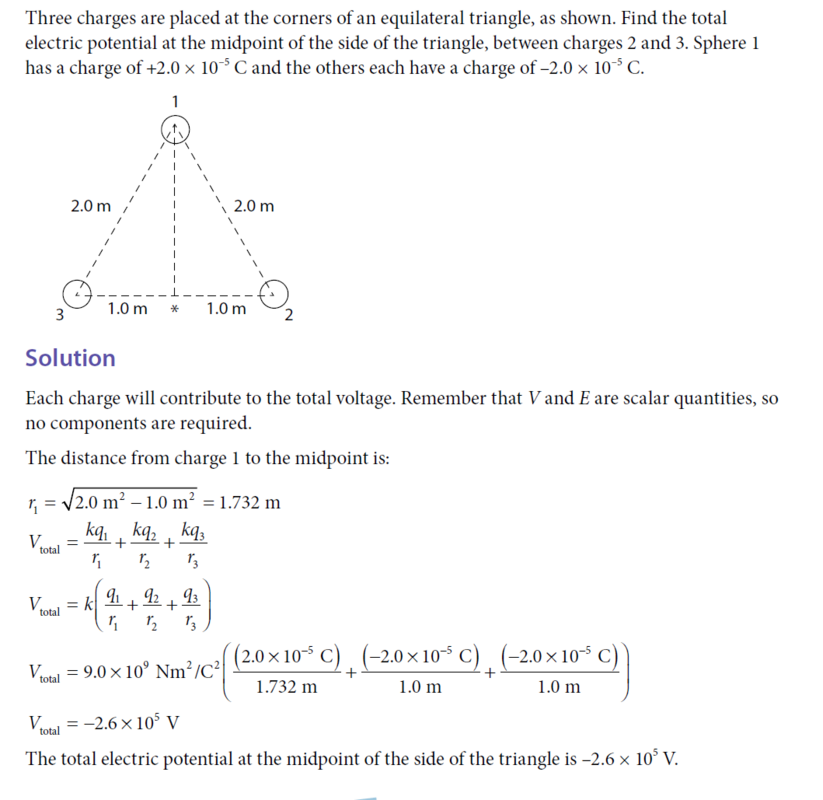 GlockParrot69:
i think this is it!
Sam:
Wait, yeah we're solving it actually hah
GlockParrot69:
but there's a slight difference. We're only dealing with Q2 and Q3
GlockParrot69:
wait i need to go blow my nose. 1 sec
Sam:
Why, Q1 still has an effect on the midpoint between Q2 and Q3
GlockParrot69:
really?
Sam:
The distance from charge Q1 to the midpoint between charge Q2 and Q3 \[r=\sqrt{0.1^2-0.05^2}=\frac{\sqrt5}{20}m\]
\[V_A= k\frac{q}{r}= 9\times10^9 ( \frac{4\times10^{-5}}{\frac{\sqrt{5}}{20}})=3.220 \times 10^6V\] \[V_B= k\frac{q}{r}= 9\times10^9 ( \frac{4\times10^{-5}}{0.05})=7.200\times 10^6V\] \[V_C= k\frac{q}{r}= 9\times10^9 ( \frac{4\times10^{-5}}{0.05})=7.200\times 10^6V\] \(V_A+V_B+V_C=17.62\times 10^6V\)
GlockParrot69:
damn!! :O
GlockParrot69:
wait how???? give me a few seconds to take it in.
Sam:
This could be the final answer, 99% sure of it I've freshened myself from a video before answering this https://www.khanacademy.org/science/physics/electric-charge-electric-force-and-voltage/electric-potential-voltage/v/electric-potential-charge-configuration
GlockParrot69:
|dw:1520375645883:dw|
Sam:
refreshed*
GlockParrot69:
oh you just added them all together at the end?
Sam:
Wait you're right hahah I made a mistake there
Sam:
Yeah
GlockParrot69:
sam i dont think we are dealing with Q1 pal.
Sam:
Correction \[V_A= k\frac{q}{r}= 9\times10^9 ( \frac{4\times10^{-5}}{\frac{\sqrt{3}}{20}})=1.039 \times 10^6V\] \[V_A+V_B+V_C=15.44\times 10^6V\]
Sam:
Why do you think we're not dealing with Q1?
GlockParrot69:
cuz look at the example i gave you dealing with midpoint problem.
GlockParrot69:
are you sure fam?
Sam:
Yeah? Charge Q2 and Q3
GlockParrot69:
actually you are right that Q1 has to have some type of effect of charge 2 and 3
Sam:
Q1 is in the vicinity so it has to have an effect on the problem and it isn't far too
GlockParrot69:
yeah cuz if we look at the distance ...its not actually that far,.
Sam:
Similar with the example problem you gave me, the question asked "Find the total electric potential at the midpoint of the side of the triangle, between charges 2 and 3". It didn't say anything about charge Q1 but we still got to deal with it cos it has an effect on any point
GlockParrot69:
yes sir. bows*
Sam:
You're welcome, feel free to ask if you have any doubt
GlockParrot69:
AWW Tears* Thanks you so much for your time and effort......like i can't even....Hugs*
Sam:
No problem xD, glad I'm helpful
GlockParrot69:
:)
Join our real-time social learning platform and learn together with your friends!
 KBaby:
Verse 1 We left our names in the dust of the driveway Watched the old town shrink
KBaby:
Lyrics Generator Use AI to write the lyrics for a song. Suggested Genres: Pop Hip
KBaby:
Verse 1 We left our names in the dust of the driveway Watched the old town shrink
KBaby:
Lyrics Generator Use AI to write the lyrics for a song. Suggested Genres: Pop Hip

 aitexturegenerator:
How are you all handling AI-generated textures for 3D models and game assets without losing the hand-made feel? I've been doing a small stylized environment
aitexturegenerator:
How are you all handling AI-generated textures for 3D models and game assets without losing the hand-made feel? I've been doing a small stylized environment

 Demon25:
Woke up feeling like that girl and that dude well he still aint crap pluse the du
Demon25:
Woke up feeling like that girl and that dude well he still aint crap pluse the du
 playtsec:
how do I get rid of stress from teachers... I just feel like running out the classroom and leaving on my own.
playtsec:
how do I get rid of stress from teachers... I just feel like running out the classroom and leaving on my own.
 JohnnyLFowler0812:
What type of gamer would play something and then get off for a while. Why not sta
JohnnyLFowler0812:
Which is better? Metallica Rap Country R&B hiphop Medal Gospel Chill Which 3 opti
JohnnyLFowler0812:
What type of gamer would play something and then get off for a while. Why not sta
JohnnyLFowler0812:
Which is better? Metallica Rap Country R&B hiphop Medal Gospel Chill Which 3 opti