
 kaylak:
@vocaloid
kaylak:
@Vocaloid
 iGreen:
Post your question.
 kaylak:
@Shadow
iGreen:
\(\sf <x_2-x_1,y_2-y_1>\)
iGreen:
Given the start and end points in the form of (x1, y1), (x2, y2).
iGreen:
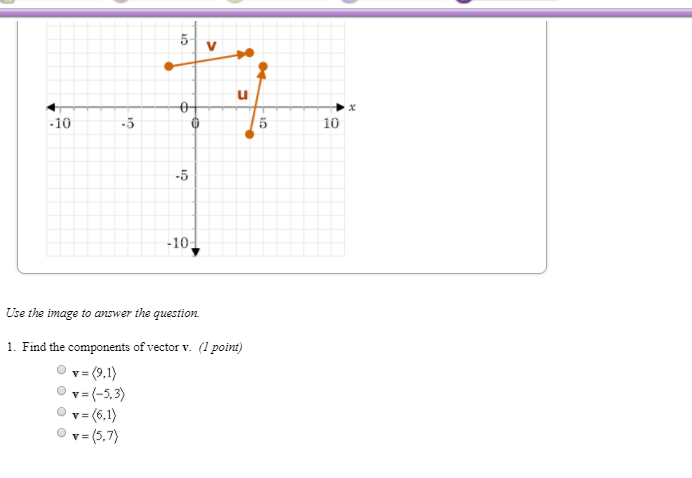
What is the start and end point of vector v?
kaylak:
-2,3 4,4
iGreen:
Yep, now plug them into here: \(\sf <x_2-x_1,y_2-y_1>\) Can you do that?
kaylak:
6,1 so c
kaylak:
@igreen
 kaylak:
@Vocaloid
 Vocaloid:
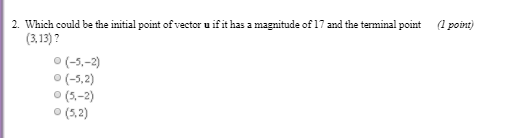
kind of need to do trial and error on this one, go one by one and calculate terminal - initial and see which one gives a magnitude of 17
kaylak:
magnitude is term-initial then square and root it right?
Vocaloid:
yeah sort of, you'd subtract terminal - intial, then calculate r = sqrt(x^2 + y^2) based on the difference
kaylak:
that was easy a lol
Vocaloid:
good
 Vocaloid:
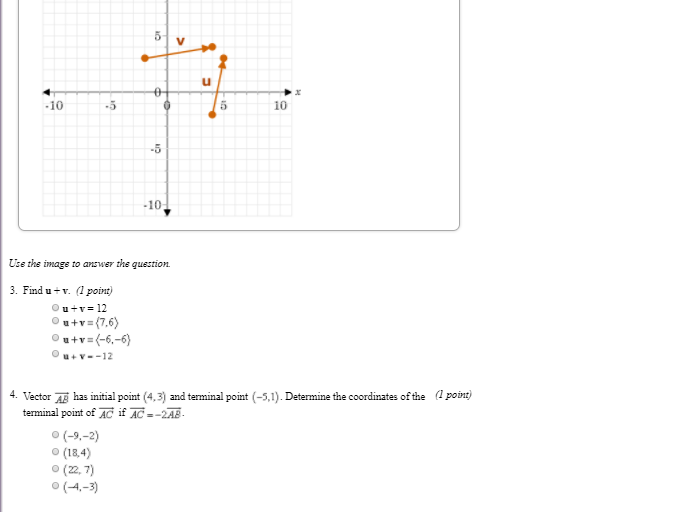
tip to tail method, re-draw the tip of one arrow at the tail of the other arrow (probably easier to draw than describe)
Vocaloid:
|dw:1522724413862:dw|
Vocaloid:
|dw:1522724433444:dw|
Vocaloid:
then you draw an arrow from the tail of v to the tip of u like so:|dw:1522724482002:dw|
kaylak:
is 3 a this type question I got wrong last time lol
Vocaloid:
it's kind of hard to see, but since the final arrow is pointing up and to the right, which answer do you think might look the best? as a hint: you are adding two vectors so the final answer must also be a vector
Vocaloid:
for a vector pointing up and to the right, would you expect the coordinates to be positive or negative?
Vocaloid:
imagine a vector at (0,0) pointing up and towards the right|dw:1522724927017:dw|
Vocaloid:
notice how the vector is pointing up along both axes so we would naturally expect the coordinates to be positive making <7,6> the only viable answer that is a vector w/ positive coordinates
Vocaloid:
for 4) you just need to subtract terminal - initial, then apply the transformation -2AB bby multiplying AB by -2
kaylak:
I'm back sorry was busy with something
kaylak:
so b
Vocaloid:
for 4, yeah, I got B too
Vocaloid:
3 and 4 are actually both B
kaylak:
yes I saw ;
 Vocaloid:
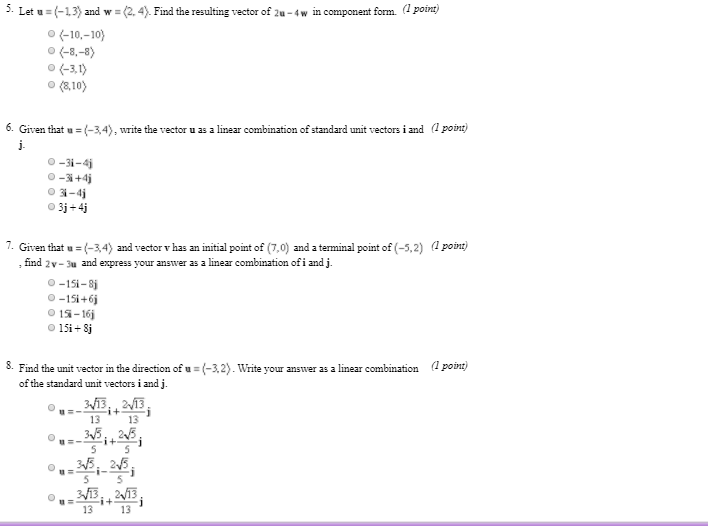
for 3) first find 2u by multiplying 2 by u, then find 4w using the same logic/reasoning, then finally subtract 2u - 4w based on your results from the earlier steps
Vocaloid:
since all of the x-coordinates are different you only need to consider the first coordinate of each vector
kaylak:
b? hold on I'm rechecking
Vocaloid:
just check the first coordinates of each vector 2u - 4w --> 2(-1) - 4(2) = ?
kaylak:
-10
kaylak:
so a
Vocaloid:
good, so if the first coordinate is -10 that eliminates all possibilities except a
Vocaloid:
for 6) the first coordinate goes in front of i and the second coordinate goes in front of j so -3i + 4j
Vocaloid:
for 7) you need to calculate v by taking terminal - initial, then calculate 2v - 3u
kaylak:
c?
Vocaloid:
i got something a little diff what did you get as your vector v?
kaylak:
-12,2
Vocaloid:
good, so u = <-3,4) and v = <-12,2> 2v - 3u = 2<-12,2> - 3<-3,4> = ? as a hint try to consider the x and y-coordinates separately then put them together into a final vector
kaylak:
-24,4 -9,12
kaylak:
I was trying to use u and terminal, too lol
Vocaloid:
good, so -24 - (-9) = ? 4 - 12 = ? then put 'em together
kaylak:
15 -8
Vocaloid:
careful with the first sign, it's -15 so A -15i - 8j
Vocaloid:
anyway for 8) calculate the magnitude of the vector first, then find the unit vector by dividing vector/magnitude
kaylak:
right and hold on
kaylak:
b
Vocaloid:
you're close, you should have gotten sqrt(13) as the magnitude, when you divide -3/sqrt(13) then rationalize it you get -3sqrt(13)/13 not -3sqrt(13)/5 so A not B
 kaylak:
@Vocaloid
Vocaloid:
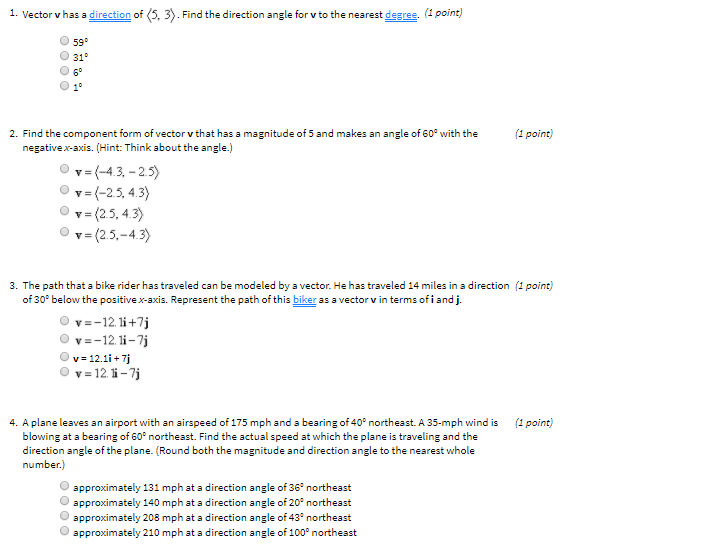
1) tan(theta) = y/x plug in y and x and solve for theta, you'll need a calculator for this wolfralpha.com
kaylak:
a?
Vocaloid:
good for 2) let's try sketching the given angle and magnitude
Vocaloid:
|dw:1522729081322:dw|
Vocaloid:
any ideas how you would calculate the height/length of that triangle?
kaylak:
by using sohcahtoa or something like that
Vocaloid:
yeah, there's a bit faster method though b/c this is a 30-60-90 triangle the side across from the 30-angle is half the hypotenuse so:
Vocaloid:
|dw:1522729216941:dw|
Vocaloid:
making B the only possibility since it starts w/ -2.5
Vocaloid:
similar thing w/ problem 3, sketch the triangle like so:|dw:1522729273981:dw|
kaylak:
oh cool
Vocaloid:
this is another 30-60-90 triangle, try calculating the height and length of the triangle to figure out the coordinates of the vector
Vocaloid:
good, D is right
kaylak:
it is oh ok then d
kaylak:
and now #4
Vocaloid:
huh I don't exactly remember but I think we would start with resolving the two vectors into their cos/sin components so 175cos(40) + 35cos(60) gives the x-coordinate I think and 175sin(40) + 35sin(60) should give the y-coordinate, then you'd calculate the magnitude of the new vector
kaylak:
so i have 151.5 and 142 so far
Vocaloid:
good so <151.5, 142> is the new vector, calculate the magnitude and direction remember the angle is given by tan(theta) = y/x and the magnitude is r = sqrt(x^2 + y^2)
kaylak:
c
Vocaloid:
awesome
 Vocaloid:
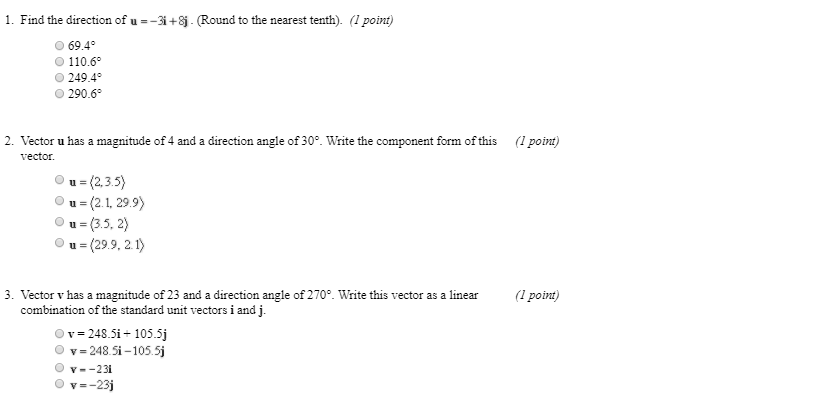
1. tan(theta) = y/x solve for theta
kaylak:
b?
Vocaloid:
awesome for 2) <magnitude*cos(theta), magnitude*sin(theta)> = ?
kaylak:
a
Vocaloid:
other way around, switch the coordinates, so C
Vocaloid:
3) same thing, magnitude*cos(theta), magnitude*sin(theta)
kaylak:
d
Vocaloid:
good
 Vocaloid:
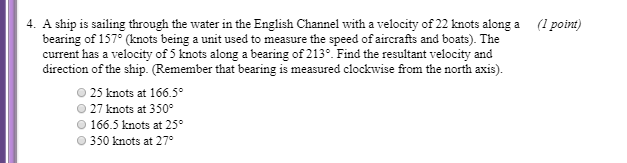
similar as the airplane problem, first find magnitude*cos(theta) + other magnitude*cos(other theta) = the new x-coordinate then find magnitude*sin(theta) + other magnitude*sin(other theta) = the new y--cordinate put those in a vector then find the direction/magnitude
Vocaloid:
ship: magnitude 22, theta = 157 degrees current: magnitude 5, theta = 213 calculate the new x and y component of the vector
kaylak:
I have -12 now what would the magnitude to divide by is
Vocaloid:
your vector needs to have an x and y- coordinate
kaylak:
ok so -24 and 12
Vocaloid:
current magnitude*cos(theta) + ship magnitude*cos(theta) = ?
Vocaloid:
check your calculations again
kaylak:
a?
Vocaloid:
good, A it's 1AM, I need to go to sleep
kaylak:
okay goodnight
Join our real-time social learning platform and learn together with your friends!
 KBaby:
Verse 1 We left our names in the dust of the driveway Watched the old town shrink
KBaby:
Lyrics Generator Use AI to write the lyrics for a song. Suggested Genres: Pop Hip
KBaby:
Verse 1 We left our names in the dust of the driveway Watched the old town shrink
KBaby:
Lyrics Generator Use AI to write the lyrics for a song. Suggested Genres: Pop Hip
 aitexturegenerator:
How are you all handling AI-generated textures for 3D models and game assets without losing the hand-made feel? I've been doing a small stylized environment
aitexturegenerator:
How are you all handling AI-generated textures for 3D models and game assets without losing the hand-made feel? I've been doing a small stylized environment

 Demon25:
Woke up feeling like that girl and that dude well he still aint crap pluse the du
Demon25:
Woke up feeling like that girl and that dude well he still aint crap pluse the du
 playtsec:
how do I get rid of stress from teachers... I just feel like running out the classroom and leaving on my own.
playtsec:
how do I get rid of stress from teachers... I just feel like running out the classroom and leaving on my own.
 JohnnyLFowler0812:
What type of gamer would play something and then get off for a while. Why not sta
JohnnyLFowler0812:
Which is better? Metallica Rap Country R&B hiphop Medal Gospel Chill Which 3 opti
JohnnyLFowler0812:
What type of gamer would play something and then get off for a while. Why not sta
JohnnyLFowler0812:
Which is better? Metallica Rap Country R&B hiphop Medal Gospel Chill Which 3 opti