
 zarkam21:
Help
 Vocaloid:
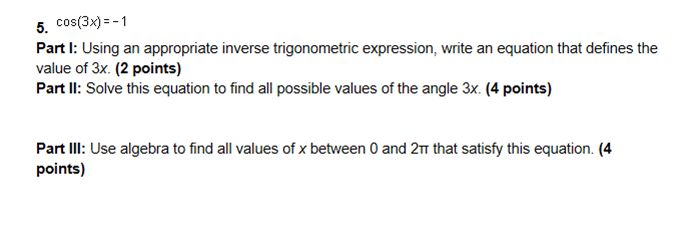
well, in order to "undo" the cos which inverse trig function would you use?
zarkam21:
sin
Vocaloid:
well that's a good guess but if we take the sin of both sides we just get sin(cos(3x)) = sin(-1) which doesn't really help us much but we can take the arccos of both sides to undo the cos, what do you get when you take the arccos of both sidse?
zarkam21:
-3
Vocaloid:
hm
zarkam21:
Ugh :/
Vocaloid:
so we start with cos(3x) = -1 and take the arccos of both sides we get arccos[cos(3x)] = arccos(-1) make sense so far?
zarkam21:
yes , i think so
Vocaloid:
the arccos and the cos cancel out to get 3x = arccos(-1) so that "defines" the value of 3x and is a sufficent sol'n for part I
Vocaloid:
anyway for part II: they want the angle sol'ns for 3x so what angle(s) correspond to arccos(-1)?
zarkam21:
angle as in on the unit circle?
Vocaloid:
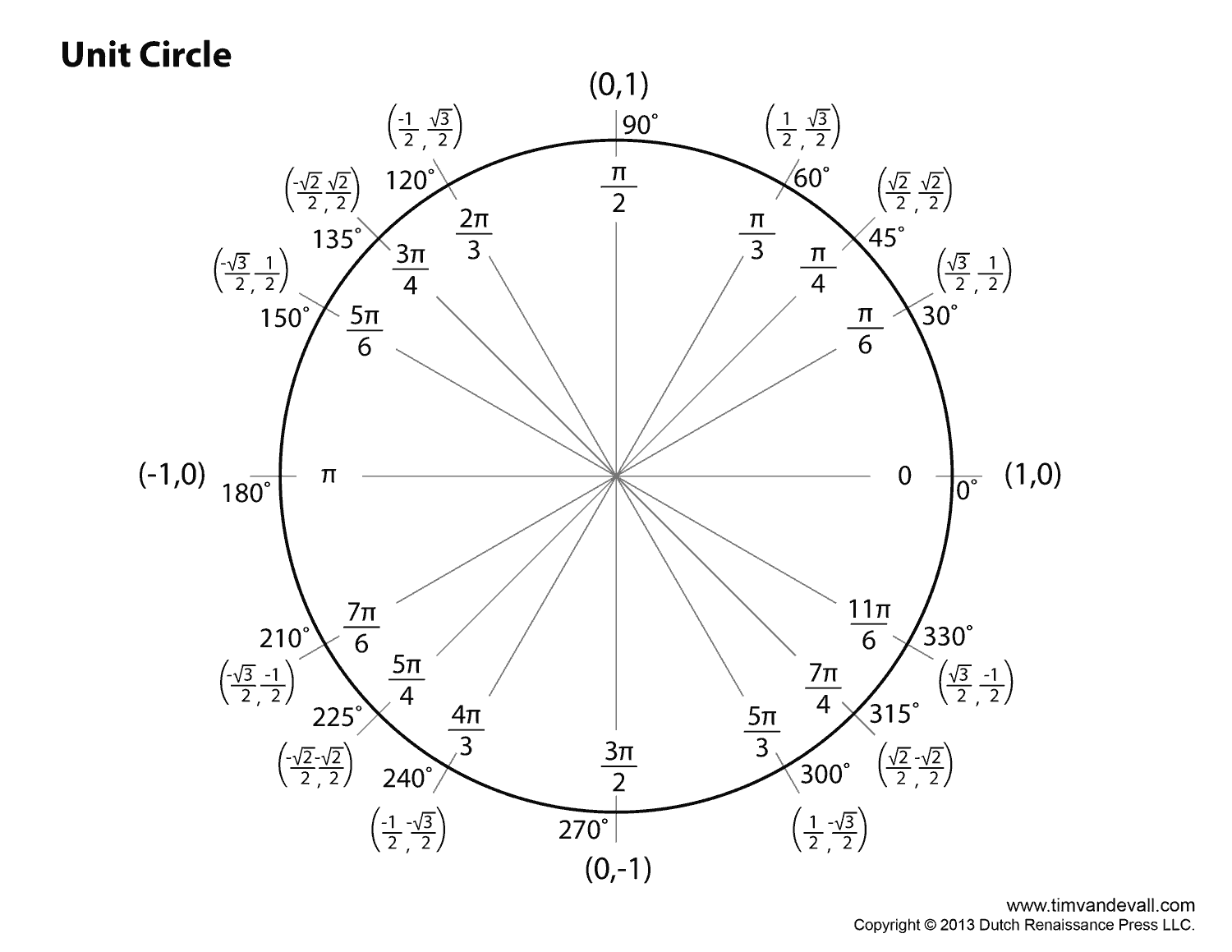
yes, what angle gives a cos value of -1?
zarkam21:
3pi/2
Vocaloid:
that's sin not cos
 Vocaloid:
cos is the x-coordinate so check to see where the x-coordinate is -1
zarkam21:
oh pi
zarkam21:
sorry
Vocaloid:
awesome so part II is just 3x = pi then for part III is just algebra, solve this equation for x
zarkam21:
x=pi/3
Vocaloid:
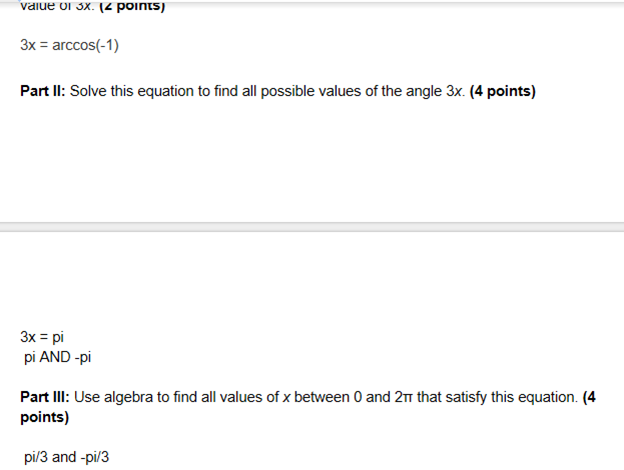
good ^^ I kind of forgot that cos(theta) is an even function so part II has pi AND -pi as its sol'ns and part III has pi/3 and -pi/3 as its' sol'ns ;;
 Vocaloid:
good for part II, "3x = pi" and "3x = -pi" is a better way to express the information
 Vocaloid:
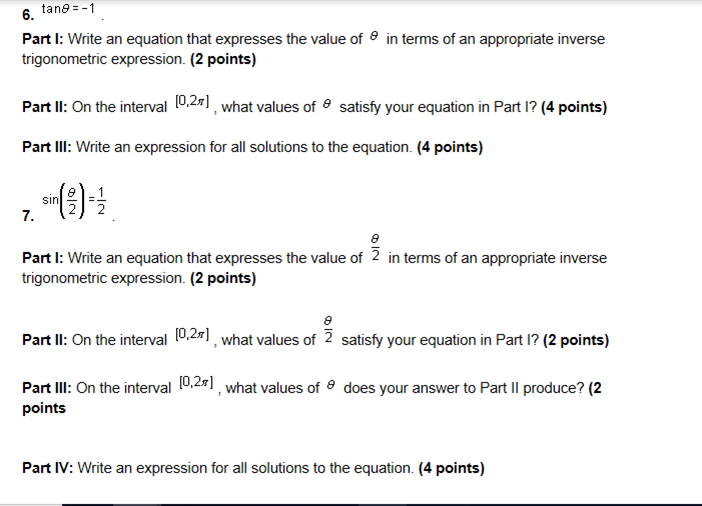
alrighty then for part I how would you solve tan(theta) = -1 for theta?
zarkam21:
inverse? :/
Vocaloid:
good, you'd take the arctan of each side, lmk what you get for theta
zarkam21:
arctan[tan(theta) = arctan (-1)
Vocaloid:
good, so the arctan and theta cancel out on the left side to get theta = arctan(-1)
zarkam21:
that is part I right
Vocaloid:
yes then for part II simply solve arctan(-1) by finding the angle where tan = -1
zarkam21:
3pi/2
Vocaloid:
keep in mind tan(theta) = sin(theta)/cos(theta) so you want the angles where sin and theta have the same magnitude but opposite sides
zarkam21:
it would be a y value right
Vocaloid:
tan = y/x
zarkam21:
Pi :/
Vocaloid:
at pi, sin = 0 and cos = -1 so sin/cos = 0 not -1
Vocaloid:
|dw:1523643301644:dw|
Vocaloid:
|dw:1523643306345:dw|
Vocaloid:
notice how these two locations have sin and cos equal in magnitude but opposite in sign? your sol'ns are therefore 7pi/4 and 3pi/4
zarkam21:
Alright and an expression would be one that would invlude 7pi/4 and 3pi/4 right
Vocaloid:
yeah, for part III since tan repeats itself every pi units it's 7pi/4 +/- pi and 3pi/4 +/- pi
zarkam21:
for number same process so i would take the inverse
Vocaloid:
yes, the arcsin of both sides
zarkam21:
arcsin[sin(theta/2) = arctan (1/2)
Vocaloid:
it's arcsin on the right side not arctan
zarkam21:
Oops
Vocaloid:
anyway, that gives us theta/2 = arcsin(1/2) as your sol'n for part I
zarkam21:
fixed that
Vocaloid:
anyway for part II just need to solve for theta/2 by finding angles on the UC where sin(theta) = 1/2
zarkam21:
2pi/3
Vocaloid:
sin is the y-coordinate and it needs to be 1/2 not -1/2
Vocaloid:
|dw:1523643714704:dw|
Vocaloid:
|dw:1523643719221:dw|
Vocaloid:
so pi/6 and 5pi/6 are your sol'ns for part II
Vocaloid:
then for part III if theta/2 = pi/6 and theta/2 = 5pi/6 solve for your two theta values
zarkam21:
1/2?
zarkam21:
wait i would use the unit circle
zarkam21:
sqrt3/2
Vocaloid:
you don't need to use the UC here, this is just simple algebra if theta/2 = pi/6 what does theta = ?
zarkam21:
pi/3
Vocaloid:
good, and if theta/2 = 5pi/6 then theta = 5pi/3 so your sol'ns for part III are pi/3 and 5pi/3
Vocaloid:
then for part IV you just need to consider all possible sin values, since sin repeats itself every 2pi units it's 5pi/3 +/- 2pi * n and pi/3 +/- 2pi*n
Vocaloid:
also you need to go back to the tan problem (#6) and change part III to 7pi/4 +/- n*pi and 3pi/4 +/- n*pi ( I forgot the n's)
zarkam21:
Perfect, you must get going now !! =) Thank you !!
Join our real-time social learning platform and learn together with your friends!
 KBaby:
Verse 1 We left our names in the dust of the driveway Watched the old town shrink
KBaby:
Lyrics Generator Use AI to write the lyrics for a song. Suggested Genres: Pop Hip
KBaby:
Verse 1 We left our names in the dust of the driveway Watched the old town shrink
KBaby:
Lyrics Generator Use AI to write the lyrics for a song. Suggested Genres: Pop Hip

 aitexturegenerator:
How are you all handling AI-generated textures for 3D models and game assets without losing the hand-made feel? I've been doing a small stylized environment
aitexturegenerator:
How are you all handling AI-generated textures for 3D models and game assets without losing the hand-made feel? I've been doing a small stylized environment

 Demon25:
Woke up feeling like that girl and that dude well he still aint crap pluse the du
Demon25:
Woke up feeling like that girl and that dude well he still aint crap pluse the du
 playtsec:
how do I get rid of stress from teachers... I just feel like running out the classroom and leaving on my own.
playtsec:
how do I get rid of stress from teachers... I just feel like running out the classroom and leaving on my own.
 JohnnyLFowler0812:
What type of gamer would play something and then get off for a while. Why not sta
JohnnyLFowler0812:
Which is better? Metallica Rap Country R&B hiphop Medal Gospel Chill Which 3 opti
JohnnyLFowler0812:
What type of gamer would play something and then get off for a while. Why not sta
JohnnyLFowler0812:
Which is better? Metallica Rap Country R&B hiphop Medal Gospel Chill Which 3 opti