
 hardlyhuman:
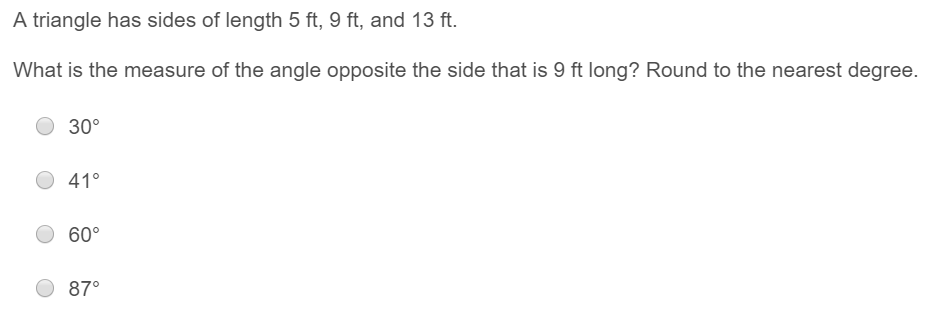
Geometry problem help please.
 Hero:
Hero:
Hi @hardlyhuman are you familiar with law of cosines?
hardlyhuman:
Hi again and a little
Hero:
Would you mind posting it here so I know that you know it? Thanks.
hardlyhuman:
In trigonometry, the law of cosines relates the lengths of the sides of a triangle to the cosine of one of its angles.
Hero:
Yeah, but what is the law of cosines formula?
 Hero:
Hero:
\(c^2 = a^2 + b^2 - 2ab\cos(C)\)
Hero:
That's the correct form it should be remembered.
hardlyhuman:
okay
Hero:
Because the first part is the Pythagorean Theorem `c^2 = a^2 + b^2` - `2ab\cos(C)` Then you're subtracting twice the legs (a and b) and the product of the cosine of the angle.
hardlyhuman:
ok
Hero:
So anyway, what you can do first is draw a model triangle with the given side lengths. Click the draw feature below this chat do to so.
hardlyhuman:
|dw:1525381581170:dw|
hardlyhuman:
I think it's 41
Hero:
Looks great. So now, the next step would be to smartly select your a, b, and c, values.
Hero:
Would you mind showing the work you did to get 41?
hardlyhuman:
No work, just making a guess
Hero:
Explain how to "guess" 41 from the given information.
hardlyhuman:
half of a 90 degree angle would be 45 and it looks to be a little less than that so, I thought 41
hardlyhuman:
wait hold on, did the wrong side
hardlyhuman:
nope, same guess
Hero:
Nope, that is not close to logical reasoning for this one.
Hero:
Right now, we need to assign variables for each given side a, b, and c. What variables have you assigned for each given side?
hardlyhuman:
a=5 b=9 c=13
hardlyhuman:
I really don't know what I'm doing here
Hero:
I know. That was intentional. I wanted you to do it wrong so that I could explain to you how to do it right. Since we need to find the angle opposite the side that is 9 ft long we need to make that our side c. So set c = 9. Then it won't matter which a or b you assign to the other sides.
Hero:
Let's try this again now, knowing that c = 9.
hardlyhuman:
okay
hardlyhuman:
A=5 B=13 C=9
Hero:
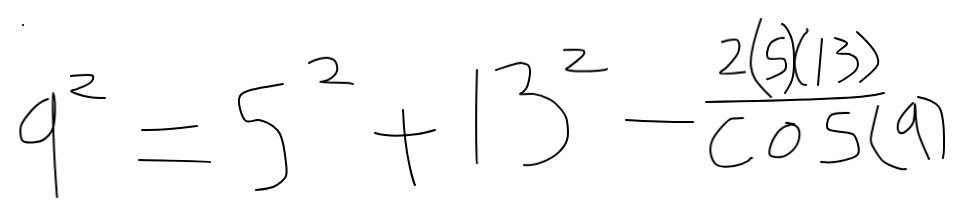
Okay, next plug those values in to the formula. But remember, since those are side values, we use smaller case a, b, and c and know that \(C \ne c\) The big \(C\) is what we are trying to find. The big \(C\) represents the angle opposite side \(c\).
 Hero:
Hero:
No, that does not reflect the formula I gave you.
hardlyhuman:
okay, let me try this again
Hero:
How about start with the formula I gave you and use \(\LaTeX\) to input the values.
hardlyhuman:
is this it? c2=a2+b2−2abcos(C)
hardlyhuman:
and I don't know what that other stuff is supposed to be
Hero:
Typing this `\(c^2 = a^2 + b^2 - 2ab\cos(C)\)` makes this: \(c^2 = a^2 + b^2 - 2ab\cos(C)\)
hardlyhuman:
so is that it or no?
Hero:
I can't interpret what you wrote because you are not using the right symbols. You have to at least use the caret symbol for exponents.
hardlyhuman:
ok
hardlyhuman:
how would i use the caret symbol for exponents?
Hero:
I just showed you look above
hardlyhuman:
k
Hero:
Alternatively you can use the equation button just below the chat.
 Hero:
Hero:
That's better, but you forgot to enter the a and b values for the `2ab` portion of the formula.

Join our real-time social learning platform and learn together with your friends!
 KBaby:
Verse 1 We left our names in the dust of the driveway Watched the old town shrink
KBaby:
Lyrics Generator Use AI to write the lyrics for a song. Suggested Genres: Pop Hip
KBaby:
Verse 1 We left our names in the dust of the driveway Watched the old town shrink
KBaby:
Lyrics Generator Use AI to write the lyrics for a song. Suggested Genres: Pop Hip

 aitexturegenerator:
How are you all handling AI-generated textures for 3D models and game assets without losing the hand-made feel? I've been doing a small stylized environment
aitexturegenerator:
How are you all handling AI-generated textures for 3D models and game assets without losing the hand-made feel? I've been doing a small stylized environment

 Demon25:
Woke up feeling like that girl and that dude well he still aint crap pluse the du
Demon25:
Woke up feeling like that girl and that dude well he still aint crap pluse the du
 playtsec:
how do I get rid of stress from teachers... I just feel like running out the classroom and leaving on my own.
playtsec:
how do I get rid of stress from teachers... I just feel like running out the classroom and leaving on my own.
 JohnnyLFowler0812:
What type of gamer would play something and then get off for a while. Why not sta
JohnnyLFowler0812:
Which is better? Metallica Rap Country R&B hiphop Medal Gospel Chill Which 3 opti
JohnnyLFowler0812:
What type of gamer would play something and then get off for a while. Why not sta
JohnnyLFowler0812:
Which is better? Metallica Rap Country R&B hiphop Medal Gospel Chill Which 3 opti