
 zarkam21:
Help with 4 part question
 Vocaloid:
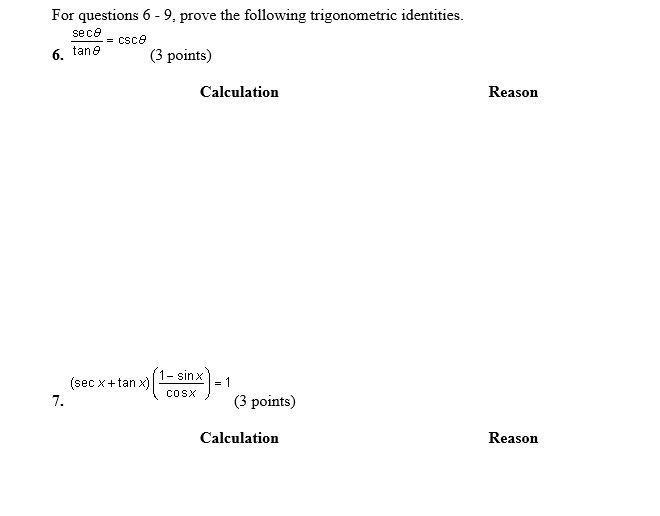
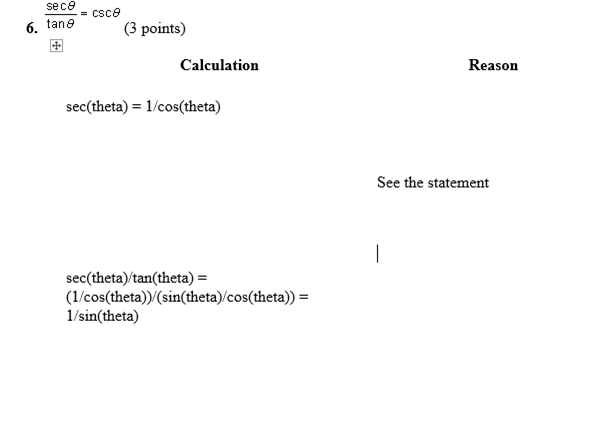
let's start with 6 we can re-write sec as 1/cos and tan as sin/cos so sec/tan = (1/cos)/(sin/cos) = ? (remember your rules for dividing fractions)
zarkam21:
csc(x)
Vocaloid:
good, the equation equals 1/sin which equals csc thus, proof complete
 zarkam21:
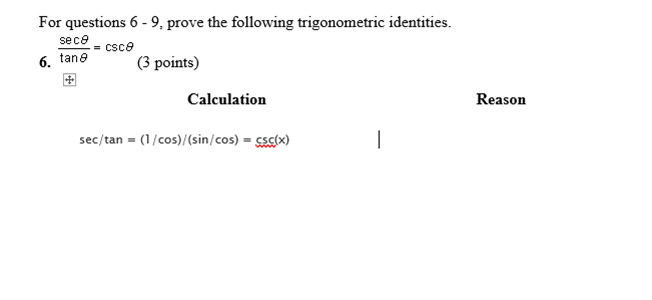
Like this
Vocaloid:
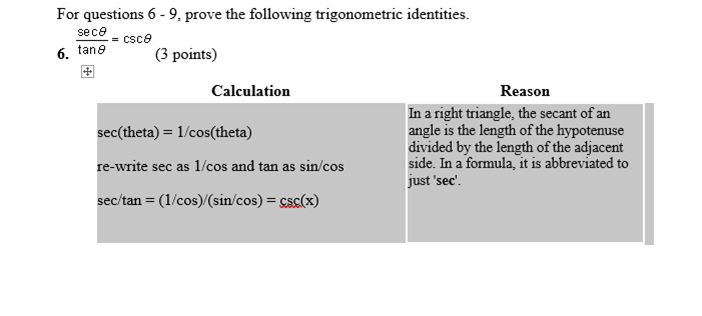
well they might want you to break it down into steps like, the first step could be sec(theta) = 1/cos(theta) with the reason being "sec definition" or something, then repeat for each of the substitutions we made
 Vocaloid:
notice how we also said that tan(theta) = sin(theta)/cos(theta), that could be another step then for the third step you could simply write sec(theta)/tan(theta) = (1/cos(theta))/(sin(theta)/cos(theta)) = 1/sin(theta) with the reasoning being "substituting for tan and sec and algebraic simplification", then write the step that converts 1/sin(theta) to csc(theta) using the csc definition
zarkam21:
something like this
Vocaloid:
oh when I said "sec definition" I wasn't talking about the literal definition of secant, just the statement that says sec(theta) = 1/cos(theta)
 zarkam21:
wait so like this
Vocaloid:
|dw:1525491441566:dw|
Vocaloid:
|dw:1525491446346:dw|
Vocaloid:
then, next step would be to cancel out cos(theta) to get 1/sin(theta), last step would be 1/sin(theta) = csc(theta) using the definition of csc as a reason
Vocaloid:
anyway if you have any additional questions or just want to move onto #7 i'm ready
zarkam21:
okay im ready sorry i was writing it all down
Vocaloid:
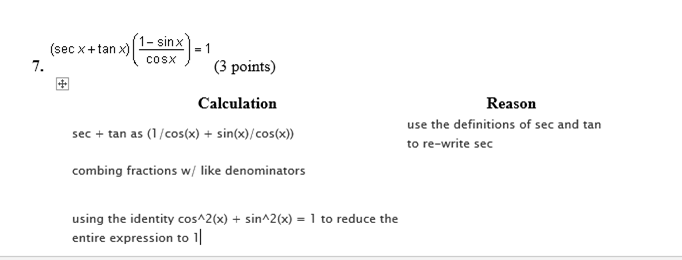
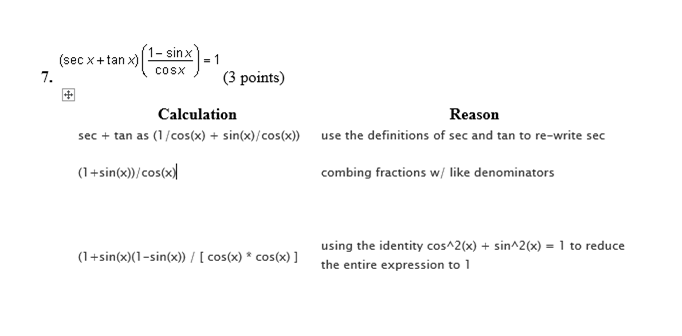
ok, so for 7 we would use the definitions of sec and tan to re-write sec + tan as (1/cos(x) + sin(x)/cos(x)) using the reasoning of "combining fractions w/ common denominators" or something like that, we can re-write this as (1+sin(x))/cos(x) then, we can simply multiply the two fractions to get (1+sin(x)(1-sin(x)) / [ cos(x) * cos(x) ] this should equal 1 (check your identities if you are getting stuck)
zarkam21:
okay and the reasoning for this would be the definition right
Vocaloid:
the definition of what
zarkam21:
waot nevermind we are simply just multiplying so would there even be a reasoning for that>
Vocaloid:
there are several steps, let's try to break it down from the top
Vocaloid:
ok, so for 7 we would use the definitions of sec and tan to re-write sec + tan as (1/cos(x) + sin(x)/cos(x)) notice how we used two definitions, one for sec, one for tan, to re-write the expression
zarkam21:
yes i got that
zarkam21:
after that would be combining right
Vocaloid:
yes, combing fractions w/ like denominators
Vocaloid:
then multiplying, then using the identity cos^2(x) + sin^2(x) = 1 to reduce the entire expression to 1
zarkam21:
would combing fractions w/ like denominators and using the identity cos^2(x) + sin^2(x) = 1 to reduce the entire expression to 1 because different calculations or the same
zarkam21:
like2 different
Vocaloid:
two different steps
 zarkam21:
like thisright =)
Vocaloid:
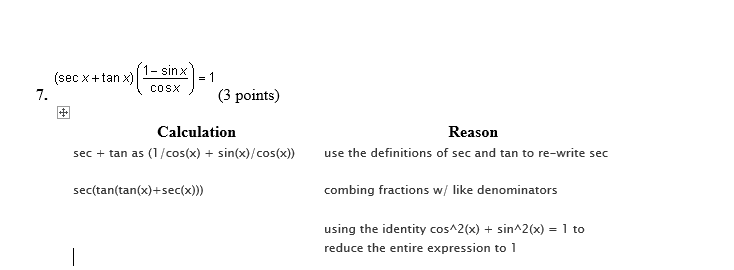
the calculations need to be on the left side, the reasonings/explanations on the right side
Vocaloid:
|dw:1525492631374:dw|
Vocaloid:
|dw:1525492636223:dw|
Vocaloid:
then on the left side you would write what the results of applying the steps are
 zarkam21:
The next reason , I am not completely sure how to calculate
Vocaloid:
\(\color{#0cbb34}{\text{Originally Posted by}}\) @Vocaloid ok, so for 7 we would use the definitions of sec and tan to re-write sec + tan as (1/cos(x) + sin(x)/cos(x)) using the reasoning of "combining fractions w/ common denominators" or something like that, we can re-write this as (1+sin(x))/cos(x) then, we can simply multiply the two fractions to get (1+sin(x)(1-sin(x)) / [ cos(x) * cos(x) ] this should equal 1 (check your identities if you are getting stuck) \(\color{#0cbb34}{\text{End of Quote}}\)
Vocaloid:
what did we get after we combined the fractions?
 Vocaloid:
good, what's the next step after combining the fractions?
zarkam21:
multiplying the fractions
zarkam21:
and you get (1+sin(x)(1-sin(x)) / [ cos(x) * cos(x) ]
Vocaloid:
good
Vocaloid:
then, when you expand the numerator and denominator you get (1- sin^2(x)) / cos^2(x) and this equals 1 thus, proof complete
zarkam21:
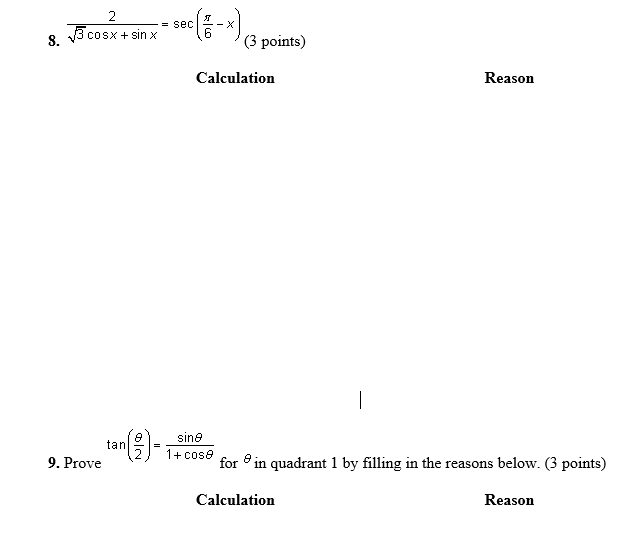
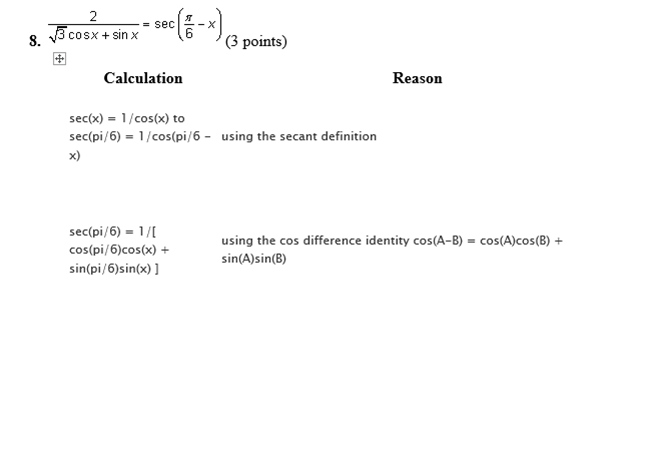
Okay 8
Vocaloid:
using the secant definition sec(x) = 1/cos(x) therefore sec(pi/6) = 1/cos(pi/6 - x) using the cos difference identity cos(A-B) = cos(A)cos(B) + sin(A)sin(B) sec(pi/6) = 1/[ cos(pi/6)cos(x) + sin(pi/6)sin(x) ] then you just need to plug in the values of cos(pi/6) and sin(pi/6) into the equation, then do a bit of algebraic manipulation/simplification to get to the expression in the original problem
Vocaloid:
*plug the values from the unit circle
zarkam21:
sqrt3/2 , 1/2
Vocaloid:
good, plug those in and simplify the expression until you get what's in the original problem
 Vocaloid:
*sec(pi/6 - x) = 1/cos(pi/6 - x)
Vocaloid:
otherwise yeah, keep going
 zarkam21:
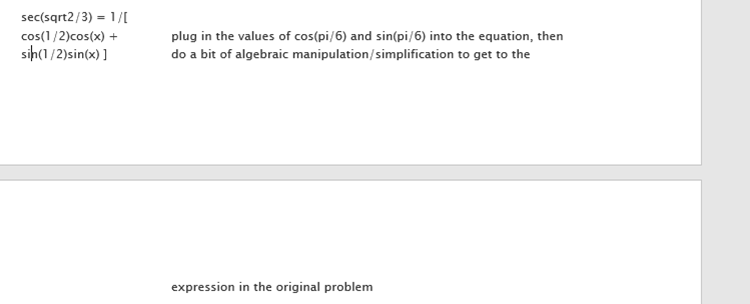
this is what Igot
Vocaloid:
the 'do a bit of algebraic manipulation" is instructions for you, not to include in the solution
zarkam21:
lol oh
zarkam21:
is everything else okay>
Vocaloid:
now, [this is instructions for you, do not include this in the answer] plug in the values for cos(pi/6) and sin(pi/6), then simplify the problem until it looks like the original equation
Vocaloid:
*** almost, wherever it says sec(pi/6) it needs to be sec(pi/6 - x)
zarkam21:
sec(pi/6 - x)= 1/[ cos(1/2)cos(x) + sin(1/2)sin(x) ]
Vocaloid:
anyway it's getting pretty late here, lemme wrap this up
zarkam21:
so like that
zarkam21:
okay sure
zarkam21:
I dont want to hold you up either :/
Vocaloid:
step 1: sec(pi/6 - x) = 1/cos(pi/6 - x) reason: secant definition step 2: 1/cos(pi/6 - x) = 1/[cos(pi/6)cos(x) + sin(pi/6)sin(x)] reason: cos difference identity cos(A-B) = cosAcosB - sinAsinB step 3: 1/[sqrt(3)/2cos(x) + (1/2)sin(x)] reason: substituting the values for cos(pi/6) and sin(pi/6) from the UC step 4: 2/[sqrt(3)cos(x) + sin(x)] reason: multiply the numerator and denominator by 2 to eliminate the fraction
Vocaloid:
and done
Vocaloid:
9 is pretty complex but here goes:
Vocaloid:
tan(theta/2) = sin(theta/2)/cos(theta/2) using the tan definition sin(theta) * 2cos(theta/2)
cos(theta/2) * 2cos(theta/2) ^ that's a fraction; we multiplied the num and denom by 2 cos (theta/2) to get this now we consider the numerator and denominator separately:
Vocaloid:
*should be sin(theta/2) in the numerator
Vocaloid:
anyway, sin(theta/2) * 2 * cos(theta/2) = sin(theta) using the identity sin(2x) = 2sin(x)cos(x) [let x = theta/2] that's the numerator, then we move to the denominator
Vocaloid:
2cos^2(theta/2) using the identity: cos^2(x) = cos(2x) + 1 gives us 2cos^2(theta/2) = cos(theta) + 1
Vocaloid:
putting it all together gives us tan(theta/2) = sin(theta)/ (1 + cos(theta))
Vocaloid:
disclaimer: not my solution, here's the condensed version here|dw:1525495204458:dw|
Vocaloid:
anyway I'm kinda sleepy so I'm gonna hit the hay, try to break it down step by step, showing what sort of reasoning/proof you applied for each step, then what the result of applying the step is
zarkam21:
I git it... than you so much
Join our real-time social learning platform and learn together with your friends!
 KBaby:
Verse 1 We left our names in the dust of the driveway Watched the old town shrink
KBaby:
Lyrics Generator Use AI to write the lyrics for a song. Suggested Genres: Pop Hip
KBaby:
Verse 1 We left our names in the dust of the driveway Watched the old town shrink
KBaby:
Lyrics Generator Use AI to write the lyrics for a song. Suggested Genres: Pop Hip

 aitexturegenerator:
How are you all handling AI-generated textures for 3D models and game assets without losing the hand-made feel? I've been doing a small stylized environment
aitexturegenerator:
How are you all handling AI-generated textures for 3D models and game assets without losing the hand-made feel? I've been doing a small stylized environment

 Demon25:
Woke up feeling like that girl and that dude well he still aint crap pluse the du
Demon25:
Woke up feeling like that girl and that dude well he still aint crap pluse the du
 playtsec:
how do I get rid of stress from teachers... I just feel like running out the classroom and leaving on my own.
playtsec:
how do I get rid of stress from teachers... I just feel like running out the classroom and leaving on my own.
 JohnnyLFowler0812:
What type of gamer would play something and then get off for a while. Why not sta
JohnnyLFowler0812:
Which is better? Metallica Rap Country R&B hiphop Medal Gospel Chill Which 3 opti
JohnnyLFowler0812:
What type of gamer would play something and then get off for a while. Why not sta
JohnnyLFowler0812:
Which is better? Metallica Rap Country R&B hiphop Medal Gospel Chill Which 3 opti