
 zarkam21:
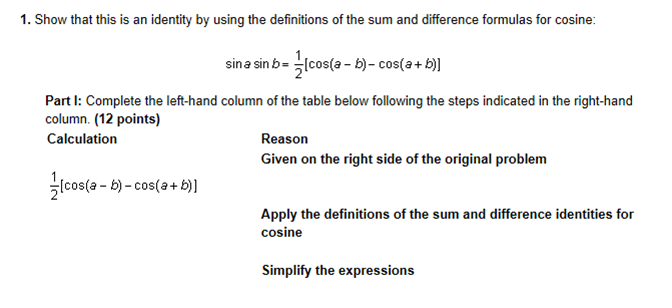
2 part question
 Hero:
Hero:
Afternoon @zarkam21, how far have you gotten with this one?
zarkam21:
I would isolate sin right
Hero:
Strange that it says to complete the left hand side of the column. The left hand side of the column contains the expression \(\dfrac{1}{2}\left[\cos(a - b)-\cos(a + b)\right]\) So we have to manipulate that until we get the expression of the left side of the equation. Hope that's not confusing for you.
Hero:
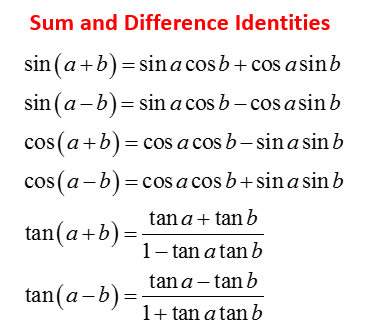
In other words it is expecting you to use sum and difference formulas to simplify the expression. Do you know the sum formula for \(\cos(a + b)\)?
 Hero:
Hero:
Okay, would you mind posting your steps here since you have the formulas there right in front of you?
zarkam21:
YEs I am doing that, its just taking me a min
Hero:
Okay, take your time.
zarkam21:
Sin a cos b - cos a sin b
zarkam21:
Im having a harf time
zarkam21:
this is what i got so far
Hero:
I'd prefer if you started with the original expression, then post up to the point where you are now. I want to see how you are manipulating the expression.
 zarkam21:
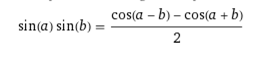
and then: 2sin(a) sin(b) = cos (a-b) - cos (a+b)
Hero:
? But remember, we're only working with the expression on the right side of the equation.
zarkam21:
oh beginning with the 1/2?
Hero:
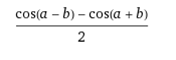
Yes and you're trying to manipulate that until you get the left side of the equation. But you don't do anything to the left side. You leave that as is.
 Hero:
Hero:
Yes, manipulate that until you get the left hand side of the equation. Post each of your steps here. What would be the first step?
zarkam21:
that is expansion
Hero:
Here, let's do it this way. I'll just walk you through the whole thing. I'm going to write the expression. Then tell you the steps. You will just have to perform the steps afterwards. Use \(\LaTeX\) though.
Hero:
Okay, so we start with: \(\dfrac{1}{2}\left[\cos(a - b)-\cos(a + b)\right]\) The first step is to replace the expression \(\cos(a - b)\) with \(\cos(a)\cos(b)+\sin(a)\sin(b)\)
Hero:
@zarkam21, go ahead and try performing that step.
zarkam21:
\[1/2 [\cos(a) \cos(b)+\sin(a) \sin(b) - \cos(a+b)]\]
Hero:
Okay, that's great. Next replace \(\cos(a + b)\) with \(\cos(a)\cos(b) - \sin(a)\sin(b)\). Make sure to put that entire expression in parentheses due to the minus on the outside.
zarkam21:
\[1/2[\cos(a)\cos(b)+\sin(a)\sin(b)−(\cos(a) \cos(b)-\sin(a)\sin(b))]\]
Hero:
Very good, now distribute the negative to expression in the parentheses, then remove the parentheses. Basically you will flip the signs of each term in the parentheses. Let's see if you can perform this step correctly.
zarkam21:
would it be each like (b)
zarkam21:
or the entire thing like sin (b)
Hero:
It would be like \(-(a - b) = -a + b\) for example.
zarkam21:
\[1/2[\cos -a \cos -b +\sin -a \sin -b − \cos-a \cos-b−\sin-a \sin(-b))]\]
zarkam21:
ugh :/
Hero:
Yep, I see that I confused you. It doesn't work that way. The variables are in parentheses. You can't do anything with them in this instance.
Hero:
But don't get frustrated. This is how you learn. The correct distribution is this:
Hero:
At this point, we have: \(1/2[\cos(a)\cos(b)+\sin(a)\sin(b)−(\cos(a) \cos(b)-\sin(a)\sin(b))]\) After distributing the negative and removing the parentheses we end up with: \(1/2[\cos(a)\cos(b)+\sin(a)\sin(b)−\cos(a) \cos(b)+\sin(a)\sin(b))]\) Notice how the signs have flipped now after distributing the negative.
Hero:
Next step is to combine like terms. Do you think you can perform this next step? Yea or Nea?
zarkam21:
Yes I think I can
Hero:
Okay, good luck :D
zarkam21:
sin(a)sin(b) 1/2 (cos(a-b)-cos(a+b))
Hero:
@zarkam21 I don't understand what you have written here. I asked you to combine like terms.
zarkam21:
well cos cancels out doesn't it
zarkam21:
and we are left with sin
Hero:
Yes but you still must write out the expression correctly. Otherwise, you can make a critical mistake and get it wrong. When you combine like terms you should have ended up with \(1/2[\cos(a)\cos(b) - \cos(a)\cos(b) + \sin(a)\sin(b) + \sin(a)\sin(b)]\)
zarkam21:
1/2[sin(a)sin(b)+sin(a)sin(b)]
Hero:
Yes correct.
Hero:
And then you would combine the expressions involving sine to get what?
zarkam21:
well there are 2 a's and 2 b's so maybe a^2
Hero:
By the way, we should write the fraction properly at this point to get: \(\dfrac{2\sin(a)\sin(b)}{2}\)
Hero:
At this point it is clear that 2 cancels at top and bottom to get just \(\sin(a)\sin(b)\)
zarkam21:
yay
zarkam21:
thank you so much i know thay took a lot of patience
Hero:
@zarkam21, you're welcome. Hopefully you understand the process a little better now.
Join our real-time social learning platform and learn together with your friends!
 KBaby:
Verse 1 We left our names in the dust of the driveway Watched the old town shrink
KBaby:
Lyrics Generator Use AI to write the lyrics for a song. Suggested Genres: Pop Hip
KBaby:
Verse 1 We left our names in the dust of the driveway Watched the old town shrink
KBaby:
Lyrics Generator Use AI to write the lyrics for a song. Suggested Genres: Pop Hip

 aitexturegenerator:
How are you all handling AI-generated textures for 3D models and game assets without losing the hand-made feel? I've been doing a small stylized environment
aitexturegenerator:
How are you all handling AI-generated textures for 3D models and game assets without losing the hand-made feel? I've been doing a small stylized environment

 Demon25:
Woke up feeling like that girl and that dude well he still aint crap pluse the du
Demon25:
Woke up feeling like that girl and that dude well he still aint crap pluse the du
 playtsec:
how do I get rid of stress from teachers... I just feel like running out the classroom and leaving on my own.
playtsec:
how do I get rid of stress from teachers... I just feel like running out the classroom and leaving on my own.
 JohnnyLFowler0812:
What type of gamer would play something and then get off for a while. Why not sta
JohnnyLFowler0812:
Which is better? Metallica Rap Country R&B hiphop Medal Gospel Chill Which 3 opti
JohnnyLFowler0812:
What type of gamer would play something and then get off for a while. Why not sta
JohnnyLFowler0812:
Which is better? Metallica Rap Country R&B hiphop Medal Gospel Chill Which 3 opti