
 harliii:
Jarvis needs to determine the distance across a lake. However, he can't measure this distance directly over the water. So, he set up a situation where he could use the measurements of two similar triangles to find the distance across the lake. He selects a point X such that XZ is perpendicular to VZ, where V is a point at the other end of the lake. He then picks a point Y on XZ. From point Y, he finds point W on XV such that WY is parallel to VZ. If XY = 3,594 feet, WY = 1,797 feet, and XZ = 10,782 feet, what is the length of VZ, the distance across the lake?
harliii:
@hero can you tell me how to solve this
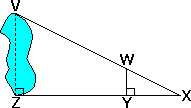
 Hero:
Hero:
|dw:1525718794283:dw|
Hero:
Okay @harliii they give you values for XY, WY, and XZ. Would you mind writing those values on the corresponding segments in the diagram please?
harliii:
idk how to do that
harliii:
nvm I figure it out
Hero:
Okay great.
Hero:
@harliii what happened to you? I only left the room for a minute because I was helping another student.
harliii:
I figure it out I didn't know how to set it up on the drawing so I just figure it out
Hero:
What do you mean? You don't know how to add the values for each segment to the drawing? Let me do the first one for you.
harliii:
know like I didn't how to put it in the graph u don't have help anymore I know how to do it now
Hero:
|dw:1525719596436:dw|
Hero:
|dw:1525719646897:dw|
Hero:
What do you mean you know how to do it now? If you know how to do it, post your steps.
harliii:
xy=xz wy=vz
harliii:
its a fraction
harliii:
3,594=10,782 1,797=x
harliii:
19375254/3,594=5,391 and that is vz
Join our real-time social learning platform and learn together with your friends!
 KBaby:
Verse 1 We left our names in the dust of the driveway Watched the old town shrink
KBaby:
Lyrics Generator Use AI to write the lyrics for a song. Suggested Genres: Pop Hip
KBaby:
Verse 1 We left our names in the dust of the driveway Watched the old town shrink
KBaby:
Lyrics Generator Use AI to write the lyrics for a song. Suggested Genres: Pop Hip

 aitexturegenerator:
How are you all handling AI-generated textures for 3D models and game assets without losing the hand-made feel? I've been doing a small stylized environment
aitexturegenerator:
How are you all handling AI-generated textures for 3D models and game assets without losing the hand-made feel? I've been doing a small stylized environment

 Demon25:
Woke up feeling like that girl and that dude well he still aint crap pluse the du
Demon25:
Woke up feeling like that girl and that dude well he still aint crap pluse the du
 playtsec:
how do I get rid of stress from teachers... I just feel like running out the classroom and leaving on my own.
playtsec:
how do I get rid of stress from teachers... I just feel like running out the classroom and leaving on my own.
 JohnnyLFowler0812:
What type of gamer would play something and then get off for a while. Why not sta
JohnnyLFowler0812:
Which is better? Metallica Rap Country R&B hiphop Medal Gospel Chill Which 3 opti
JohnnyLFowler0812:
What type of gamer would play something and then get off for a while. Why not sta
JohnnyLFowler0812:
Which is better? Metallica Rap Country R&B hiphop Medal Gospel Chill Which 3 opti