
 zarkam21:
An ambulance with its siren wailing is approaching an observer. Write two or three sentences to compare the pitch of the sound for the observer with the pitch for the ambulance driver. What is the term used to describe this phenomenon?
 Vocaloid:
well, for a sound wave that is moving with respect to the observer, it gets its pitch distorted based on the compression of sound waves, do you remember what this phenomenon is called? starts with a d
zarkam21:
well the decibal scale is used to measure different intensities, that isn't it is it?
Vocaloid:
|dw:1526656023486:dw| the name is the Doppler Effect notice how the soundwaves become more compressed as the ambulance approaches the observer, raising the pitch any ideas how this would compare to the person driving the ambulance? is the siren distorted at all for the driver?
Vocaloid:
well, since the driver is moving at the same speed as the siren, the driver hears the sound without any pitch distortion
zarkam21:
The driver is moving at the same speed as the siren, as a result of this, the driver does not have any pitch distortion. This phonomenon is called the Doppler Effect.
zarkam21:
Sorry I was AFK
Vocaloid:
well good but you also need to include how the sound is affected for the bystander
zarkam21:
The sound is affected by the bystander as well. Because of this sound, it is not distorted
zarkam21:
is this right?
zarkam21:
:/
zarkam21:
like it would stay the same for the driver
zarkam21:
and for the bystander the closer the driver is getting the higher th epitch
Vocaloid:
so if you scroll up a bit, we said that for the bystander, as the ambulance drives by the waves get compressed and the pitch goes up yeah that
zarkam21:
So is this good for the final (in my own words): The driver is moving at the same speed as the siren, as a result of this, the driver does not have any pitch distortion. This phonomenon is called the Doppler Effect. Also, for the bystander as the ambulance drives by him or comes closer to him the pitch goes up and it gets louder for him.
Vocaloid:
good but it would be a good idea to move the sentence with the doppler effect at the end
Vocaloid:
* to the end
zarkam21:
A light wave travels through water (n = 1.33) at an angle of 28°. What angle does it have when it passes from the water into glass (n = 1.5)?
Vocaloid:
|dw:1526658592483:dw| the water is the original medium so for n1 and theta1 we use the values for water for n2 we use glass plug everything in and solve for theta2
Vocaloid:
(ignore the c parts they're not relevant here)
zarkam21:
1.5=1.33/1.5=sin(28)/Sin(x) x=2.3
Vocaloid:
hm. I got x = 24.6 degrees your calculator might be in radians mode
zarkam21:
. A sound is transmitted through equal lengths of air and steel. In which material does sound travel faster? Write one or two sentences to explain your reasoning.
zarkam21:
air I think?
zarkam21:
And because it is not a solid and has an open surface to move faster?
Vocaloid:
generally the order of sound speeds is solids > liquids > gases sounds move faster in solids because the particles are closer together, allowing them to transmit waves more easily
zarkam21:
Between these two examples, the solid item would move the fastest, which is steel. This is so because in a solid the molecules are the closest in comparison to a liquid or gas. This allows there to be more wave movements.
Vocaloid:
A+
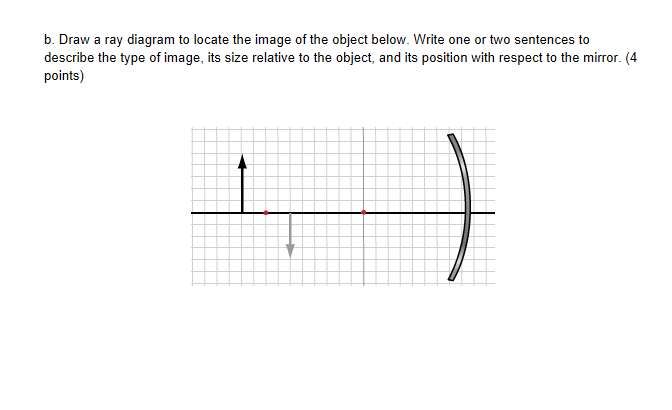 zarkam21:
Should I get maybe @rishavraj to help with this one
zarkam21:
or i think there was a chart maybe
zarkam21:
|dw:1526660382361:dw|
Vocaloid:
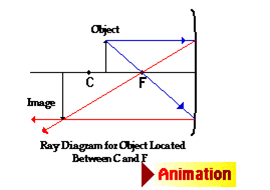
http://www.physicsclassroom.com/class/refln/Lesson-3/Ray-Diagrams-Concave-Mirrors well I can try to draw it from what I remember|dw:1526660510061:dw|
Vocaloid:
|dw:1526660515560:dw|
 rishavraj:
@zarkam21 try this you will be able to do it by yourself :) http://www.physicsclassroom.com/class/refln/Lesson-3/Ray-Diagrams-Concave-Mirrors
rishavraj:
oops @Vocaloid already posted it ... :) @zarkam21 lemme know if u need further help :)
Vocaloid:
oh well yeah I guess you could try the steps, we can try helping if you're getting stuck
Vocaloid:
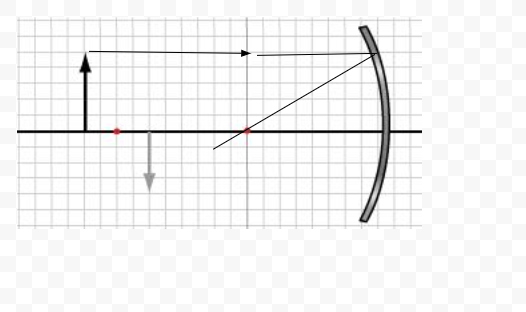
next would be drawing how that top ray bounces back from the lens and crosses the focal point, would you mind trying this step?
 zarkam21:
would be this right
Vocaloid:
sort of, just be careful because your image is in a different location/size than that diagram the top of the image is where your rays should converge
rishavraj:
@zarkam21 nah that incorrect ... for ur question the object is beyond Center of Curvature.. but the new image u posted.. object is in mid of R and 2R
Vocaloid:
|dw:1526660986884:dw| can you try drawing a straight line from this point, crossing the focal point?
 rishavraj:
@zarkam21 now make another ray which passes thru the F and then gets reflected back to travel parallel to the principal axis
Vocaloid:
good but this needs to be extended just a bit so it touches the image|dw:1526661168094:dw|
Vocaloid:
|dw:1526661192136:dw|
Vocaloid:
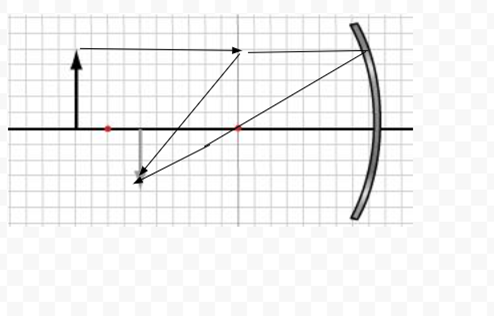
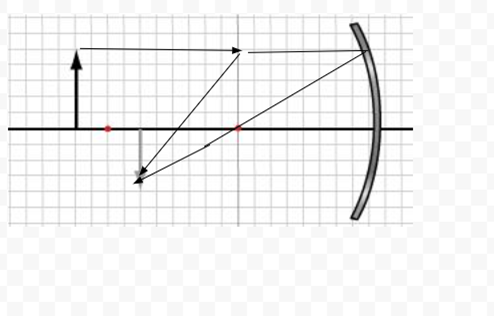
then we start from the top of the object (the black arrow), draw a ray down to the focal point, then touch the mirror, can you try this?
rishavraj:
@Vocaloid great job man :)
 zarkam21:
@rishavraj isnt she just amazing
Vocaloid:
hm, not quite right, the second ray should point from the object to the focal point|dw:1526661366635:dw|
Vocaloid:
|dw:1526661371577:dw|
Vocaloid:
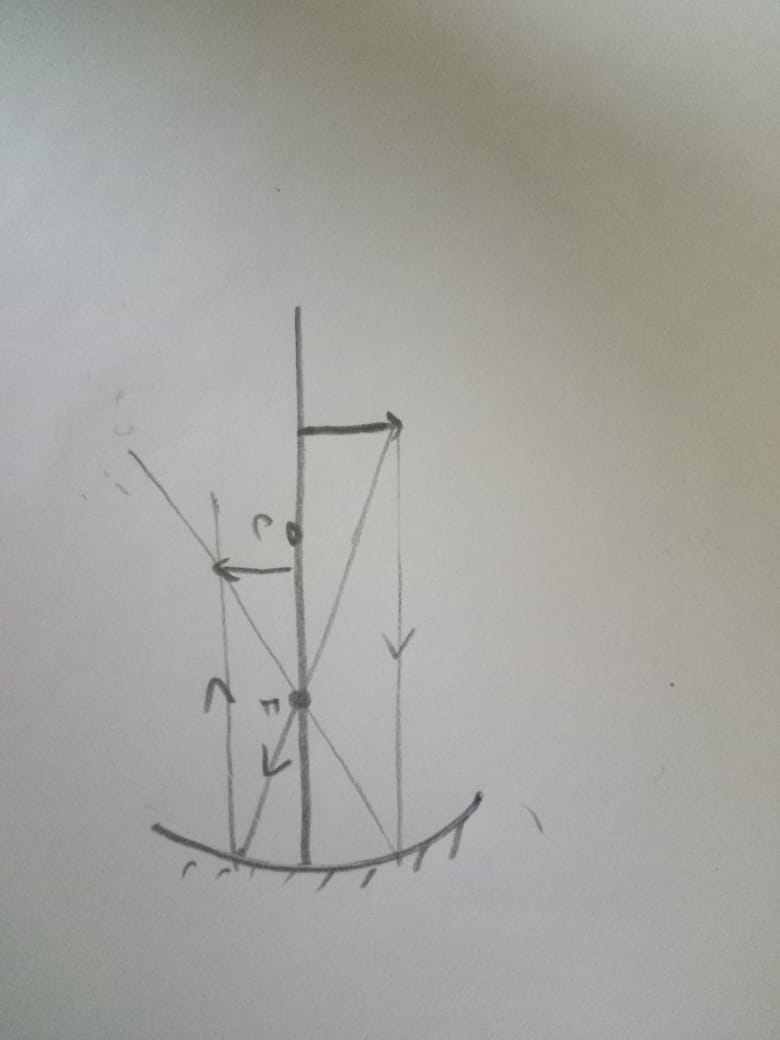
then it bounces off, parallel to the focal axis, like so:|dw:1526661430023:dw|
 Vocaloid:
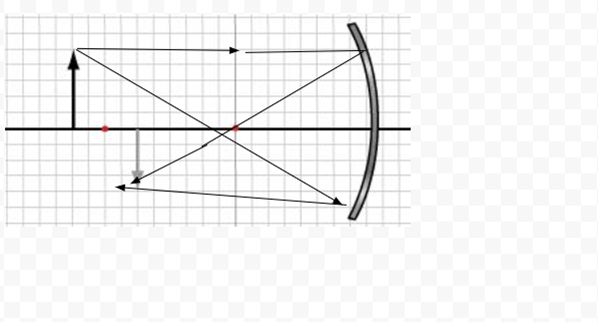
now, if we look at the tip of the image, that's where the lines converge so I believe this is done
 rishavraj:
damn was my reply just ignored ?? o_O *eye roll*
zarkam21:
An object is located 85.0 cm from a convex lens. The focal length is 25.0 cm. What is the image distance? Is the image real or virtual?
Vocaloid:
thank you rishi ;_; anyway I might let rishi take over b/c I forgot this ;_;
zarkam21:
Sure
zarkam21:
@rishavraj what do i do here
rishavraj:
lemme ask straight.. u want the answer or u wanna understand? :\
zarkam21:
I want to understand. I am never here for the answers
rishavraj:
@zarkam21 you are aware of the lens formula ?
zarkam21:
I forgot that formula? Is it di=do*f
rishavraj:
its \[\frac{ 1 }{ v } - \frac{ 1 }{ u } = \frac{ 1 }{ f }\]
zarkam21:
oh okay so it would be 1/85-1/u=1/25
rishavraj:
u -> object distance v -> image distance
zarkam21:
1/v-1/85=1/25 v=425/22 v=19.32
rishavraj:
so it would be \[\frac{ 1 }{ v } - \frac{ 1 }{ -85 } = \frac{ 1 }{ 25 }\]
rishavraj:
it would be -85 \[\frac{ 1 }{ v } - (\frac{ 1 }{ -85 }) =\frac{ 1 }{ 25 }\]
rishavraj:
@zarkam21 done?
zarkam21:
OH okay
zarkam21:
1/v-1/-85=1/25 v=-425/22 v=-19.32
zarkam21:
like this right
rishavraj:
@zarkam21 great :)
zarkam21:
can we move to the next question
zarkam21:
the image would be virtual ?
rishavraj:
yes
zarkam21:
i thought it was real
rishavraj:
@zarkam21 hold on
zarkam21:
okay
rishavraj:
@zarkam21 solve it again answer would be 35.4 something
zarkam21:
1/v-1/-85=1/25 v=-425/12 v=31.4
rishavraj:
425/12 = 35.4 -_-
zarkam21:
oh im sorry that was a typing mistke
zarkam21:
this would be a real image ?
rishavraj:
real..
zarkam21:
Yayyy
zarkam21:
thank you
zarkam21:
Can we do another question? Can I tag you
rishavraj:
would u not tag me if i said NO :P lol
zarkam21:
Lol i eill tage you then
Join our real-time social learning platform and learn together with your friends!
 KBaby:
Verse 1 We left our names in the dust of the driveway Watched the old town shrink
KBaby:
Lyrics Generator Use AI to write the lyrics for a song. Suggested Genres: Pop Hip
KBaby:
Verse 1 We left our names in the dust of the driveway Watched the old town shrink
KBaby:
Lyrics Generator Use AI to write the lyrics for a song. Suggested Genres: Pop Hip

 aitexturegenerator:
How are you all handling AI-generated textures for 3D models and game assets without losing the hand-made feel? I've been doing a small stylized environment
aitexturegenerator:
How are you all handling AI-generated textures for 3D models and game assets without losing the hand-made feel? I've been doing a small stylized environment

 Demon25:
Woke up feeling like that girl and that dude well he still aint crap pluse the du
Demon25:
Woke up feeling like that girl and that dude well he still aint crap pluse the du
 playtsec:
how do I get rid of stress from teachers... I just feel like running out the classroom and leaving on my own.
playtsec:
how do I get rid of stress from teachers... I just feel like running out the classroom and leaving on my own.
 JohnnyLFowler0812:
What type of gamer would play something and then get off for a while. Why not sta
JohnnyLFowler0812:
Which is better? Metallica Rap Country R&B hiphop Medal Gospel Chill Which 3 opti
JohnnyLFowler0812:
What type of gamer would play something and then get off for a while. Why not sta
JohnnyLFowler0812:
Which is better? Metallica Rap Country R&B hiphop Medal Gospel Chill Which 3 opti