
 zarkam21:
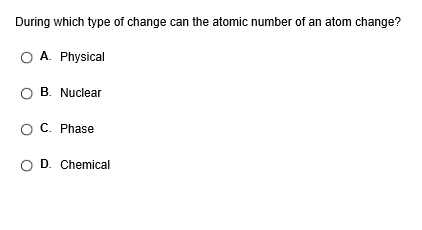
Chemical
 Vocaloid:
that's a good guess but not quite, in a chemical reaction, there will be the same atoms on both sides of the equation, so the # of protons are actually staying the same |dw:1526668773693:dw| it has to be nuclear reactions since neither physical nor chemical rxns change the identities of the atoms invovled
 zarkam21:
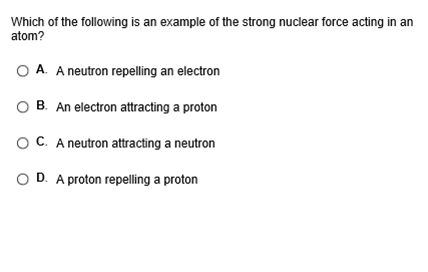
A
zarkam21:
Im actually unsure of this, could you explain to me
Vocaloid:
"nuclear force" indicates that we are looking for forces that act within the nucleus which excludes electrons (so not B) neutrons don't exert any attractive or repulsive force on their own so proton-proton repulsions are the only viable choice here
 zarkam21:
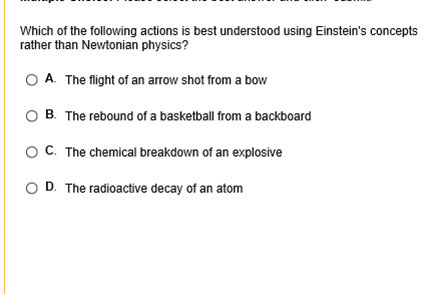
C
Vocaloid:
tbh I feel like C+D could both work but I'm leaning more towards D because Einstein's work was in subatomic physics, C would be more along the lines of materials/applied chemistry
 zarkam21:
I think its either B or C
Vocaloid:
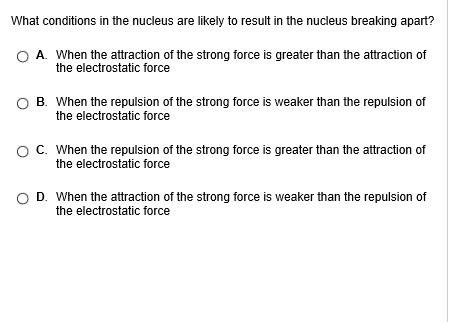
so there's two forces going on in the nucelus: 1. the strong force is an attractive force that holds all the protons + neutrons together 2. the electrostatic force is a repulsive force b/c all the protons repel each other so what conditions might cause the nucleus to break apart?
zarkam21:
1
Vocaloid:
soo if the nucleus is breaking apart would we expect: the attractive force to be weak or strong? would we expect the repulsive force to be weak or strong?
Vocaloid:
remember, both forces are there, one is just weaker than the other
zarkam21:
Umstrong
zarkam21:
I think :/
zarkam21:
Actually weak
Vocaloid:
so the attraction must be weak, and the repulsion must be strong, which leads us to D
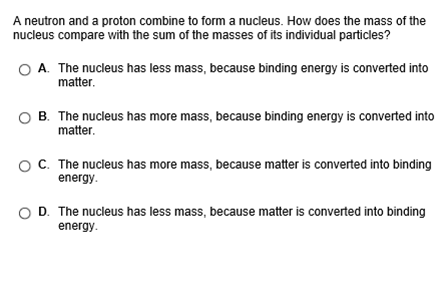 zarkam21:
D
Vocaloid:
good
Join our real-time social learning platform and learn together with your friends!
 KBaby:
Verse 1 We left our names in the dust of the driveway Watched the old town shrink
KBaby:
Lyrics Generator Use AI to write the lyrics for a song. Suggested Genres: Pop Hip
KBaby:
Verse 1 We left our names in the dust of the driveway Watched the old town shrink
KBaby:
Lyrics Generator Use AI to write the lyrics for a song. Suggested Genres: Pop Hip

 aitexturegenerator:
How are you all handling AI-generated textures for 3D models and game assets without losing the hand-made feel? I've been doing a small stylized environment
aitexturegenerator:
How are you all handling AI-generated textures for 3D models and game assets without losing the hand-made feel? I've been doing a small stylized environment

 Demon25:
Woke up feeling like that girl and that dude well he still aint crap pluse the du
Demon25:
Woke up feeling like that girl and that dude well he still aint crap pluse the du
 playtsec:
how do I get rid of stress from teachers... I just feel like running out the classroom and leaving on my own.
playtsec:
how do I get rid of stress from teachers... I just feel like running out the classroom and leaving on my own.
 JohnnyLFowler0812:
What type of gamer would play something and then get off for a while. Why not sta
JohnnyLFowler0812:
Which is better? Metallica Rap Country R&B hiphop Medal Gospel Chill Which 3 opti
JohnnyLFowler0812:
What type of gamer would play something and then get off for a while. Why not sta
JohnnyLFowler0812:
Which is better? Metallica Rap Country R&B hiphop Medal Gospel Chill Which 3 opti