
 lexxii:
Help?
 Shadow:
Any thoughts to how you would approach this?
lexxii:
Well I thought it was \[A=\frac{ d^2 }{ 2 }\] but I don't think that is even close to right.
Shadow:
The area of an object is it's width (base) multiplied by it's height.
Shadow:
For squares it's just side multiplied by side (since all lengths for it's sides are the same value).
Shadow:
I'll give you a hint. Pythagoras
lexxii:
Pythagorean/Pythagoras theorem?Huh?
Shadow:
Pythagoras is the guy who found the theorem, lol
Shadow:
But yes, you would say Pythagorean Theorem.
Shadow:
Do you see how it could be applied here?
lexxii:
no?
Shadow:
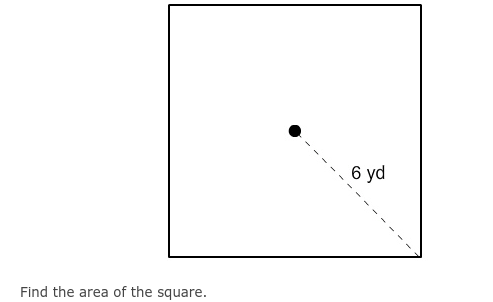
The diagonal from the center of the square to the corner is how long?
lexxii:
6yd
Shadow:
How long is it from corner to corner?
lexxii:
12 yd
Shadow:
What shape does that diagonal create?
lexxii:
oh I see now... a triangle
Shadow:
You got it? (:
lexxii:
maybeeeeeeeeee
Shadow:
Well what are you thinking you should do next
lexxii:
Well you mentioned the pythagorean theorem so do you write it out that way????
Shadow:
Do you know how to use pythagorean's theorem?
lexxii:
\[a^2+b^2=c^2\]
lexxii:
then the 12 you be placed into c right?
Shadow:
Yes, c is the hypotenuse.
lexxii:
So then \[a^2+b^2=12^2\]?
Shadow:
Correct. a and b are the sides of the triangle. But since this is a square, what can we do with our formula?
lexxii:
I'm not sure, I've only done the pythagorean theorem with a single missing variable and never like this.
Shadow:
You have to think about this one.
Shadow:
About the sides of this 'triangle' that are actually sides of what shape?
lexxii:
The square?
Shadow:
Yes
Shadow:
And sides of a square are?
lexxii:
Not sure on that part?
Shadow:
They're equal.
lexxii:
Oh I thought you were asking what the length would be I was like ummm...
Shadow:
lol
lexxii:
That makes a 100% more sense LOL
Shadow:
Haha, so what do you think the next step is?
lexxii:
Not sure what you would do without having at least one of the variables
Shadow:
But if the sides are the same length, what can you dew?
lexxii:
not sure?
Shadow:
If two sticks are the same length, I can represent them with the same variable.
lexxii:
so instead of a and b you could just use say a?
Shadow:
Yes
lexxii:
okay
lexxii:
So what would I have to do next?
Shadow:
\[a^2 + a^2 = 12^2\]
Shadow:
What could you do on the left side
lexxii:
All I can think of is combine like variables but that doesnt sound right
Shadow:
what is a + a
lexxii:
a? I'm so confused??
Shadow:
a + a = 2a
lexxii:
so 2a then wouldnt you have to add the exponent?
lexxii:
or no?
Shadow:
yes
Shadow:
I was just illustrating the concept of adding variables.
lexxii:
oh okie
lexxii:
So would it just be \[2a^2\]? bc a^2 + a^2 is 2a^2
Shadow:
yes
lexxii:
So \[2a^2=12^2\] then what?
Shadow:
Solve for a, which is the side of a square.
lexxii:
So you get \[a^2=6^2\]?
Shadow:
PEMDAS Exponents > Multiplication
lexxii:
So I do what???
Shadow:
Don't divide by 2, do the exponent on 12 first
Shadow:
12^2 = ?
lexxii:
Sorry I was doing the math so it would be 144 then divide that by the 2 to get \[a^2=72\]?
lexxii:
Is that right?
Shadow:
yes
Shadow:
Keep going
lexxii:
So then plug it in as \[2*72=12^2\]????
Shadow:
what
Shadow:
I mean 2 times 72 is 12^2 but what are you trying to do
lexxii:
Idunno I'm lost
Shadow:
\(\color{#0cbb34}{\text{Originally Posted by}}\) @lexxii Sorry I was doing the math so it would be 144 then divide that by the 2 to get \[a^2=72\]? \(\color{#0cbb34}{\text{End of Quote}}\)
Shadow:
Lets go back to here. What do you do next?
lexxii:
Then wouldnt you plug that in? I'm confused.
Shadow:
We need to solve for a.
Shadow:
But a is not isolated. We have an exponent there. How do we get rid of it?
lexxii:
\[\sqrt{a}\]??
Shadow:
\[\sqrt (a^2) = a \] Correct
Shadow:
And what you do to one side, you?
lexxii:
Do to the other
lexxii:
So 8.48?
Shadow:
That seems to be what a is
Shadow:
Now what do you do (:
lexxii:
Plug it in now?
Shadow:
For the area of a square, yes
Shadow:
Technically we could have skipped this if we first discussed the area of a square which is side times side or....s^2 (:
Shadow:
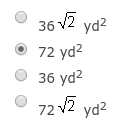
You will know what I mean once you multiply the sqrt of 72 by the sqrt of 72, lol
lexxii:
It came back as 72?
Shadow:
yes
 Shadow:
Yep
lexxii:
Okay thank you so much! haha this wasn't exactly short.
lexxii:
So thanks for bearing with me :)
Join our real-time social learning platform and learn together with your friends!
 KBaby:
Verse 1 We left our names in the dust of the driveway Watched the old town shrink
KBaby:
Lyrics Generator Use AI to write the lyrics for a song. Suggested Genres: Pop Hip
KBaby:
Verse 1 We left our names in the dust of the driveway Watched the old town shrink
KBaby:
Lyrics Generator Use AI to write the lyrics for a song. Suggested Genres: Pop Hip

 aitexturegenerator:
How are you all handling AI-generated textures for 3D models and game assets without losing the hand-made feel? I've been doing a small stylized environment
aitexturegenerator:
How are you all handling AI-generated textures for 3D models and game assets without losing the hand-made feel? I've been doing a small stylized environment

 Demon25:
Woke up feeling like that girl and that dude well he still aint crap pluse the du
Demon25:
Woke up feeling like that girl and that dude well he still aint crap pluse the du
 playtsec:
how do I get rid of stress from teachers... I just feel like running out the classroom and leaving on my own.
playtsec:
how do I get rid of stress from teachers... I just feel like running out the classroom and leaving on my own.
 JohnnyLFowler0812:
What type of gamer would play something and then get off for a while. Why not sta
JohnnyLFowler0812:
Which is better? Metallica Rap Country R&B hiphop Medal Gospel Chill Which 3 opti
JohnnyLFowler0812:
What type of gamer would play something and then get off for a while. Why not sta
JohnnyLFowler0812:
Which is better? Metallica Rap Country R&B hiphop Medal Gospel Chill Which 3 opti