
 princeevee:
help
 princeevee:
@Shadow
 Shadow:
I'm going to be honest, that doesn't look like fun.
princeevee:
it's 12th grade math
Shadow:
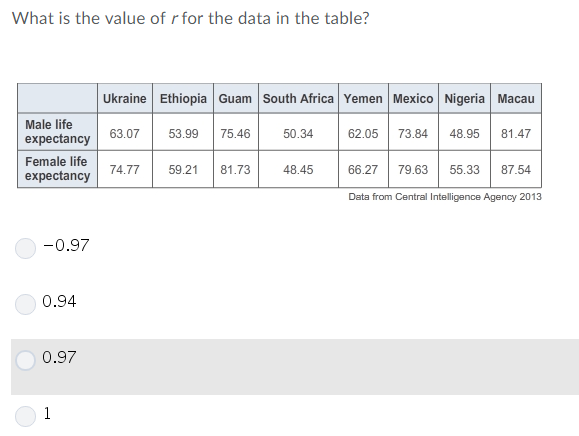
@dude Any ideas besides using the formula
Shadow:
\[r = \frac{ n (\sum xy) - (\sum x)(\sum y) }{ \sqrt ([n \sum x^{2} - (\sum x)^{2}][n \sum y^{2} - (\sum y)^{2} ] }\]
Shadow:
It's not negative, and it's not perfect...so it's 0.94 or 0.97
Shadow:
This is a Finance class right?
Shadow:
Or statistics
 dude:
dude:
I did this before, its statistics
dude:
I think there was a more simple way, but I dont think I have notes from back then
Shadow:
http://www.statisticshowto.com/probability-and-statistics/correlation-coefficient-formula/ There are other formulas here but I don't understand them.
Shadow:
By the way, n is the sample size, so basically how many columns you have.
dude:
Which equation do you not understand o.o
Shadow:
The latter two
Shadow:
Only cause I have never taken a stats class, and thus, have never seen them before. The only reason I understand this one is because you encounter summation in precalculus.
dude:
Latter 2? xD
Shadow:
By the way @princeevee if you do not know what that E looking symbol means, it stands for sum. So you would just add up all the x points for \[\sum x\]
Shadow:
There are only three formulas on the website. I get the first one, latter refers to that of which is last in an arrangement.
Shadow:
I have to go to class, so if you feel like giving this a shot or waiting for a math powerhouse like @Angle or Vocaloid is she isn't busy...
Shadow:
if*
 mhchen:
Yeh this is definitely statistics. It's a calculator class so you can just use this. https://www.socscistatistics.com/tests/pearson/Default2.aspx They also grade you on interpreting 'r' so watch out for that. You use a TI-84 NSpire calculator for that class right?
Join our real-time social learning platform and learn together with your friends!
 Demon25:
For a hoco proposal with a cheerleader and football player, what else should be a
Demon25:
For a hoco proposal with a cheerleader and football player, what else should be a

 Breathless:
TOC: "MGF any confirmation on the commander? we require confirmation as soon as[radio static].
Breathless:
TOC: "MGF any confirmation on the commander? we require confirmation as soon as[radio static].
 EdwinJsHispanic:
I wrote something that I don't know if I want it as a poem or song, Please let me know on yours thoughts about it, I'm still doing this! "Broken promises an
EdwinJsHispanic:
I wrote something that I don't know if I want it as a poem or song, Please let me know on yours thoughts about it, I'm still doing this! "Broken promises an
 thehearken:
hi um I don't know if this is the right section for this, but can someone go over my poem and tell me if its good enough to give my English professor for a
thehearken:
hi um I don't know if this is the right section for this, but can someone go over my poem and tell me if its good enough to give my English professor for a
 heartlessprophet:
Aye what's 19z%u00f74p=9u03c0 my teacher thinking of impossible questions for us
heartlessprophet:
Aye what's 19z%u00f74p=9u03c0 my teacher thinking of impossible questions for us
 kippppp:
does anyone have any good tips for writing stories? i'm trying to write a dnd campaign but i'm not that great of a writer yet.
kippppp:
does anyone have any good tips for writing stories? i'm trying to write a dnd campaign but i'm not that great of a writer yet.
 GRIZZLEY19:
Y'all let me know what y'all think about this beat I made I took me like a hour maybe rate it 0/10 https://drive.
GRIZZLEY19:
Y'all let me know what y'all think about this beat I made I took me like a hour maybe rate it 0/10 https://drive.
 Ultrilliam:
Welcome to the 10th Anniversary Update! (Part 2) Sorry this one passed the date a
Ultrilliam:
Welcome to the 10th Anniversary Update! (Part 2) Sorry this one passed the date a
 Twaylor:
was walking downtown and my adhd brain wanted to make some (rock?) lyrics: There'
Twaylor:
was walking downtown and my adhd brain wanted to make some (rock?) lyrics: There'