
 zarkam21:
Help With Calculus
.png) zarkam21:
zarkam21:
@Shadow @Vocaloid
 Mercury:
if cos(x) = 3x/pi somewhere between 0 and pi/2 then cos(x) - 3x/pi = 0 must have a solution between 0 and pi/2 evaluate cos(x) - 3x/pi at both endpoints (so evaluate it at x = 0 and x = pi/2), and see if 0 is contained between the two results
zarkam21:
It is
zarkam21:
@SmokeyBrown
 Vocaloid:
then that's it, you're done with the proof
zarkam21:
Do I have to make a graph
Vocaloid:
not really, the algebraic proof should be enough if your teacher allows it, sure, why not
zarkam21:
okay so the evaluation for the pointzero would equal zero and the evaluation at th epoint pi/2 = -1.5
Vocaloid:
hm close, I think cos(x) - 3x/pi ends up being 1 at x = 0 and -1.5 at pi/2
Vocaloid:
cos(0) - 3(0)/pi = cos(0) = 1 now, since 0 is between 1 and -1.5, then the intermediate value 0 is a solution, therefore making cos(x) - 3x/pi = 0 somewhere between the interval, therefore making cos(x) = 3x/pi somewhere between the interval, thus completing the proof
Vocaloid:
if you want to prove this graphically, you can graph cos(x) - 3x/pi between 0 and pi/2 and it will end up crossing the x-axis somewhere, thus showing the proof visually
 zarkam21:
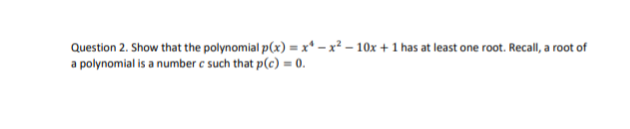
DO I just make a graph of this polynomial for this question>
Vocaloid:
you could, yeah, you'd just pick an interval that shows that the function has at least one positive value and one negative value, as well as being continuous
zarkam21:
So whats the best way to do this problem like make a graph or another way
Vocaloid:
I'd probably show it algebraically, you can pick 1 x-value that gives a positive output value, and 1 x-value that gives a negative output value, and, assuming the function is continuous (which it is) that proves that it crosses the x-axis somewhere and thus has at least one root
Vocaloid:
to save you some time x = 0 and x = 1 fulfill this requirement
zarkam21:
so when I substitute 0 I get 1 When I substitute 1 I get -9
Vocaloid:
good, since one result is + and the other is - that means 0 must be an intermediate value thus proving there's a root between x = 1 and x = 0
zarkam21:
Sorry I'm making notes as I go so I'm replying a little late
Vocaloid:
yeah, np, graphing would work, it's just that making a graph isn't always practical especially on an exam
 zarkam21:
And btw for the previous question do you just pick any two points and work with it
Vocaloid:
for the intermediate value problems, yes, I try to pick x-values that are easy to calculate, and work in terms of proving the intermediate value
Vocaloid:
anyway for 3 you need to take the derivative of sqrt(x+1) according to derivative rules, bring the exponent down as a coefficient, reduce the exponent by 1, and take the derivative of what's inside the parentheses
zarkam21:
SO If I were to pick 0 and 2 It would still work
Vocaloid:
yes
zarkam21:
OKay perfect
zarkam21:
I'm confused, what is the exponent in sqrt (x+1)
Vocaloid:
sqrt(x+1) is equivalent to (x+1)^(1/2) so the exponent would be 1/2
Vocaloid:
|dw:1539389527896:dw| brief review
zarkam21:
-1/2?
zarkam21:
:S
Vocaloid:
yeah you're on the right track so, if we take the exponent down from (x+1)^(1/2) we get (1/2) then we take (x+1)^(1/2), reduce the exponent by 1 to get (x+1)^(-1/2)
Vocaloid:
then we take the derivative of the thing in parentheses, (x+1). the derivative of a constant by itself is 1 (so derivative of x is 1, derivative of p is 1, derivative of triangle is 1, etc.) and the derivative of a constant is 0, so the derivative of x + 1 is 1 + 0 or just 1
Vocaloid:
then putting the three parts of the derivative together: (1/2) * (x+1)^(-1/2) * (1) = your derivative
Vocaloid:
now it doesn't just want the derivative, it wants f'(1) which is the derivative at x = 1, so we'd just plug x = 1 into the derivative (1/2) * (x+1)^(-1/2) * (1) to get the solution
zarkam21:
1/2^3/2
Vocaloid:
be careful with parentheses (1/2) * (x+1)^(-1/2) ---> plugging in x = 1 gives us ---> (1/2) * 2 ^(-1/2) = 1/[2sqrt(2)]
Vocaloid:
basically, a^(-1/2) is equivalent to 1/sqrt(a) since negative exponents can be re-written as positive exponents in the denominator
zarkam21:
got it
zarkam21:
so the answer to f ' = 1/[2sqrt(2)]
Vocaloid:
yeah
 Vocaloid:
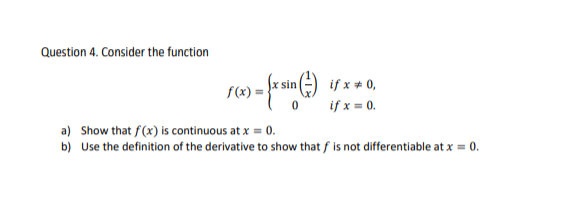
to show that a piecewise function is differentiable at a certain point, show that that the function is continuous ---> show that the pieces of the function are equal at that point
zarkam21:
do I use the x values provided so 0?
Vocaloid:
yes so in this case just show that x * sin(1/x) = 0 at x = 0 (which is pretty easy)
zarkam21:
its false when I do x=0
Vocaloid:
well, I guess if you get technical about it, sin(1/x) * x is undefined at 0, but the limit is 0 (it approaches 0 without actually getting there) making the function continuous
Vocaloid:
i'd have to think about b) a bit more but I think it has to do with the LH and RH limits
zarkam21:
Yeha I think it has to do with that too
Vocaloid:
ugh, idk how I would do it algebraically, but I guess you could graph it
zarkam21:
would I graph x sin (1/x)
zarkam21:
would I graph x sin (1/x)
zarkam21:
@@jhonyy9
 jhonyy9:
you wan graphing xsin(1/x) ?
zarkam21:
No, I'm asking if thats What I'm supposed to do
zarkam21:
\(\color{#0cbb34}{\text{Originally Posted by}}\) @zarkam21 \(\color{#0cbb34}{\text{End of Quote}}\)
 zarkam21:
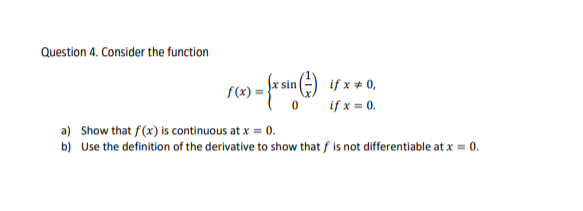
This is my problem, I'm on part b
jhonyy9:
Q. 4 - ?
zarkam21:
Yes Part B
zarkam21:
@dude
jhonyy9:
@zarkam21 than yu see the f(x) for x=0 given that f(x) =0 => not is differentiable or not ?
zarkam21:
Yes
jhonyy9:
so this mean that for x=0 => f(x) =0 and you need getting the derivativ of zero - so how ?
jhonyy9:
impossibile - i think is clearly
zarkam21:
Okay so how would I use the definition to show that
jhonyy9:
easy bc. for x=0 => f(x)=0 => have not derivativ => is not differentiable i think in this way
zarkam21:
OKay thanks, do you care if I get a second opinion?
zarkam21:
@Vocaloid when you get a chance can you please look at this
 dude:
dude:
I mean for this the question tells you that x is undefined when \(x sin(\frac{1}{x})=0\) You cannot find the derivative of an undefined point ¯\_(ツ)_/¯
zarkam21:
OKay we can just see what @Vocaloid says, as another opinion because i'm confused myself So @Vocaloid when you get a change
zarkam21:
@Shadow
zarkam21:
Undefined then?
Vocaloid:
x is defined at 0, the function manually defines it to be 0 at x = 0
zarkam21:
SO using the definition of a derivative it would be the same
Vocaloid:
what
zarkam21:
The answer to 4b. USing the definition of the derivative, for x=0 => f(x)=0 => not having a derivative. This is not differentiable
Vocaloid:
that's redundant. "it has no derivative so it's not differentiable" xsin(1/x) oscillates at x = 0 so it is not differentiable
Join our real-time social learning platform and learn together with your friends!
 KBaby:
Verse 1 We left our names in the dust of the driveway Watched the old town shrink
KBaby:
Lyrics Generator Use AI to write the lyrics for a song. Suggested Genres: Pop Hip
KBaby:
Verse 1 We left our names in the dust of the driveway Watched the old town shrink
KBaby:
Lyrics Generator Use AI to write the lyrics for a song. Suggested Genres: Pop Hip

 aitexturegenerator:
How are you all handling AI-generated textures for 3D models and game assets without losing the hand-made feel? I've been doing a small stylized environment
aitexturegenerator:
How are you all handling AI-generated textures for 3D models and game assets without losing the hand-made feel? I've been doing a small stylized environment

 Demon25:
Woke up feeling like that girl and that dude well he still aint crap pluse the du
Demon25:
Woke up feeling like that girl and that dude well he still aint crap pluse the du
 playtsec:
how do I get rid of stress from teachers... I just feel like running out the classroom and leaving on my own.
playtsec:
how do I get rid of stress from teachers... I just feel like running out the classroom and leaving on my own.
 JohnnyLFowler0812:
What type of gamer would play something and then get off for a while. Why not sta
JohnnyLFowler0812:
Which is better? Metallica Rap Country R&B hiphop Medal Gospel Chill Which 3 opti
JohnnyLFowler0812:
What type of gamer would play something and then get off for a while. Why not sta
JohnnyLFowler0812:
Which is better? Metallica Rap Country R&B hiphop Medal Gospel Chill Which 3 opti