
 bill533:
How does the printed text compare to the image?
bill533:
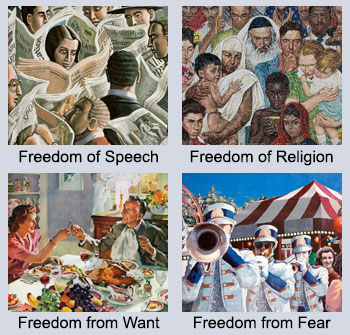
Read the passage. excerpt from "Four Freedoms Speech" by Franklin D. Roosevelt In the future days, which we seek to make secure, we look forward to a world founded upon four essential human freedoms. The first is freedom of speech and expression—everywhere in the world. The second is freedom of every person to worship God in his own way—everywhere in the world The third is freedom from want—which, translated into world terms, means economic understandings which will secure to every nation a healthy peacetime life for its inhabitants—everywhere in the world. The fourth is freedom from fear—which, translated into world terms, means a worldwide reduction of armaments to such a point and in such a thorough fashion that no nation will be in a position to commit an act of physical aggression against any neighbor—anywhere in the world. That is no vision of a distant millennium. It is a definite basis for a kind of world attainable in our own time and generation. That kind of world is the very antithesis of the so-called new order of tyranny which the dictators seek to create with the crash of a bomb. To that new order we oppose the greater conception—the moral order. A good society is able to face schemes of world domination and foreign revolutions alike without fear. Read the excerpt from Franklin D. Roosevelt's "Four Freedoms Speech," and then consider the four-framed image. How does the printed text compare to the image? A. While Roosevelt describes freedom from fear in geopolitical and military terms, the image depicts it in a simpler and more positive way. B. While Roosevelt describes freedom of speech in great and specific detail, the image depicts it in a very simple, basic, and direct way. C. While Roosevelt describes the freedom of religion in rather narrow terms, the image depicts it in a more open, broad, and inclusive way. D. While Roosevelt describes freedom from want in very American terms, the image depicts it in a more global, multicultural, and universally human way.
 bill533:
@SmokeyBrown
 SmokeyBrown:
Oh yeah I think A would be our choice here. Roosevelt gives clear examples of "freedom from fear" with reference to world events at the time. By contrast, the image's portrayal of "freedom from fear" is simplistic and generic
bill533:
Read this passage from "Four Freedoms Speech" by Franklin D. Roosevelt. A part of the sacrifice means the payment of more money in taxes. In my Budget Message I shall recommend that a greater portion of this great defense program be paid for from taxation than we are paying today. No person should try, or be allowed, to get rich out of this program; and the principle of tax payments in accordance with ability to pay should be constantly before our eyes to guide our legislation. Based on this passage, what is Roosevelt's view on tax increases? A. Tax increases should apply to the wealthy as well as to everyone else. B. Tax increases are the only way for the government to raise money. C. Tax increases should be the last option a government uses. D. Tax increases may be necessary, but will usually be unpopular.
SmokeyBrown:
The passage about taxes emphasizes "tax payments in accordance with ability to pay". With that in mind, I think A is the best choice
bill533:
Read this passage from "Four Freedoms Speech" by Franklin D. Roosevelt. No realistic American can expect from a dictator’s peace international generosity, or return of true independence, or world disarmament, or freedom of expression, or freedom of religion—or even good business. How does Roosevelt’s use of rhetoric in this excerpt advance his viewpoint? A. By using antithesis, Roosevelt emphasizes the difference between America and the countries under dictatorship. B. By using hyperbole, Roosevelt paints an extreme picture of how the dictators of Europe might respond to American requests. C. By using hypophora, Roosevelt answers the objections that members of Congress have raised about U.S. involvement in World War II. D. By using parallel structure, Roosevelt draws attention to the reasons he is concerned about the dictators who have taken power in parts of Europe.
Join our real-time social learning platform and learn together with your friends!
 KBaby:
Verse 1 We left our names in the dust of the driveway Watched the old town shrink
KBaby:
Lyrics Generator Use AI to write the lyrics for a song. Suggested Genres: Pop Hip
KBaby:
Verse 1 We left our names in the dust of the driveway Watched the old town shrink
KBaby:
Lyrics Generator Use AI to write the lyrics for a song. Suggested Genres: Pop Hip

 aitexturegenerator:
How are you all handling AI-generated textures for 3D models and game assets without losing the hand-made feel? I've been doing a small stylized environment
aitexturegenerator:
How are you all handling AI-generated textures for 3D models and game assets without losing the hand-made feel? I've been doing a small stylized environment

 Demon25:
Woke up feeling like that girl and that dude well he still aint crap pluse the du
Demon25:
Woke up feeling like that girl and that dude well he still aint crap pluse the du
 playtsec:
how do I get rid of stress from teachers... I just feel like running out the classroom and leaving on my own.
playtsec:
how do I get rid of stress from teachers... I just feel like running out the classroom and leaving on my own.
 JohnnyLFowler0812:
What type of gamer would play something and then get off for a while. Why not sta
JohnnyLFowler0812:
Which is better? Metallica Rap Country R&B hiphop Medal Gospel Chill Which 3 opti
JohnnyLFowler0812:
What type of gamer would play something and then get off for a while. Why not sta
JohnnyLFowler0812:
Which is better? Metallica Rap Country R&B hiphop Medal Gospel Chill Which 3 opti