
 hallm:
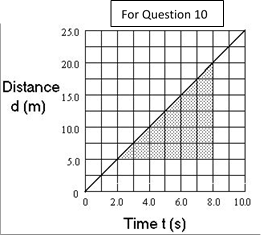
10. Use the distance time graph to answer these questions: A. What does the graph tell us about the velocity of the car? The graph tells us that that it is increasing how you know is that the line is going from 0 up if it was decreasing it would have been at the top going down. B. What is the average velocity of the car? (show work) C. Is the velocity reflected in the graph positive or negative? ___________________ D. Is there any point on the graph where the car is not moving? How do we know?
 silvernight269:
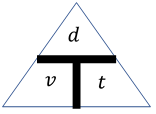
What’s the distance formula?
hallm:
it is D = 1/2a x t^2
silvernight269:
@dude Can u take it from here?
hallm:
no i still need help:c
 Shadow:
\[\frac{ \Delta x }{ \Delta t}\] Does this look familiar to you?
hallm:
no sir it doesnt
Shadow:
The triangle means change in, so change in x, which in other words, is displacement. Change in time is self explanatory. If five seconds has passed, the change in time is five seconds...
Shadow:
\[Velocity = \frac{ \Delta x }{ \Delta t }\]
 Shadow:
So if a graph is change in position over change in time, what is the slope?
hallm:
it is negative right?
Shadow:
what
Shadow:
No, what is change in position over change in time
hallm:
i have no clue i dont really understand slopes
Shadow:
\[\frac{ \Delta x }{ \Delta t }\] Remember what is this?
hallm:
it is the veritable divided by time
hallm:
or the velocity
Shadow:
Correct, it is the velocity.
Shadow:
So then if position over time is the graph, what is the slope
hallm:
the velocity
Shadow:
Did you write this: "The graph tells us that that it is increasing how you know is that the line is going from 0 up if it was decreasing it would have been at the top going down."
hallm:
no sir i didnt my friend did we are trying to work on this problem and she had to go home i told her i would finish it and i did understand the question so i have to re write that and i thought i deleted opps dont tell her
Shadow:
Well based on that line, what do you see happening to it's position, over time.
Shadow:
Position is the y axis and time is the x axis
Shadow:
line being the slope
hallm:
it would accelerate
Shadow:
Do you know what acceleration is?
Shadow:
If you don't, that's okay.
hallm:
yes sir it isnt the word im thinking of
hallm:
i meant to put something else in instead of acceleration but that is the olny thing i can think of right now
Shadow:
Acceleration is change in velocity. Which means an object would travel at 2m/s then at 4m/s, making for an acceleration of 2m/s/s (two meters per second per second). In other words, for each second, the velocity would increase by 2m/s.
Shadow:
If the car were accelerating, there would be different changes in position over time, since the ball would be traveling faster than it did before. Since the slope is constant, there are no changes in velocity, thus no acceleration.
hallm:
ohhh
hallm:
i understand
Shadow:
Okay good. So let's conquer question #1. What can you say about the change in position over time. Just look at the slope.
hallm:
it will start increasing
Shadow:
Remember, what is the slope
Shadow:
|dw:1540959635649:dw| This is a position time graph of a slope that is increasing.
Shadow:
As you can see, initially the velocity was 1m/s. Because in one second, it reached one meter. But in the next second, it reached 3 meters from 1meter. The change in position was 2 meters in 1 second, thus the velocity was 2m/s. That means it is acceleration since there was a change in velocity.
Shadow:
I meant to say, a velocity that is increasing.
Shadow:
This is not our graph. Our graph is a straight line, which means that our change in position is the SAME for each second. Thus our velocity is constant, and not changing (no acceleration/increasing).
Shadow:
This car is just cruising at a constant speed.
hallm:
so the car is going a contant speed because it isnt changing in the velocity
Shadow:
Correct, but lets say constant velocity, not constant speed.
Shadow:
Does that make sense to you?
hallm:
ohhh my gosh i understand
Shadow:
That's all they want from #1 I am pretty sure
Shadow:
Or A, lol. What about B? Do you know how to solve for the average velocity?
hallm:
no i don't and its kind of embarrassing it took me that long to understand number one
Shadow:
Lol it's okay. \[V_{avg} = \frac{ \Delta x }{ \Delta t }\] In words: the average velocity is equal to the total displacement divided by the total change in time.
Shadow:
Where do we get out displacement (change in position) from?
Shadow:
our*
hallm:
we get the change from going up from 0 because it isnt stopped anymore
Shadow:
Do you know the formula for displacement?
hallm:
sure
Shadow:
\[Displacement = \Delta x = x_{f} - x_{i}\]
Shadow:
Find the final x position then subtract it by the initial x position.
Shadow:
Just look at the graph. Where did the car end up and where did it start.
hallm:
2.0
Shadow:
Remember, we are referring to the car's position. So we are looking at the y axis, and then looking at the slope. So where did the car finish, and where did the car start?
hallm:
the car started at 0 and ended at 25.0 if we are looking at the y axis
Shadow:
Correct. Keep in mind if the slope stopped at 10m, the final position would be 10m. But it went all the way up to 25m so that is correct.
Shadow:
Just want to be sure you aren't just looking at the y axis.
Shadow:
Okay, so what is the displacement
hallm:
25?
Shadow:
Correct. You get that from 25-0 (final position minus initial).
Shadow:
What is the change in time?
hallm:
10 seconds right ?
Shadow:
Correct, so how would you find the average velocity?
hallm:
subtract 25 by 10
Shadow:
\[V_{avg} = \frac{ \Delta x }{ \Delta t }\]
hallm:
or would you divide 25 by 10
Shadow:
Correct.
hallm:
ok so that would be 2.5
Shadow:
Correct. Onto C!
Shadow:
Be sure to have m/s
Shadow:
Else 2.5 is wrong lol
hallm:
ohh thank you
Shadow:
Now, is the velocity positive or negative
hallm:
it is positive
Shadow:
Hmm, why would you say that
hallm:
there isn't a negative sign beside it
hallm:
WAIT NO ITS NEGATIVE
Shadow:
Why would you say that?
hallm:
because you would have to divide and dividing would mean going down or lessening that is all i can think of
Shadow:
Okay. Positive and negative don't mean more or less in physics. They mean direction. For example. |dw:1540961480105:dw|
Shadow:
It starts at 2, ends at -5. Finial minus initial -5 - 2 = -7 The displacement is 7 units in the negative direction.
Shadow:
Displacement is a vector property, which means it depends on direction. That's why if the graph uses a positive, use a pos, and it uses a negative number, use the negative. If you end up with a positive displacement, the velocity will be positive, likewise for negative.
Shadow:
If neg displacement, then negative velocity.
hallm:
so it is positive because it is going up 2.5 every second
Shadow:
It is positive because it is moving in the positive direction.
Shadow:
If it was moving from 10m back down to 5m, that would mean the car had change it's velocity by driving in the other direction.
Shadow:
Does that make sense?
hallm:
not really
Shadow:
Think of it as a number line |dw:1540961765366:dw| If the slope is going towards 2m, a positive number, that means the change in velocity is in the positive direction. If however the slope is going towards a negative number, that means the change in velocity is in the negative direction.
hallm:
ok i get that better now
Shadow:
Just think of yourself standing on the y axis (position) and moving up and down on it. If you go from 10m to 25m, you have a positive displacement. if you go from 5m to 0m, you have a negative displacement.
Shadow:
All about direction.
hallm:
ok so it would be a positive direction
Shadow:
Correct. The velocity is positive.
hallm:
ahh ok
Shadow:
Now D. Thoughts? (:
hallm:
i dont think it will be stopping because it is at a constant rate going up
Shadow:
Correct. But here is an important question. What would the slope look like if it stopped moving?
Shadow:
Remember, the velocity is change in position over time
hallm:
well umm i|dw:1540922672532:dw|
Shadow:
proud of you
Shadow:
That is exactly correct.
Shadow:
Say a car stopped for one second at 10m. It would be: |dw:1540962377371:dw|
Shadow:
Because time continues on, even if it's not changing in position. You're all done.
hallm:
yayyy i got it right
hallm:
woohoo that took a while but i understand now
Shadow:
Yeah I could have just done the work for you but then you wouldn't understand and now you can help your friend too (:
hallm:
yeah im exited to show her how much ive learned thank you
Shadow:
No problem man.
Join our real-time social learning platform and learn together with your friends!
 KBaby:
Verse 1 We left our names in the dust of the driveway Watched the old town shrink
KBaby:
Lyrics Generator Use AI to write the lyrics for a song. Suggested Genres: Pop Hip
KBaby:
Verse 1 We left our names in the dust of the driveway Watched the old town shrink
KBaby:
Lyrics Generator Use AI to write the lyrics for a song. Suggested Genres: Pop Hip
 aitexturegenerator:
How are you all handling AI-generated textures for 3D models and game assets without losing the hand-made feel? I've been doing a small stylized environment
aitexturegenerator:
How are you all handling AI-generated textures for 3D models and game assets without losing the hand-made feel? I've been doing a small stylized environment

 Demon25:
Woke up feeling like that girl and that dude well he still aint crap pluse the du
Demon25:
Woke up feeling like that girl and that dude well he still aint crap pluse the du
 playtsec:
how do I get rid of stress from teachers... I just feel like running out the classroom and leaving on my own.
playtsec:
how do I get rid of stress from teachers... I just feel like running out the classroom and leaving on my own.
 JohnnyLFowler0812:
What type of gamer would play something and then get off for a while. Why not sta
JohnnyLFowler0812:
Which is better? Metallica Rap Country R&B hiphop Medal Gospel Chill Which 3 opti
JohnnyLFowler0812:
What type of gamer would play something and then get off for a while. Why not sta
JohnnyLFowler0812:
Which is better? Metallica Rap Country R&B hiphop Medal Gospel Chill Which 3 opti