
 kaylak:
calculus help 10 questions
kaylak:
about to post give me a sec!
kaylak:
@mhchen
kaylak:
@Tranquility
 kaylak:
@nuts
kaylak:
@Tranquility
kaylak:
@Vocaloid
 Vocaloid:
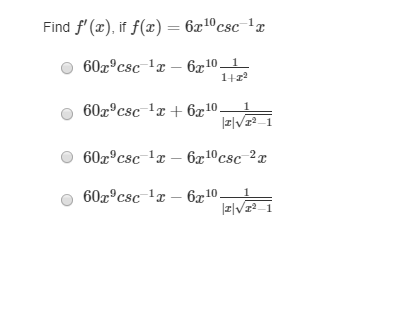
|dw:1542062919231:dw| for 1 just apply the product rule to the derivative and fill in the derivative for csc^-1
Vocaloid:
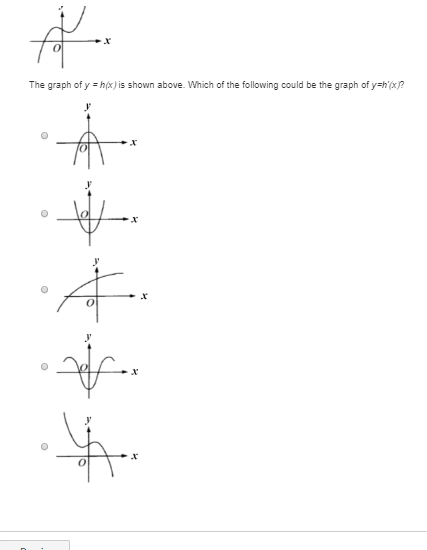
for 2, identify the parts where the derivative would be 0 (where the slope of the original function is 0), where the derivative is positive (where the original function is increasing) and where the derivative is negative (where the original function is decreasing) and piece together the derivative
Vocaloid:
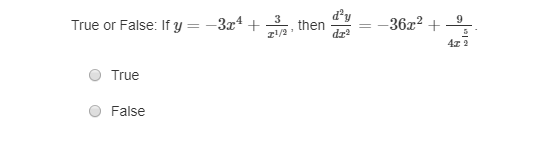
for 3, just take the derivative wrt x two times
kaylak:
is 1 D?
Vocaloid:
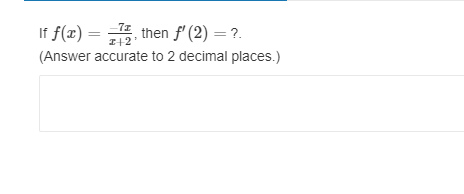
for 4 just take the derivative, plug in x = 2 and round
Vocaloid:
yeah that's what i got too
kaylak:
2 is a or d
Vocaloid:
check again remember the derivative must be positive at both extremes
kaylak:
I meant a or e
kaylak:
sorry
kaylak:
3 is false because it is 3/2 not 5/2
Vocaloid:
there are only two choices (b and d) where the derivative is positive at both extremes of the graph between b and d see which one has the derivative end behavior that matches the behavior of the graph notice how the original graph is increasing at either extreme and only decreasing in the middle
kaylak:
c looks like it since you plot points where it is 0
Vocaloid:
second derivative, not the first derivative
Vocaloid:
3*x^(1/2) first derivative = 3 * (-1/2) * x^(-3/2) second derivative = 3 * (1/2) * (-3/2) * x^(-5/2) = 9/(4x^(5/2))
Vocaloid:
|dw:1542064419769:dw|
Vocaloid:
|dw:1542064427305:dw|
kaylak:
okay that makes sense
kaylak:
so 4 take derivative and then plug 2 in right ?
Vocaloid:
yes
kaylak:
f'(2)=-7/8
Vocaloid:
good they want a decimal to two places so -0.88
kaylak:
yep
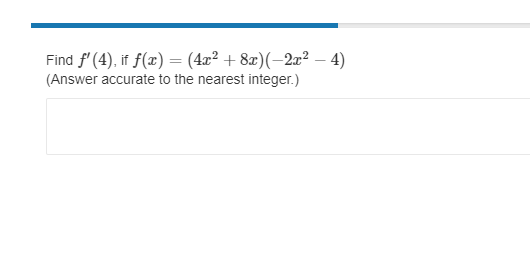
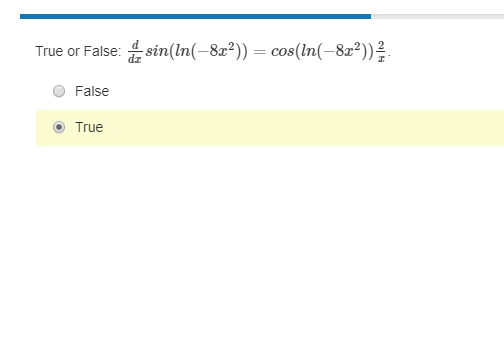
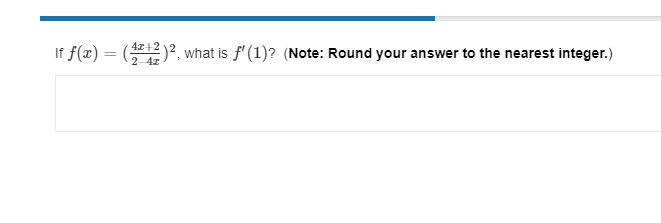
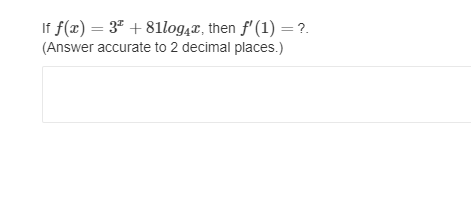 Vocaloid:
same logic as before just take the derivative and plug in x = 4
 Zarkon:
sneaky... \(\frac{d}{dx}\sin(\ln(-8x^2))\)
kaylak:
that's what I thought
kaylak:
is the sin question correct?
Vocaloid:
i think so
Zarkon:
\(-8x^2\leq0\) therefore \(\ln(-8x^2)\) is undefined
Zarkon:
I'm betting they didn't take that into account when making the question though
Zarkon:
if you allow negative values into the log function then you have to introduce branch cuts
kaylak:
okay so for this sake idk if it's true or false but let me work on the easier ones
kaylak:
-2976
kaylak:
@Vocaloid
Vocaloid:
yeah that's it
kaylak:
I am working on some others and you can check them
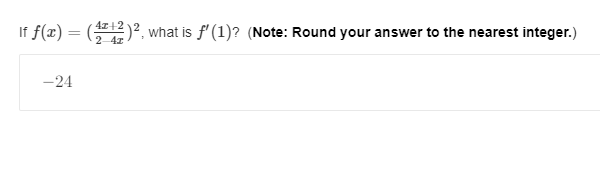 kaylak:
@Vocaloid
Vocaloid:
good
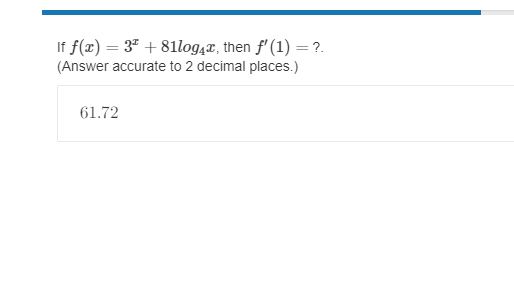
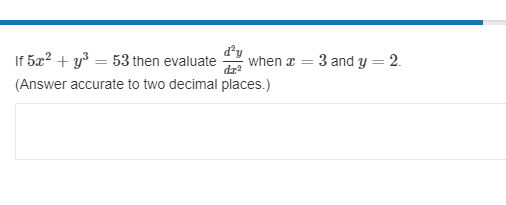
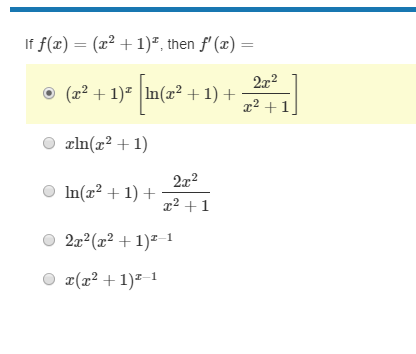
 kaylak:
last few questions
Vocaloid:
yes you would take the implicit second derivative
kaylak:
so take 2nd and then plug in?
Vocaloid:
yes
kaylak:
I messed up someone could you help me
kaylak:
is 1 of the last 2 correct
kaylak:
@Vocaloid
Vocaloid:
yes
kaylak:
okay so the second derivative question I messed up
Vocaloid:
take the first implicit derivative then solve for the dy/dx term by moving all the variables to one side then take the derivative again
 kaylak:
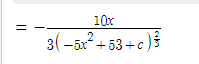
but I have no y to plug in
Vocaloid:
where are you getting c from
kaylak:
the whole dx du formula thing c is constant or something
kaylak:
let's just start over
kaylak:
okay I think I have it now
kaylak:
1/3 or.33
kaylak:
@Vocaloid
kaylak:
one more question above and then 'm done I promise
 Vocaloid:
|dw:1542073225421:dw|
Vocaloid:
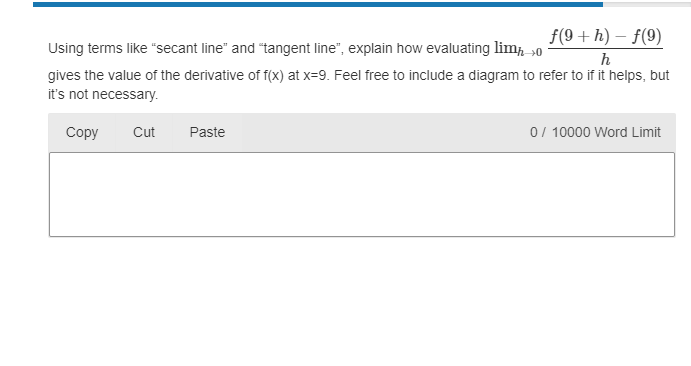
basically the formula they give you allows you to calculate the slope of the line at x = 9 at infinitely small intervals between 9 and h, giving you the slope of the tangent, and thus, the derivative
kaylak:
what about secnt line
Vocaloid:
i don't think it's relevant here
kaylak:
okay yay thank yo uso much!
Join our real-time social learning platform and learn together with your friends!
 KBaby:
Verse 1 We left our names in the dust of the driveway Watched the old town shrink
KBaby:
Lyrics Generator Use AI to write the lyrics for a song. Suggested Genres: Pop Hip
KBaby:
Verse 1 We left our names in the dust of the driveway Watched the old town shrink
KBaby:
Lyrics Generator Use AI to write the lyrics for a song. Suggested Genres: Pop Hip
 aitexturegenerator:
How are you all handling AI-generated textures for 3D models and game assets without losing the hand-made feel? I've been doing a small stylized environment
aitexturegenerator:
How are you all handling AI-generated textures for 3D models and game assets without losing the hand-made feel? I've been doing a small stylized environment

 Demon25:
Woke up feeling like that girl and that dude well he still aint crap pluse the du
Demon25:
Woke up feeling like that girl and that dude well he still aint crap pluse the du
 playtsec:
how do I get rid of stress from teachers... I just feel like running out the classroom and leaving on my own.
playtsec:
how do I get rid of stress from teachers... I just feel like running out the classroom and leaving on my own.
 JohnnyLFowler0812:
What type of gamer would play something and then get off for a while. Why not sta
JohnnyLFowler0812:
Which is better? Metallica Rap Country R&B hiphop Medal Gospel Chill Which 3 opti
JohnnyLFowler0812:
What type of gamer would play something and then get off for a while. Why not sta
JohnnyLFowler0812:
Which is better? Metallica Rap Country R&B hiphop Medal Gospel Chill Which 3 opti